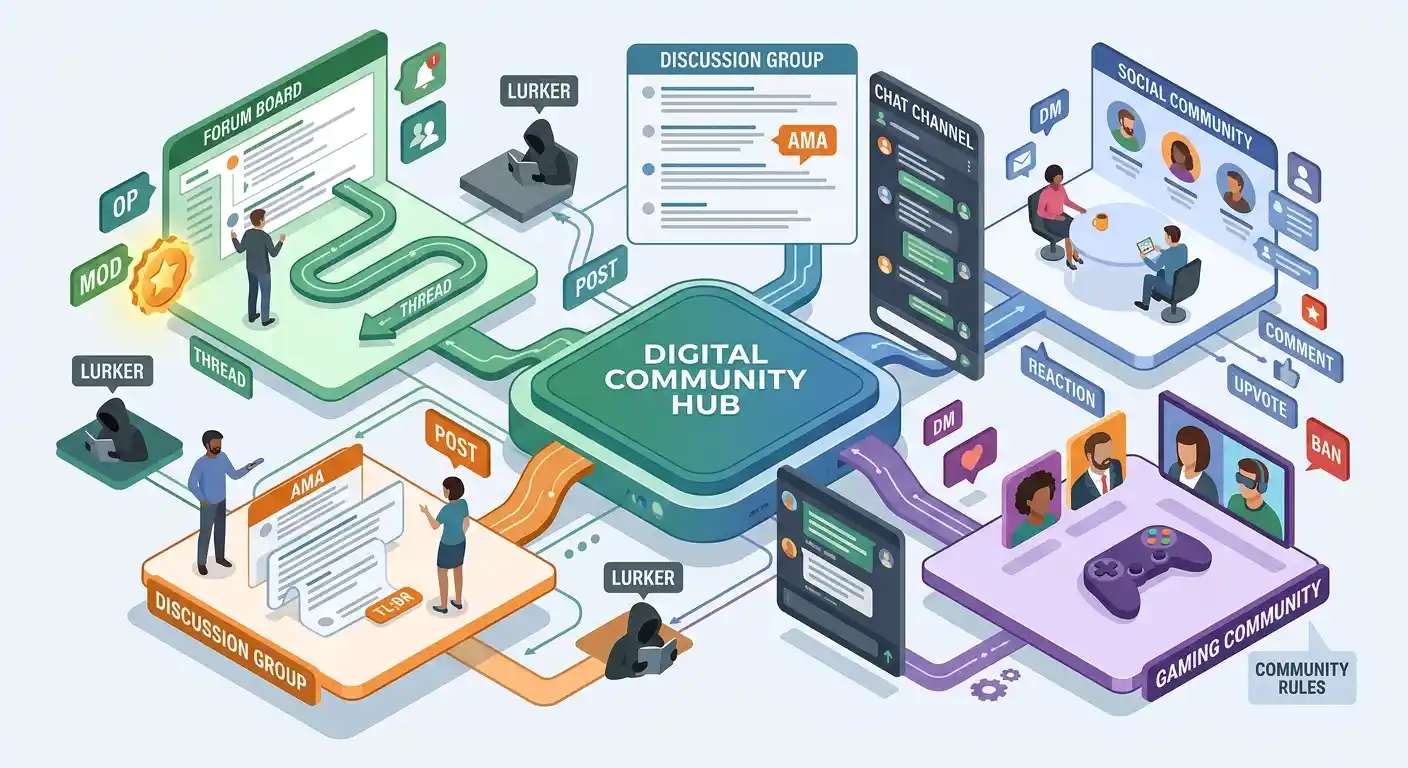
Online community terms are the words, abbreviations, and phrases people use to describe discussions, members, posts, moderation, and shared behavior in internet communities. They appear across forums, social platforms, chat groups, and other online spaces.
Key Takeaways
- Online community terms describe how people participate, communicate, and organize discussions online.
- Some are general internet terms, while others belong mainly to a particular community or platform.
- Common examples include OP, thread, lurker, mod, admin, upvote, downvote, AMA, and TL;DR.
- The same abbreviation can have different meanings depending on the community and conversation.
- Community-specific language often helps members understand shared rules, roles, and social norms.
- New users can usually understand unfamiliar terms by checking the surrounding conversation and the community’s own rules or glossary.
Online Community Terms Meaning in Text
Online community terms is a broad category rather than one particular abbreviation or slang expression. It refers to the vocabulary used when people interact in digital communities.
These terms can describe:
- People: member, newcomer, lurker, moderator, admin
- Content: post, comment, thread, reply, repost
- Interaction: upvote, downvote, reaction, mention
- Community structure: forum, group, channel, subreddit
- Moderation: mod, ban, mute, report, community rules
- Internet shorthand: OP, AMA, TL;DR, IMO, FAQ
A community glossary from Guild, for example, groups many terms around community activities, participation, management, and engagement.
Are Online Community Terms Slang?
Some are slang or informal internet language, while others are simply standard technical or community vocabulary.
For example, lurker is an established internet term for someone who reads community content without regularly posting or commenting.
By contrast, words such as administrator or moderator are not necessarily slang. They describe roles within an online community.
What Do Online Community Terms Stand For?
There is no single full form because online community terms is a category, not an acronym.
However, many individual terms within the category are abbreviations:
| Term | Meaning | Common Use |
|---|---|---|
| OP | Original Poster | Referring to the person who started a discussion |
| AMA | Ask Me Anything | Open question-and-answer discussions |
| TL;DR | Too Long; Didn’t Read | Brief summary of a longer post |
| IMO | In My Opinion | Marking a personal viewpoint |
| IIRC | If I Recall Correctly | Indicating uncertainty about a remembered detail |
| AFAIK | As Far As I Know | Qualifying information |
OP commonly refers to the person who started a discussion, while AMA describes a question-and-answer format.
How Are Online Community Terms Used?
These terms appear wherever people communicate or organize discussions online.
Posts and Threads
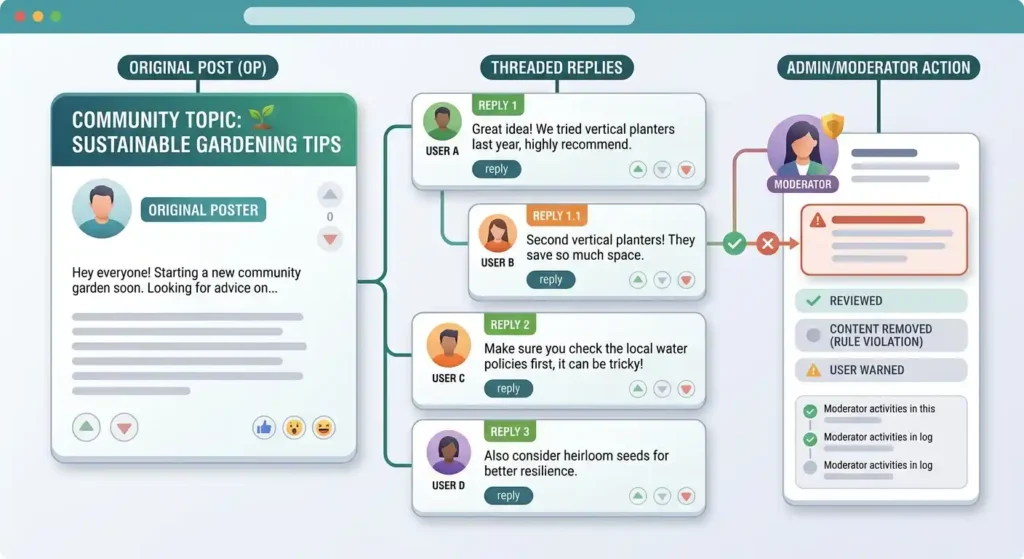
A post is a piece of content shared with a community. A thread generally refers to the original post together with its discussion, or to a particular chain of replies.
For example:
“I saw the answer in the thread.”
Comments and Replies
A comment responds to a post or another comment. Communities often use threaded replies to keep different conversations organized.
Community Roles
Terms such as member, moderator, admin, contributor, and lurker describe different forms of participation or responsibility.
Rules and Moderation
Communities may use terms such as rules, guidelines, moderation, report, ban, mute, and appeal when discussing how behavior is managed.
Internet Shorthand
Abbreviations make longer expressions quicker to type. Examples include OP, AMA, TL;DR, IMO, IIRC, and AFAIK.
Online Community Terms in Different Contexts
The exact meaning of a community term can depend on where you see it.
In Forums
Forum vocabulary commonly includes thread, post, reply, member, moderator, and lurker.
A lurker reads discussions but rarely contributes posts or comments. Research on online communities treats lurking as a distinct form of participation rather than simply assuming that every member actively posts.
On Discussion Communities
You may encounter terms such as OP, upvote, downvote, karma, flair, AMA, and crosspost. These are particularly associated with discussion-based communities.
In Chat Communities
Chat-focused communities may use terms describing channels, threads, replies, moderators, members, mentions, and reactions.
In Gaming Communities
Gaming communities often develop their own vocabulary. A term that has a general meaning elsewhere can also acquire a specialized gaming meaning.
In Social Media Communities
You may see terms such as DM, post, comment, tag, mention, repost, follower, and community guidelines.
The important point is that context matters. A term can have a general internet meaning while also having a specialized meaning within a particular community.
Common Online Community Terms

OP
OP usually means Original Poster: the person who created the discussion being commented on. In some contexts, OP can have other meanings, so the surrounding conversation matters.
Example:
“OP explained what happened in the update.”
Thread
A thread is a connected discussion centered on a post or topic.
Example:
“Check the whole thread before asking.”
Lurker
A lurker is someone who reads or follows community discussions but rarely posts or comments.
Example:
“I’ve been a lurker here for months.”
Moderator or Mod
A moderator, often shortened to mod, helps enforce a community’s rules and manage discussions.
Example:
“The mod removed the post because it broke the rules.”
Admin
An admin generally has administrative responsibility for a platform or community. The exact powers of an admin depend on the service.
Upvote
An upvote is a positive vote or reaction used by some communities to help surface content.
Downvote
A downvote is a negative vote used by some communities to indicate that content is not useful, relevant, or appropriate.
AMA
AMA means Ask Me Anything. It describes a format in which someone invites a community to ask questions.
TL;DR
TL;DR means “Too Long; Didn’t Read.” It commonly introduces a short summary of a longer piece of writing.
Flair
A flair is a label or tag used to categorize a post or sometimes identify a user within a community.
Karma
On Reddit, karma is a score associated with votes received on posts and comments. Its exact role depends on the community and platform rules.
Real Chat and Community Examples
Here are realistic examples showing how these terms can appear naturally:
- “OP answered the question in an edit.”
- “The whole thread is worth reading.”
- “I’m mostly a lurker here.”
- “Ask the mods if you’re unsure.”
- “The post got a lot of upvotes.”
- “Why was this downvoted?”
- “There’s an AMA happening tonight.”
- “TL;DR: The update fixed the problem.”
- “Check the post flair before commenting.”
- “IIRC, that feature was removed last year.”
- “AFAIK, that’s still the current rule.”
- “IMO, the second option makes more sense.”
- “The answer is somewhere in the thread.”
- “Please read the community guidelines first.”
- “A mod left a note explaining the removal.”
- “I found this through an older discussion.”
- “The OP posted an update this morning.”
- “There are several helpful replies below.”
- “That topic has its own community.”
- “I’m new here, so I’m still learning the terminology.”
What Tone Do Online Community Terms Have?
There is no single tone because this category contains many different types of language.
Depending on the term, online community vocabulary can be:
- Casual: OP, mod, lurker
- Neutral: thread, comment, member
- Informal: TL;DR, IMO
- Technical: moderation, administrator, community guidelines
- Community-specific: terms whose meaning depends on a particular group’s culture
A useful rule is to avoid assuming that an abbreviation automatically has a particular emotional tone. The surrounding message usually provides the necessary context.
Are Online Community Terms Rude or Offensive?
Most basic community vocabulary is neutral and not inherently rude.
Terms such as thread, comment, moderator, admin, OP, AMA, and TL;DR can normally be used in ordinary online discussion.
However, some community-specific slang can be insulting, dismissive, or controversial. A term’s appropriateness depends on its definition, the community’s norms, and how it is being used.
For school, work, or formal writing, it is usually clearer to spell out unfamiliar internet abbreviations unless the audience already understands them.
Other Meanings and Platform-Specific Uses
Because online communities differ, individual terms can have specialized meanings.
Reddit Terms
Reddit communities commonly use vocabulary such as subreddit, OP, karma, flair, AMA, crosspost, and lurker. A subreddit is a topic-focused community, while OP identifies the person who created the post.
Forum Terms
Traditional forums often emphasize threads, posts, replies, moderators, members, and lurkers. The structure is usually centered on organized discussions.
Community Management Terms
Community managers may use terms such as engagement, contributors, members, lurkers, moderation, guidelines, and KPIs. These describe community behavior and management rather than casual slang.
Common Mistakes About Online Community Terms
Assuming Every Term Is Slang
Not every community word is slang. Moderator, administrator, thread, and guidelines can be straightforward descriptive terms.
Assuming Every Community Uses the Same Vocabulary
Different communities develop different conventions. A word that feels obvious in one group may be unfamiliar or have another meaning elsewhere.
Confusing OP With Admin or Moderator
OP identifies the person who started a particular discussion. A moderator manages community rules, while an admin generally has broader administrative responsibilities. These are different roles.
Assuming Lurkers Are Not Community Members
Someone can read, learn, and follow discussions without posting. Research on online communities specifically recognizes lurking as a form of participation.
Assuming Karma Equals Expertise
A community score or reputation number does not automatically establish that someone is an expert. Its meaning and practical importance depend on the platform and community.
Online Community Terms and Related Internet Slang
| Term | Meaning | Common Use |
|---|---|---|
| OP | Original Poster | Identifying the person who started a discussion |
| AMA | Ask Me Anything | Open Q&A |
| TL;DR | Too Long; Didn’t Read | Summarizing long content |
| IMO | In My Opinion | Marking a personal opinion |
| IIRC | If I Recall Correctly | Qualifying a remembered detail |
| AFAIK | As Far As I Know | Qualifying information |
| Mod | Moderator | Community rule enforcement |
| Lurker | Quiet reader | Following discussions without regularly posting |
These terms overlap with general internet slang, but their meanings can become more specific inside individual communities.
People Also Ask About Online Community Terms
What are examples of online community terms?
Examples include OP, thread, post, comment, lurker, moderator, admin, upvote, downvote, AMA, TL;DR, flair, and karma. The exact vocabulary varies by community.
What does OP mean in an online community?
OP usually means Original Poster, the person who created the discussion being referenced. In other contexts, OP can have a different meaning, so the surrounding conversation matters.
What is a lurker in an online community?
A lurker is someone who follows or reads community discussions without regularly posting or commenting. Lurking can be a way to learn how a community communicates before participating more actively.
What does AMA mean online?
AMA means Ask Me Anything. It describes a question-and-answer format in which someone invites other community members to ask questions.
What is the difference between a moderator and an admin?
A moderator generally helps enforce rules within a particular community, while an admin usually has broader administrative responsibility for a platform or service. Exact responsibilities vary.
Why do online communities have their own terms?
Shared vocabulary makes it easier for members to describe familiar activities, roles, and behaviors. Community-specific language can also help create a sense of shared identity and make communication more efficient.
Are online community terms the same as texting slang?
Not exactly. Texting slang focuses mainly on informal messaging, while online community terms also include words for community roles, content structures, moderation, and platform features.
Can one online term have multiple meanings?
Yes. Some abbreviations have different meanings in different communities. The safest way to interpret one is to consider the platform, topic, surrounding words, and how members of that particular community use it.
Conclusion
Online community terms are the vocabulary people use to discuss members, posts, threads, reactions, moderation, and shared online behavior. Common examples include OP, AMA, TL;DR, thread, lurker, mod, admin, upvote, and downvote. Their tone is usually casual or neutral, but individual terms can be community-specific, so context is important.

Emma Brooks is a writer whose work centers on puns, jokes, and topic-specific wordplay. Across four and a half years of experience, she has covered subjects involving food, animals, seasonal occasions, technology, entertainment, and trending topics. Emma identifies useful terms, tests different joke angles, and revises setups and punchlines to strengthen wording and comedic delivery.