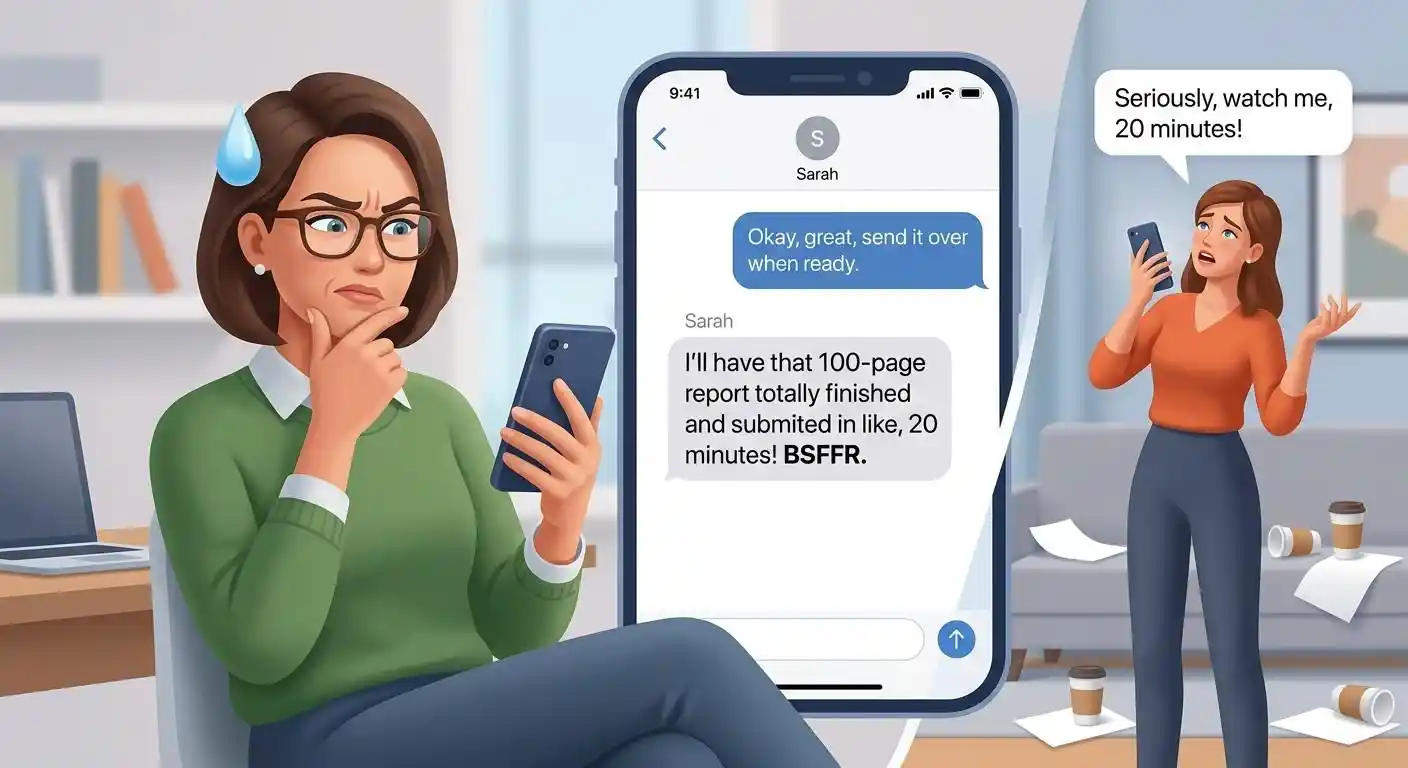
BSFFR means “Be So F*ing For Real”** in texting and internet slang. It is used to call out something that sounds unrealistic, dishonest, ridiculous, or hard to believe, often with a tone of disbelief, sarcasm, or frustration.
Key Takeaways
- BSFFR is an informal texting initialism meaning “Be So F*ing For Real.”**
- It is essentially a stronger version of BFFR, which means “Be F***ing For Real.”
- People use it when they want someone to be honest, serious, or realistic.
- The tone can be playful, sarcastic, blunt, or confrontational, depending on context.
- BSFFR can appear in texts, DMs, group chats, comments, and social media conversations.
- Because it contains profanity, it is best suited to casual communication, not professional or formal settings.
BSFFR Meaning in Text
In text messages, BSFFR is an informal internet-slang abbreviation for “Be So F*ing For Real.”** It is commonly used as a reaction when someone says something the sender considers unbelievable, exaggerated, dishonest, unrealistic, or ridiculous.
The phrase is basically a stronger way of saying:
- “Be serious.”
- “Are you for real?”
- “Come on, seriously?”
- “You can’t actually believe that.”
- “Stop playing and be honest.”
The “BS” at the beginning makes it different from BFFR. Both expressions communicate a similar idea, but BSFFR expands to “Be So Fing For Real,”** while BFFR is generally “Be Fing For Real.”**
BSFFR is not normally a friendly informational abbreviation. It is a reaction phrase used to push back against something someone has said.
What Does BSFFR Stand For?
BSFFR stands for “Be So F*ing For Real.”**
It is an initialism, meaning the letters represent the beginning parts of the words in the phrase.
The word “so” gives BSFFR a slightly different construction from BFFR:
- BSFFR = Be So F***ing For Real
- BFFR = Be F***ing For Real
- FR = For Real
All three can be used to question whether someone is being serious or truthful, but BSFFR can feel especially emphatic.
How Is BSFFR Used?
BSFFR is mainly used in casual online communication when someone wants to react strongly to another person’s statement.
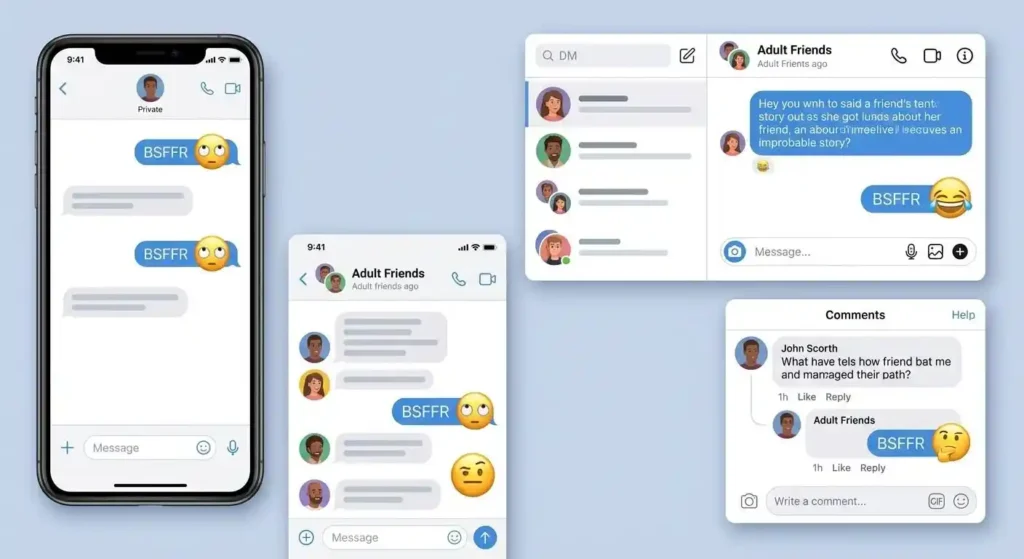
In Text Messages
A friend might make an exaggerated claim, and the response could simply be:
“BSFFR 😭”
The short reply communicates strong disbelief without requiring a full sentence.
In DMs
BSFFR can be used when friends are discussing someone’s behavior, an unusual story, or an opinion that seems unreasonable.
In Group Chats
It can work as a quick reaction when several people are already discussing something surprising or ridiculous.
On Social Media
BSFFR can appear in comments and replies when someone disagrees with a claim or thinks a post is unrealistic.
In Online Conversations
The abbreviation works best when the people involved already understand informal internet slang. It can sound much more direct than simply saying “really?”
BSFFR in Different Contexts
The meaning stays basically the same, but the tone can change significantly depending on the relationship and conversation.
From a Friend
A friend saying “BSFFR 😂” may be teasing you rather than genuinely angry.
For example:
“I swear I can finish this entire project in ten minutes.”
“BSFFR 😂”
The response suggests the friend does not believe the claim.
From a Guy
If a guy sends BSFFR, the abbreviation does not have a special male-specific meaning. It still means “Be So F*ing For Real.”**
Whether the message is joking, annoyed, or serious depends on the conversation.
From a Girl
The same applies if a girl uses BSFFR. Gender does not change the definition.
From a Crush
If your crush says “BSFFR”, don’t automatically interpret it as flirting, rejection, or romantic interest. The phrase itself mainly signals disbelief or a demand for honesty.
For example, if you say:
“I definitely didn’t eat the last slice.”
and they reply:
“BSFFR 😂”
they may simply be calling out an obvious excuse.
In Dating
BSFFR can be used when someone questions an unusual dating claim or an unrealistic statement.
For example:
“He said he didn’t see my message for three days.”
“BSFFR.”
Here, the response communicates skepticism.
In a Relationship
Partners may use BSFFR seriously or jokingly.
A playful exchange might look like:
“I’m never stealing your fries again.”
“BSFFR 😂”
The relationship context can make the expression feel teasing instead of hostile.
In a Group Chat
In a group chat, BSFFR can be a quick reaction to an exaggerated story, questionable claim, or unexpected opinion.
The surrounding messages help determine whether it is humorous disbelief or genuine irritation.
Real Chat Examples
Here are natural, non-graphic examples of how BSFFR can appear in casual conversations:
- A: “I can finish this whole assignment in five minutes.”
B: “BSFFR 😭” - A: “I didn’t know the test was today.”
B: “BSFFR, you literally reminded me about it yesterday.” - A: “I’m never going to buy snacks again.”
B: “BSFFR 😂” - A: “I wasn’t late. The clock is wrong.”
B: “BSFFR.” - A: “This is definitely the easiest class ever.”
B: “BSFFR 😭” - A: “I only watched one episode.”
B: “BSFFR, you finished the whole season.” - A: “I totally didn’t forget.”
B: “BSFFR 😂” - A: “I can clean my room in ten minutes.”
B: “BSFFR.” - A: “I don’t even like pizza.”
B: “BSFFR 😭” - A: “I wasn’t nervous at all.”
B: “BSFFR.” - A: “I definitely remembered your birthday.”
B: “BSFFR 😂” - A: “That movie wasn’t sad.”
B: “BSFFR, you were crying.” - A: “I only spent five dollars.”
B: “BSFFR 😭” - A: “I’m going to wake up early tomorrow.”
B: “BSFFR 😂” - A: “I never procrastinate.”
B: “BSFFR.” - A: “I wasn’t ignoring you.”
B: “BSFFR, you left me on read.” - A: “I can totally do this without help.”
B: “BSFFR.” - A: “I’m not tired.”
B: “BSFFR 😭”
These examples show that BSFFR often works as a short reaction rather than a complete sentence.
How to Reply to BSFFR
Your reply should match the tone. If the sender is joking, you can joke back. If they sound genuinely annoyed, a straightforward answer is better.
Casual Replies
- “I am being serious 😭”
- “Okay, okay, hear me out.”
- “I’m actually serious.”
- “No, I’m telling you the truth.”
- “Wait, let me explain.”
Friendly Replies
- “I swear I’m not making this up.”
- “Hear me out first 😂”
- “Okay, you got me.”
- “I’m being honest.”
- “I knew you wouldn’t believe me.”
Funny Replies
- “Let me live 😂”
- “You don’t have to call me out like that.”
- “Okay, maybe I exaggerated.”
- “Fine, you caught me 😭”
- “I said what I said.”
Neutral Replies
- “Yes, I’m serious.”
- “I’m being honest.”
- “What part don’t you believe?”
- “That’s actually what happened.”
- “I can explain.”
Flirty/Relationship Replies
Use these only when the conversation is already clearly playful or romantic:
- “You know I’m telling the truth 😂”
- “You really don’t believe me?”
- “Come on, give me a chance to explain.”
- “Okay, maybe you know me too well.”
- “I promise I’m being serious.”
What Tone Does BSFFR Have?
BSFFR is generally strong, informal, and expressive.
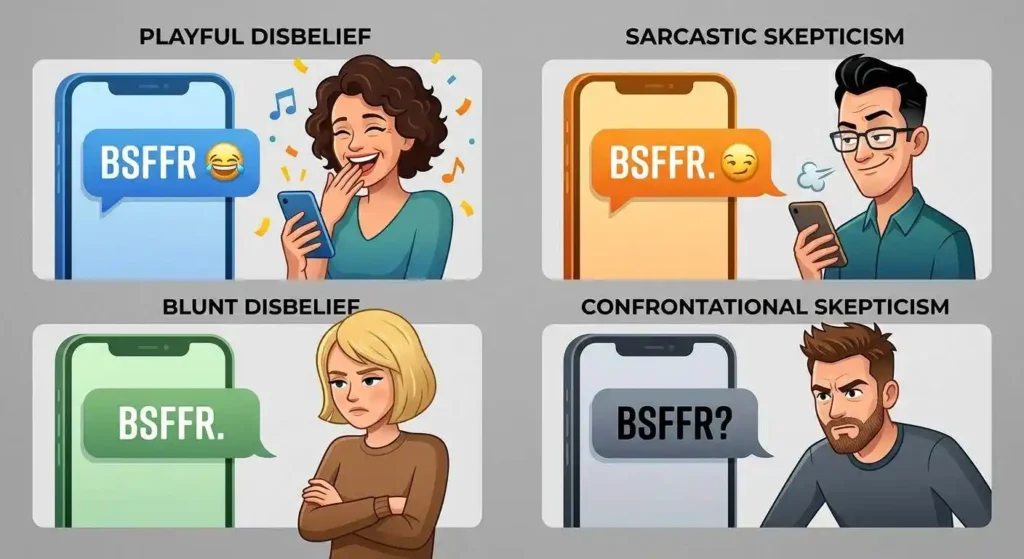
Depending on context, it can sound:
- Playful
- Sarcastic
- Skeptical
- Disbelieving
- Blunt
- Annoyed
- Confrontational
- Emphatic
An important clue is what comes after it.
“BSFFR 😂” may feel playful.
“BSFFR, seriously?” can sound more confrontational.
So punctuation, capitalization, emojis, and the relationship between the people can all affect how the message comes across.
Is BSFFR Rude or Offensive?
BSFFR can sound rude because it contains profanity and directly challenges what another person has said.
It is generally better suited to informal conversations with people who are comfortable with that style of language.
Casual Conversations
It can work among friends when the tone is understood.
Social Media
BSFFR can appear naturally in informal comments and replies, but strangers may interpret it more harshly than close friends would.
School
It is generally better to avoid BSFFR in school assignments, messages to teachers, or other school-related communication.
Work
BSFFR is not appropriate for most professional workplace communication.
Professional Communication
Use alternatives such as “Are you serious?”, “Can you clarify?”, or “I don’t think that’s accurate” when you need a professional tone.
Other Meanings of BSFFR
For the texting and internet-slang query, “Be So F*ing For Real”** is the relevant meaning.
BSFFR does not have a widely established technology, medical, finance, sports, or business meaning that is more relevant than its slang use. It is best understood as an online reaction phrase rather than a technical acronym.
Common Mistakes About BSFFR
Confusing BSFFR With BFFR
They are closely related but not identical.
BSFFR means “Be So Fing For Real,”** while BFFR is generally “Be Fing For Real.”**
Thinking BSFFR Means “Best Friends Forever”
It does not. BFF can mean “Best Friends Forever,” but BSFFR is a different slang expression.
Assuming BSFFR Always Means Anger
Not necessarily. Friends may use it playfully or sarcastically, especially with laughing or crying emojis.
Assuming It Proves Romantic Intent
BSFFR does not automatically mean someone is flirting, jealous, interested, or rejecting you. The conversation around it matters.
Using It in Formal Communication
Because it contains profanity and has a confrontational edge, BSFFR is generally unsuitable for professional or formal writing.
Thinking “BS” Means Something Separate Here
In BSFFR, the letters are part of the entire phrase “Be So F*ing For Real.”** They should not be interpreted as the separate abbreviation “bullshit” in this slang expansion.
BSFFR and Related Slang
| Term | Meaning | Common Use |
|---|---|---|
| BSFFR | Be So F***ing For Real | Strong disbelief or calling someone out |
| BFFR | Be F***ing For Real | Telling someone to be realistic or serious |
| FR | For Real | Emphasizing honesty or agreement |
| FRFR | For Real, For Real | Strong emphasis that something is genuine |
| No cap | No lie / I’m being truthful | Emphasizing honesty |
| Deadass | Seriously / genuinely | Emphasizing that someone is being serious |
BSFFR and BFFR are the closest matches. FR and FRFR are usually less confrontational, while no cap generally emphasizes truth rather than directly calling someone out.
People Also Ask About BSFFR
What does BSFFR mean in texting?
BSFFR means “Be So F*ing For Real.”** It is used when someone wants another person to be serious, honest, or realistic, often because their statement seems unbelievable.
What is the difference between BSFFR and BFFR?
BSFFR means “Be So Fing For Real,” while BFFR means “Be Fing For Real.” They communicate essentially the same idea, although BSFFR adds the word “so” and can feel more emphatic.
Is BSFFR the same as “be for real”?
They have the same basic idea, but BSFFR is much more informal and contains profanity. A cleaner alternative is simply “Be for real” or “Are you serious?”
Is BSFFR rude?
It can be. The profanity and direct wording can make it sound blunt or confrontational, especially when used with someone you do not know well.
What does BSFFR mean on social media?
On social media, BSFFR is generally used as a reaction to something the sender finds unbelievable, unrealistic, exaggerated, or dishonest. It often functions as a short comment meaning “be serious” or “come on.”
Can BSFFR be used jokingly?
Yes. Friends can use BSFFR playfully when someone makes an exaggerated claim. An emoji such as 😂 or 😭 can sometimes make the message feel more humorous, although context remains important.
Does BSFFR mean someone is mad?
Not always. It can communicate annoyance, but it can also express disbelief, sarcasm, teasing, or playful skepticism.
What is a cleaner alternative to BSFFR?
Depending on the situation, you can say “Are you serious?”, “Be real,”, “Come on,”, “Seriously?”, or “I don’t believe you.” These alternatives avoid profanity while keeping the basic message.
Conclusion
BSFFR means “Be So F*ing For Real”** and is used in texting and online conversations to express strong disbelief, skepticism, sarcasm, or frustration.
It is closely related to BFFR, but BSFFR includes the word “so” and can add extra emphasis. The expression is informal and contains profanity, so it is best suited to casual conversations rather than school, workplace, or professional communication.
The tone depends on context. Among friends, BSFFR can be playful or teasing, while in a disagreement it can sound blunt or confrontational. It does not automatically indicate romantic interest or any particular feeling beyond the reaction to what was said.

Emma Brooks is a writer whose work centers on puns, jokes, and topic-specific wordplay. Across four and a half years of experience, she has covered subjects involving food, animals, seasonal occasions, technology, entertainment, and trending topics. Emma identifies useful terms, tests different joke angles, and revises setups and punchlines to strengthen wording and comedic delivery.