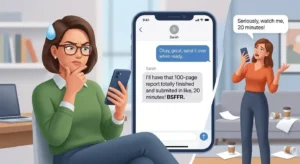
IDM usually means “I don’t mind” in text messages and online chats. It is an informal texting abbreviation used to show that someone is okay with something, has no strong preference, or is comfortable with another person’s choice.
Key Takeaways
- IDM stands for “I don’t mind.”
- It is an informal texting initialism used in casual digital communication.
- IDM often means “either is fine,” “I’m okay with it,” or “you can choose.”
- Its tone is usually neutral, relaxed, or flexible, but a very short reply can sometimes feel indifferent.
- IDM does not automatically indicate flirting, romantic interest, annoyance, or rejection.
- In other contexts, IDM can refer to Intelligent Dance Music, identity management, or other specialized terms.
IDM Meaning in Text
The main IDM meaning in text is “I don’t mind.”
IDM is an initialism and messaging shorthand formed from the first letters of I, don’t, and mind. In casual conversations, someone uses it when they have no strong preference or are comfortable with a suggestion.
For example:
“Pizza or burgers?”
“idm.”
Here, IDM means “I don’t mind. Either one is fine.”
It can also be used when someone is giving another person the choice:
“Do you want to meet at 5 or 6?”
“IDM, you choose.”
That means “I don’t mind; you decide.”
The exact feeling can depend on the surrounding conversation. A message such as “idm, whatever works for you” sounds flexible, while a one-word “idm” may feel more neutral or detached.
What Does IDM Stand For?
In texting, IDM stands for “I Don’t Mind.”
It is not normally a separate formal phrase. It is simply a shortened way of writing the sentence in casual online communication.
Depending on context, “I don’t mind” can communicate:
- I’m okay with it.
- Either option is fine.
- I have no preference.
- You can decide.
- It doesn’t bother me.
- I’m comfortable with that.
For example:
“Should we go Saturday or Sunday?”
“IDM.”
The person is saying that either day works for them.
How Is IDM Used?
IDM is mainly used in informal conversations, especially when someone is answering a question about preferences or making plans. It can appear in text messages, DMs, group chats, social-media conversations, and other casual online communication.
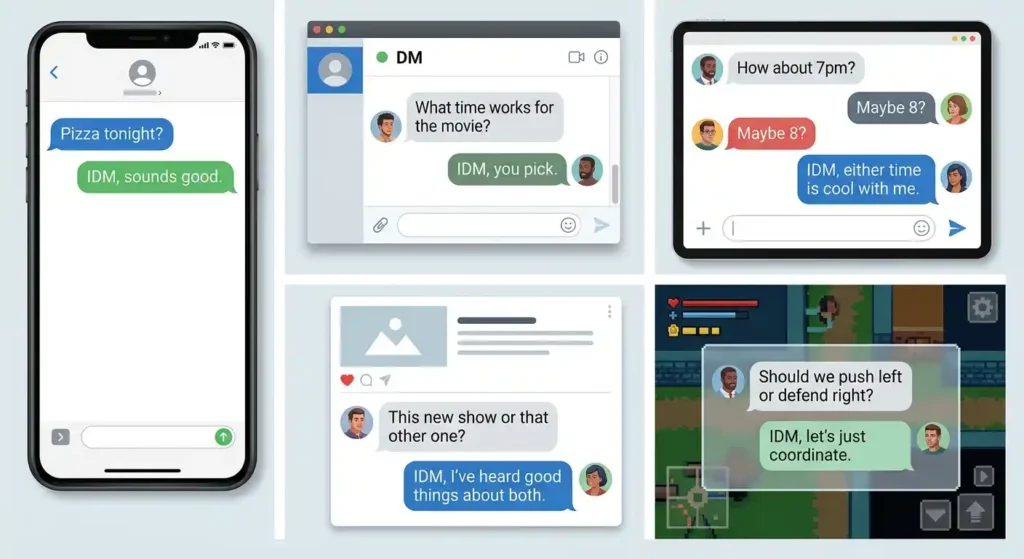
Text Messages
“What should we eat tonight?”
“IDM, you pick.”
The sender is leaving the decision to the other person.
DMs
“Want to call now or later?”
“idm either way.”
Here, the sender is saying that both options are acceptable.
Group Chats
“Movie at 7 or 8?”
“IDM.”
This can mean the person has no preference about the time.
Social Media
IDM can also appear in casual social-media conversations when someone wants to express that they are fine with something.
“I can post it tomorrow if you want.”
“idm.”
The sender is saying they are okay with that plan.
Gaming Chats
In a gaming conversation, IDM can be used when someone does not care which option the group chooses.
“Which map should we play?”
“idm.”
The meaning is still “I don’t mind.”
IDM in Different Contexts
IDM generally keeps the same meaning, but the tone and intention can change with context.
From a Friend
If a friend says:
“Pizza or tacos?”
“idm.”
They probably mean “Either is fine with me.”
It is usually a simple statement of flexibility.
From a Guy
If a guy sends IDM, the abbreviation itself does not tell you whether he is interested, annoyed, or uninterested.
For example:
“Where do you want to go?”
“idm, you choose.”
This most directly means “I don’t mind; you decide.”
His gender does not create a different definition.
From a Girl
The same applies if a girl sends IDM. It does not automatically mean she is flirting, upset, rejecting you, or showing romantic interest.
Look at the conversation, wording, punctuation, emojis, and relationship for additional clues.
From a Crush
If someone you like sends “idm,” do not assume the abbreviation contains a hidden romantic message.
For example:
“Want to watch a movie or get something to eat?”
“idm.”
That usually means “I’m fine with either.” Any romantic meaning would have to come from the broader conversation, not IDM alone.
In Dating or a Relationship
IDM can sound warm and flexible:
“Where should we go tonight?”
“idm, you choose 😊”
But it can also sound detached if the conversation is serious:
“Do you actually want to talk about this?”
“idm.”
The second example could feel like the person is not strongly invested in continuing the discussion. Context matters.
In a Group Chat
IDM is useful when someone does not want to make the final decision:
“Should we order pizza or Chinese?”
“idm, whatever everyone wants.”
In Social Media Comments
A short “idm” may simply show that the commenter has no preference. The words around it, emojis, and punctuation can make the intended attitude clearer.
Real Chat Examples
Here are realistic examples of how IDM can appear in casual conversations:
- Friend: “Pizza or burgers?”
You: “idm, you pick.” - Friend: “Should we go Friday or Saturday?”
You: “IDM either day.” - Friend: “What movie do you want to watch?”
You: “idm.” - Group chat: “6 PM or 7 PM?”
Reply: “IDM.” - Friend: “Do you want coffee or tea?”
Reply: “idm, both are fine.” - Friend: “Where should we eat?”
Reply: “IDM, your choice.” - Friend: “Can we meet tomorrow instead?”
Reply: “Yeah, idm.” - Friend: “Do you mind if I bring someone?”
Reply: “idm.” - Friend: “Which game should we play?”
Reply: “IDM, choose one.” - Friend: “Do you want to stay here or go out?”
Reply: “idm either way.” - Group chat: “Beach or park?”
Reply: “IDM.” - Friend: “Is 8 okay?”
Reply: “idm.” - Friend: “Should I call you later?”
Reply: “IDM, whenever.” - Friend: “Do you care which color we get?”
Reply: “idm.” - Friend: “Want pizza tonight?”
Reply: “idm lol.” - Friend: “You want to choose the restaurant?”
Reply: “idm, you can choose.” - Friend: “Can we watch something else?”
Reply: “Sure, idm.” - Friend: “Do you want to go now or wait?”
Reply: “idm, whatever works.” - Friend: “Are you okay if we change the plan?”
Reply: “Yeah, idm.” - Friend: “Which seat do you want?”
Reply: “idm, any is fine.”
These examples show that IDM usually communicates flexibility rather than strong enthusiasm or opposition.
How to Reply to IDM
The best response depends on what the person is saying they do not mind.
Casual Replies
- “Okay, you pick.”
- “Cool, either works.”
- “Sounds good.”
- “Your choice.”
- “Alright, I’ll decide.”
Friendly Replies
- “Haha okay, I’ll choose.”
- “Fair enough.”
- “No worries.”
- “Got you.”
- “Alright, let’s do that.”
Funny Replies
- “Wow, so many opinions 😂”
- “Okay, I guess I’m in charge.”
- “Your vote has been recorded as ‘whatever.’ 😂”
- “Fine, I’ll make the executive decision.”
- “No preference detected.”
Neutral Replies
- “Okay.”
- “Got it.”
- “No problem.”
- “Which one would you prefer if you had to choose?”
- “Let me know if you change your mind.”
Flirty/Relationship Replies
A flirty response only makes sense if the overall conversation is already clearly playful or romantic. IDM itself does not establish romantic intent.
- “Then I’m choosing for both of us 😄”
- “Okay, my choice it is.”
- “Deal.”
- “Fine, but you’re coming with me.”
What Tone Does IDM Have?
IDM is generally casual, informal, neutral, and flexible.
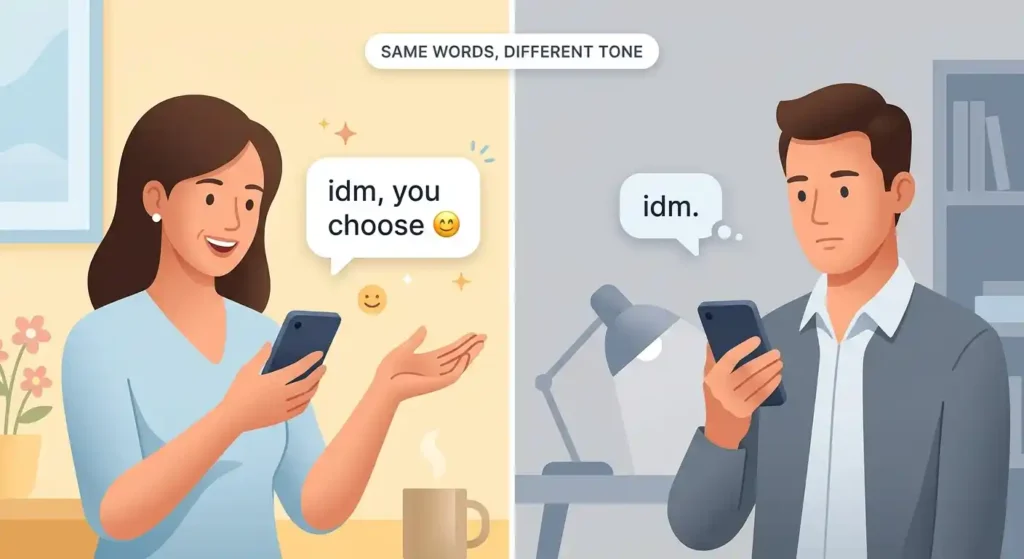
It can sound:
- Friendly: “idm, you choose.”
- Relaxed: “idm either way.”
- Neutral: “IDM.”
- Playful: “idm lol.”
- Indifferent: “idm.”
- Slightly detached: “idm, whatever.”
The difference often comes from what surrounds the abbreviation.
Compare:
“idm, you choose 😊”
with:
“idm.”
The first sounds more openly friendly and flexible. The second is shorter and can feel more detached, especially if the conversation is already tense.
Is IDM Rude or Offensive?
IDM is not inherently rude or offensive. It is a casual abbreviation for “I don’t mind.”
However, a very short reply can sometimes sound uninterested or dismissive, especially if someone is asking a serious or personal question.
Casual Conversations
IDM is fine in relaxed conversations with friends and other people who understand texting shorthand.
Social Media
It can work in casual comments, DMs, and social-media conversations.
School
IDM may be fine in an informal message to a classmate, but it should not be used in formal assignments.
Use “I don’t mind” instead.
Work
Avoid IDM in professional emails, workplace documents, and formal communication. A clearer phrase such as “I don’t have a preference” is more appropriate.
Formal Writing
IDM is informal messaging shorthand, so spell out “I don’t mind” in essays, reports, applications, and other formal writing.
Other Meanings of IDM
IDM has several established meanings outside casual texting. These should be interpreted according to the subject of the conversation.
IDM in Music
In music discussions, IDM can mean “Intelligent Dance Music.” It refers to a genre or style of electronic music.
For example:
“I’ve been listening to IDM lately.”
Here, the person is talking about music, not the texting phrase “I don’t mind.”
IDM in Technology
In technology and software discussions, IDM can refer to identity management, a field involving the management of digital identities and access.
This meaning is unrelated to texting slang.
IDM in Design
IDM can also stand for intelligent design movement in certain contexts. This is a specialized use rather than ordinary messaging shorthand.
Common Mistakes About IDM
Confusing IDM With IDC
These abbreviations are similar but have an important difference:
- IDM = I don’t mind
- IDC = I don’t care
IDM often sounds softer because it commonly communicates acceptance or flexibility.
Confusing IDM With IDK
- IDM = I don’t mind
- IDK = I don’t know
If someone says “IDM which movie,” they are saying they have no preference.
If they say “IDK which movie,” they are saying they do not know which one to choose.
Assuming IDM Means “I Don’t Matter”
Although alternative interpretations can appear in informal slang lists, “I don’t mind” is the established texting meaning. Do not interpret IDM as “I don’t matter” unless the surrounding conversation clearly supports that reading.
Assuming IDM Is Always Friendly
IDM often sounds neutral or easygoing, but a one-word reply can feel detached in a serious conversation.
Assuming IDM Has a Romantic Meaning
IDM does not automatically indicate flirting, attraction, rejection, or affection. The broader conversation is what provides that context.
Confusing Texting IDM With Music IDM
If someone is discussing electronic music, IDM may mean Intelligent Dance Music instead of “I don’t mind.”
IDM and Related Slang
| Term | Meaning | Common Use |
|---|---|---|
| IDM | I don’t mind | Showing flexibility or acceptance |
| IDC | I don’t care | Showing indifference |
| WTV | Whatever | Showing flexibility or indifference |
| IDK | I don’t know | Showing uncertainty |
| NVM | Never mind | Dropping or changing a topic |
| TBH | To be honest | Introducing an honest opinion |
The most useful comparison is IDM vs. IDC. If someone says “IDM,” they often mean that either choice is acceptable. “IDC” is more direct and can sound stronger.
People Also Ask About IDM
What does IDM mean in texting?
IDM means “I don’t mind.” It is used when someone is okay with a choice, suggestion, or situation and does not have a strong preference.
Does IDM mean “I don’t mind”?
Yes. In casual texting and internet slang, IDM is a shortened form of “I don’t mind.” It is commonly used to communicate flexibility or acceptance.
Is IDM the same as IDC?
No. IDM means “I don’t mind,” while IDC means “I don’t care.” IDM can sound more like acceptance or flexibility, whereas IDC can communicate stronger indifference.
Is IDM rude in a text?
Usually not. IDM is generally neutral or relaxed, but a one-word “idm” can feel detached if it is sent in response to a serious question.
What does IDM mean from a guy or girl?
The meaning is the same regardless of the sender’s gender. IDM does not automatically signal flirting, attraction, rejection, or romantic interest.
What does IDM mean from a crush?
Usually, it still means “I don’t mind.” If your crush says “idm, you choose,” they are most likely saying they are fine with your choice; the abbreviation alone does not reveal romantic intent.
Can IDM mean something besides “I don’t mind”?
Yes. In other contexts, IDM can mean “Intelligent Dance Music,” “identity management,” or other specialized terms. The topic of the conversation determines which meaning fits.
What is the difference between IDM and IDK?
IDM = “I don’t mind.”
IDK = “I don’t know.”
IDM expresses a lack of preference, while IDK expresses uncertainty or a lack of knowledge.
Conclusion
IDM means “I don’t mind” in text and casual online communication. It is an informal texting initialism used to show that someone is comfortable with a choice, has no strong preference, or is willing to let someone else decide.
Its tone is usually casual, neutral, relaxed, or flexible, although a very short response can sometimes feel detached depending on the conversation. IDM is appropriate for casual chats and social media but is better written out in formal school or professional communication.
Outside texting, IDM can have specialized meanings such as Intelligent Dance Music or identity management, so context matters. In an ordinary text message, however, “I don’t mind” is the intended meaning.

Writing puns and jokes for three and a half years has given Grace Collins experience working with language across varied subjects. As a writer, she covers food, animals, seasonal themes, technology, entertainment, and trending topics. Grace gathers subject-specific terms, explores word associations, and polishes joke structures to improve phrasing, punchlines, and comedic timing.