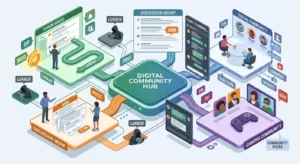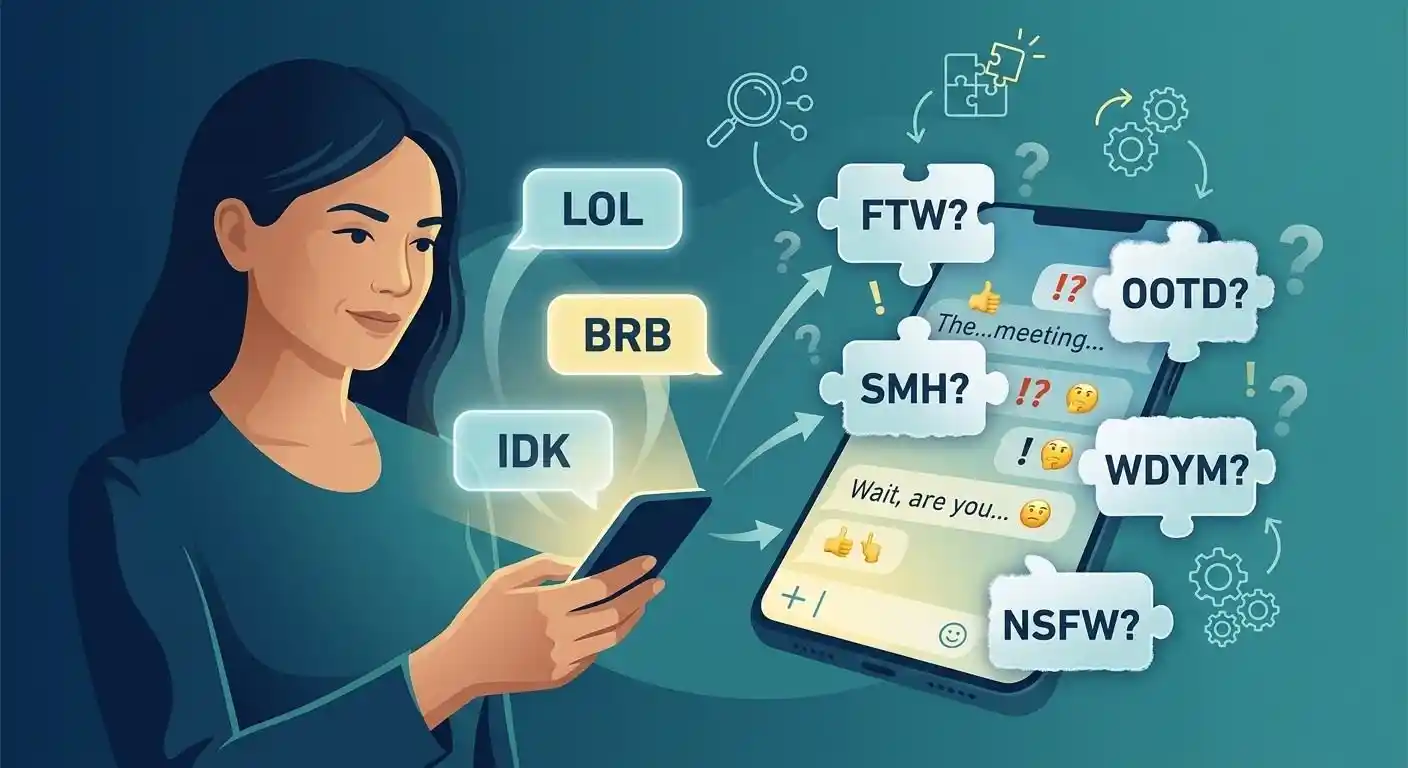
Less common acronyms in text are shortened phrases or expressions that are not as widely recognized as abbreviations such as LOL, BRB, or IDK. Their meanings can depend heavily on the conversation, community, platform, or subject being discussed.
Key Takeaways
- Less common acronyms are shorthand expressions that may not be immediately recognizable to everyone.
- Many have more than one possible meaning, so context matters.
- They can appear in texts, DMs, group chats, comments, gaming conversations, and online communities.
- A less familiar acronym does not automatically have a slang meaning.
- Some acronyms are community-specific, while others come from technical, business, or professional language.
- If an acronym is unclear, checking the surrounding message or asking the sender is usually the safest way to understand it.
Less Common Acronyms Meaning in Text
In texting, less common acronyms generally refers to shortened expressions that are used less broadly than familiar texting shorthand.
Examples of widely recognized texting acronyms include LOL for “laughing out loud,” BRB for “be right back,” and IDK for “I don’t know.” Less common acronyms may be harder to recognize because they are used by smaller groups, in specific situations, or in particular online communities.
They are a type of messaging shorthand and can appear in casual texts, DMs, social media comments, group chats, gaming conversations, and other forms of online communication.
Unlike a single slang term, “less common acronyms” does not have one fixed full form. It is a category describing acronyms that may require additional context to understand.
What Do Less Common Acronyms Stand For?
There is no single expansion for less common acronyms because the phrase describes a category rather than one particular acronym.
For example:
- ICWT can have different interpretations depending on context.
- WKT can be interpreted differently in different conversations.
- TDK may have a texting interpretation or refer to something unrelated to texting.
- ASL can have different meanings depending on how it appears in a message.
This is why you should not assume that every unfamiliar acronym has one universal definition.
How Are Less Common Acronyms Used?
Less common acronyms can be used in several types of online communication.
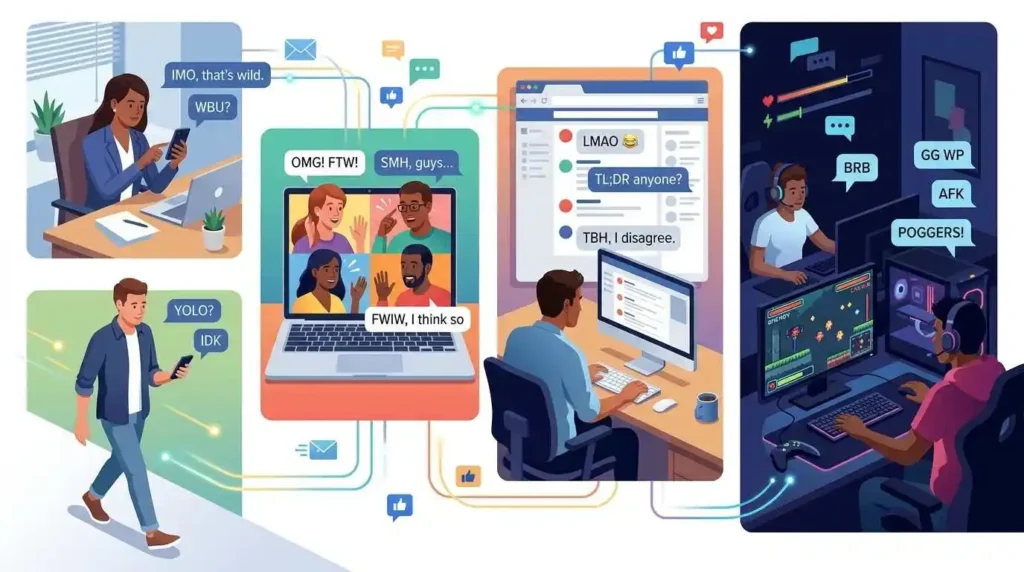
Text Messages
Someone may shorten a phrase to make a casual message quicker to type.
Example:
“WKT what happened?”
The exact interpretation depends on the conversation.
DMs
Acronyms may appear in direct messages when people use shorthand familiar to their social circle.
Example:
“LMK if you’re still coming.”
Group Chats
Group-specific shorthand can develop when people regularly discuss the same subjects, hobbies, games, or activities.
Social Media Comments
Short acronyms can make comments quicker and easier to type, especially when the meaning is already understood by the community.
Gaming and Online Communities
Gaming groups and online communities can develop specialized abbreviations that make sense to regular members but may confuse newcomers.
Less Common Acronyms in Different Contexts
The same letters can mean different things in different situations. Context is especially important when an acronym is unfamiliar.
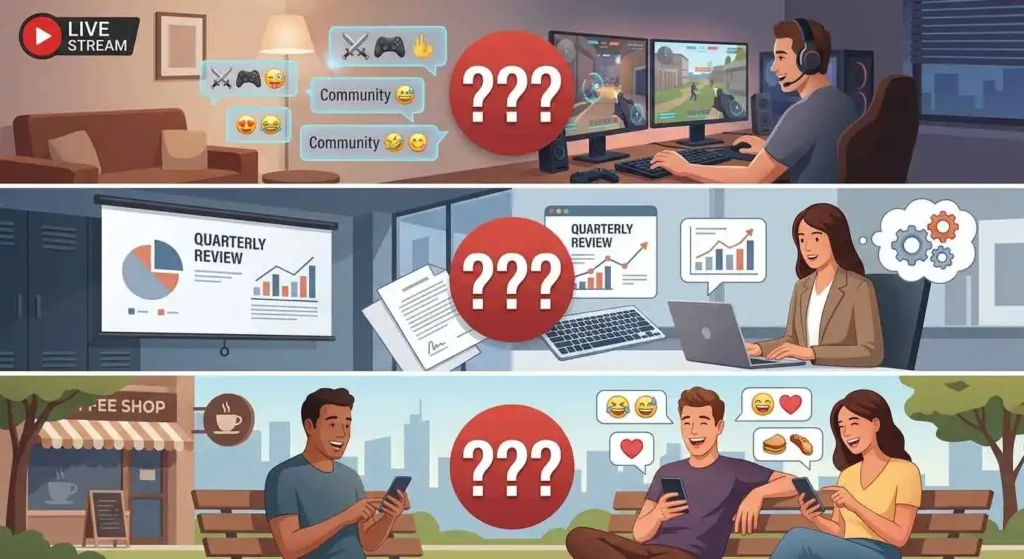
Look at:
- The words before and after the acronym
- The topic of the conversation
- Punctuation
- Emojis
- The relationship between the people chatting
- The community or activity being discussed
From a Friend
A friend may use an acronym that is familiar within your friend group. It may have little meaning outside that group.
In a Group Chat
A group can develop its own shorthand for recurring jokes, activities, places, or phrases.
On Social Media
An acronym may have a platform-specific or community-specific interpretation.
In Dating or Personal Chats
Context can matter even more in personal conversations. An unfamiliar acronym alone does not prove that someone is flirting, showing romantic interest, or expressing a particular emotion. The surrounding conversation provides the better clue.
Real Chat Examples
Because “less common acronyms” covers many different abbreviations, examples should focus on how people handle unfamiliar shorthand rather than pretending every acronym has one meaning.
- Alex: “WKT what happened?”
Sam: “Not sure what you mean by WKT.” - Mia: “ICWT 😂”
Jay: “Wait, what does ICWT mean here?” - Alex: “Can you send the file ASAP?”
Sam: “Sure, sending it now.” - Mia: “IDK if I can make it tonight.”
Jay: “No worries.” - Alex: “BTW, the plan changed.”
Sam: “Thanks for letting me know.” - Mia: “LMK when you get home.”
Jay: “Will do.” - Alex: “I saw your message LOL.”
Sam: “😂 I figured.” - Mia: “BRB, grabbing some food.”
Jay: “Okay.” - Alex: “What does that acronym mean?”
Sam: “It depends on the context.” - Mia: “I saw this in a group chat and had no idea what it meant.”
Jay: “Same. I had to ask.” - Alex: “Everyone in this server uses that abbreviation.”
Sam: “I’m still learning the terminology.” - Mia: “Is TDK supposed to mean the movie or something else?”
Jay: “What were you talking about before that?” - Alex: “That acronym means something different in our group.”
Sam: “Good to know.” - Mia: “Can you explain that abbreviation?”
Jay: “Sure, it means…” - Alex: “I thought that acronym meant something else.”
Sam: “Yeah, it can depend on the context.” - Mia: “This chat has so many abbreviations.”
Jay: “I know 😂” - Alex: “What does that stand for?”
Sam: “It’s short for…” - Mia: “I don’t recognize that one.”
Jay: “Me neither.” - Alex: “Does this acronym have another meaning?”
Sam: “It might. What was the conversation about?” - Mia: “I finally figured out what everyone meant.”
Jay: “😂 Took me a minute too.”
How to Reply to an Unfamiliar Acronym
When someone uses a less common acronym and you do not understand it, you do not need to guess.
Casual Replies
- “What does that mean?”
- “Wait, what does that stand for?”
- “I don’t know that one 😂”
Friendly Replies
- “Can you explain that one to me?”
- “I haven’t seen that abbreviation before.”
- “What does that mean in this context?”
Funny Replies
- “Okay, I need the acronym dictionary for this one 😂”
- “You lost me at the abbreviation.”
- “Translation please 😂”
Neutral Replies
- “Could you clarify that abbreviation?”
- “What does that acronym mean here?”
- “I’m not familiar with that term.”
There is usually no need to create a flirty or relationship-specific reply simply because an acronym appears in a personal conversation.
What Tone Do Less Common Acronyms Have?
Less common acronyms do not have one fixed tone.
Depending on the expression, they can be:
- Casual
- Friendly
- Informal
- Playful
- Direct
- Neutral
- Sarcastic
- Context-dependent
The acronym itself may not determine the tone. The surrounding words, punctuation, emojis, and subject of the conversation can change how a message comes across.
Are Less Common Acronyms Rude or Offensive?
The category itself is neither rude nor offensive.
Whether a particular acronym is appropriate depends on what it represents. Some abbreviations are completely neutral, while others may contain profanity, insults, sexual references, or language that is inappropriate in certain settings.
For casual conversations and social media, familiar shorthand is generally easier to understand. For school, work, or professional communication, spelling out an unfamiliar acronym can make the message clearer.
Other Meanings of Less Common Acronyms
“Less common acronym” is not a specific acronym with a separate technical, medical, financial, or sports definition. Rather, acronyms themselves can come from many fields.
For example, an acronym that looks unfamiliar in a text might actually belong to:
- Technology
- Gaming
- Business
- Finance
- Medicine
- Sports
- Education
- A particular online community
That is why identifying the subject of the conversation is important before deciding what an unfamiliar abbreviation means.
Common Mistakes About Less Common Acronyms
Assuming Every Acronym Has One Meaning
Some acronyms have multiple interpretations. The surrounding conversation can determine which one makes sense.
Treating Every Acronym as Slang
An acronym can be ordinary shorthand rather than internet slang. It might come from a professional or technical field.
Guessing From the Letters Alone
Trying to construct a meaning from the individual letters can lead to the wrong interpretation.
Assuming Romantic Intent
An acronym in a personal conversation does not automatically indicate flirting or romantic interest. Look at the complete conversation instead.
Using Unfamiliar Acronyms With Everyone
An abbreviation that makes sense to one group may confuse another. If clarity matters, spelling out the phrase is often better.
Less Common Acronyms and Related Slang
| Term | Meaning | Common Use |
|---|---|---|
| LOL | Laughing out loud | Showing amusement |
| BRB | Be right back | Temporary absence |
| IDK | I don’t know | Expressing uncertainty |
| LMK | Let me know | Asking for a response |
| TBH | To be honest | Introducing an honest opinion |
| IKR | I know, right? | Agreeing with a statement |
| NGL | Not gonna lie | Introducing a candid comment |
| TMI | Too much information | Reacting to excessive personal detail |
| TTYL | Talk to you later | Ending a conversation temporarily |
| ICYMI | In case you missed it | Calling attention to previous information |
These familiar examples help show the difference between widely recognized texting shorthand and abbreviations that require more context.
People Also Ask About Less Common Acronyms
What is considered a less common acronym?
A less common acronym is an abbreviation that is not broadly recognized outside a particular group, topic, or context. It may be familiar to people in one community but unfamiliar to other readers.
Why do people use uncommon acronyms in texts?
People use acronyms to shorten phrases and communicate quickly. In some groups, shorthand also becomes part of the shared language used by members.
Can one texting acronym have multiple meanings?
Yes. The same letters can represent different phrases. The conversation topic and surrounding words are important clues when an acronym has multiple possible interpretations.
How can I understand an acronym I have never seen before?
Read the entire message and consider what the conversation is about. If the meaning still is not clear, asking the sender what it means is more reliable than guessing.
Are uncommon acronyms the same as slang?
Not necessarily. Some are slang or internet shorthand, while others are abbreviations used in technical, professional, academic, gaming, or other specialized settings.
Should I use less common acronyms at work?
Use caution. If the recipient may not recognize the abbreviation, spelling out the phrase is usually clearer, especially in formal or professional communication.
Why can acronyms be confusing in group chats?
Different people may bring different meanings to the same abbreviation. A group can also develop its own shorthand that makes sense to regular members but not to newcomers.
Conclusion
Less common acronyms are shortened expressions that may not be immediately understood outside a particular conversation, community, or subject. They can appear in texts, DMs, group chats, social media, gaming, and specialized communication.
Unlike a single texting acronym, the phrase “less common acronyms” has no fixed full form. The key to understanding an unfamiliar abbreviation is context: consider the conversation, surrounding words, and subject before deciding what it means. When the meaning remains unclear, asking the sender is better than guessing.
SEO Meta Titles
- Less Common Acronyms in Text: Meanings & Uses
- Less Common Acronyms: Texting Meanings Explained
- Less Common Acronyms in Text and Chat Explained
SEO Meta Descriptions
- Learn what less common acronyms mean in texting, how context changes their meaning, where they appear, and how to understand unfamiliar shorthand.
- Explore less common acronyms in texts, DMs, group chats, and social media, with examples, context tips, related slang, and reply ideas.
- Confused by an unfamiliar texting acronym? Learn how less common acronyms work, how to interpret context, and when to ask what one means.

Emma Brooks is a writer whose work centers on puns, jokes, and topic-specific wordplay. Across four and a half years of experience, she has covered subjects involving food, animals, seasonal occasions, technology, entertainment, and trending topics. Emma identifies useful terms, tests different joke angles, and revises setups and punchlines to strengthen wording and comedic delivery.