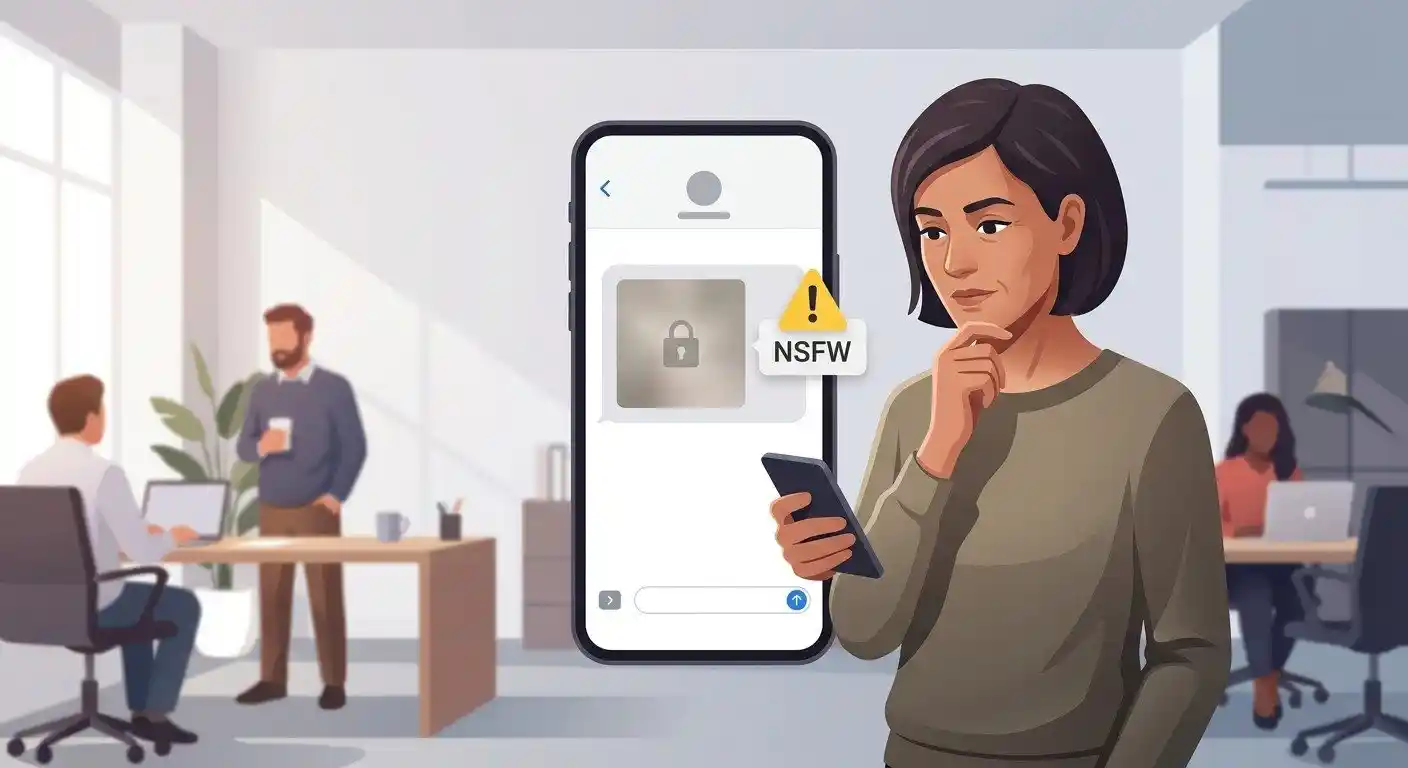
NSFW means “Not Safe For Work.” In text messages and online conversations, it is a warning that a link, image, video, joke, or other content may be inappropriate to view in a workplace, school, public setting, or around other people.
It is best understood as a content-warning abbreviation, rather than slang that expresses an emotion or reaction. The label can refer to adult, graphic, offensive, or otherwise unsuitable material, so the exact meaning depends on the context.
Key Takeaways
- NSFW stands for “Not Safe For Work.”
- It is an internet abbreviation and content warning.
- People use it before sharing material that may be unsuitable for public or professional settings.
- NSFW does not automatically mean sexual content; it can also warn about graphic, offensive, or otherwise sensitive material.
- The abbreviation itself is not necessarily rude or offensive.
- In a message, context matters when deciding what the warning refers to.
NSFW Meaning in Text
In texting and online communication, NSFW tells the reader to be cautious before opening or viewing something.
For example, if someone writes “NSFW—open this later,” they are warning you that the material may not be appropriate for a workplace, classroom, public place, or other shared environment.
NSFW is an acronym formed from the first letters of Not Safe For Work. It is commonly used as messaging shorthand because four letters can communicate the warning quickly.
The important point is that NSFW describes the content, not the person receiving it. Seeing the label does not by itself tell you why the content was marked that way.
What Does NSFW Stand For?
NSFW = Not Safe For Work.
It is also sometimes interpreted as “Not Suitable For Work,” which conveys essentially the same idea. Both expressions are used as warnings about material that may be inappropriate to view in professional or public environments.
The abbreviation is not simply a shortened spelling of one word. Each letter represents part of the phrase:
- N = Not
- S = Safe
- F = For
- W = Work
How Is NSFW Used?
NSFW is usually placed before or alongside content that someone wants to flag.
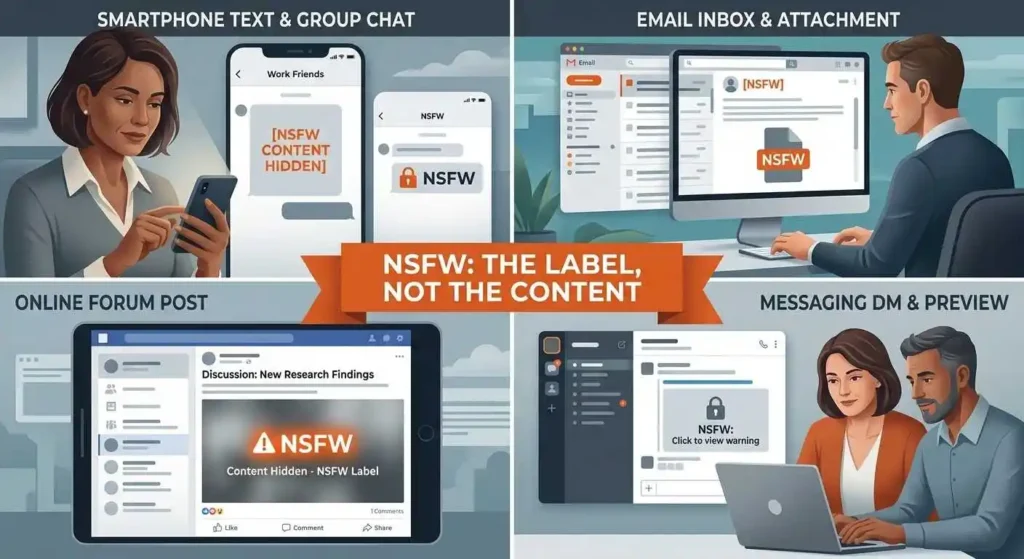
It can appear in:
- Text messages
- Private messages
- Group chats
- Online posts
- Comments
- Emails
- Forums and online communities
- Links or attachments
The warning gives the reader an opportunity to decide whether it is an appropriate time and place to view the material.
For example:
“NSFW — check this when you’re somewhere private.”
The phrase does not necessarily describe one specific type of material. It can be used broadly for content considered unsuitable for a particular setting.
Real Chat Examples
Because NSFW is a warning rather than a reaction word, it usually appears in messages about something being shared.
- Friend: “NSFW, don’t open this during class.”
- Friend: “This link is NSFW, so check it later.”
- Person A: “Should I send the screenshot?”
- Person B: “Sure, just mark it NSFW.”
- Friend: “Warning: NSFW attachment.”
- Person A: “Is this safe to open around everyone?”
- Person B: “Probably not. NSFW.”
- Friend: “NSFW warning before you click.”
- Person A: “Why did you label that NSFW?”
- Person B: “The content isn’t suitable for a public setting.”
- Friend: “Don’t open that one at school—NSFW.”
- Person A: “Thanks for the warning.”
- Person B: “No problem. Save it for later.”
- Friend: “This post should probably be marked NSFW.”
- Person A: “Got it. I’ll check it somewhere appropriate.”
- Friend: “NSFW, just giving you a heads-up.”
- Person A: “Okay, I’ll wait until I’m somewhere private.”
- Friend: “That image needs an NSFW warning.”
- Person A: “Thanks for letting me know.”
These examples show that the abbreviation is primarily about warning someone before they view potentially unsuitable content.
How to Reply to NSFW
There is no single required response. Your reply depends on whether you want more information, plan to view the content later, or simply acknowledge the warning.
Casual Replies
- “Got it.”
- “Okay, I’ll check later.”
- “Thanks for the warning.”
Friendly Replies
- “Good looking out 😅”
- “Thanks for the heads-up.”
- “I’ll wait until I’m somewhere appropriate.”
Funny Replies
- “Noted 😂”
- “Message received.”
- “Definitely saving that for later.”
Neutral Replies
- “Understood.”
- “Thanks for letting me know.”
- “I’ll avoid opening it here.”
Flirty/Relationship Replies
In a personal conversation, the surrounding message may have a playful or romantic tone, but NSFW itself does not automatically mean flirting. A neutral response such as “What do you mean by NSFW?” is appropriate if the context is unclear.
Context & Relationship Meaning
NSFW has the same basic meaning regardless of who sends it.
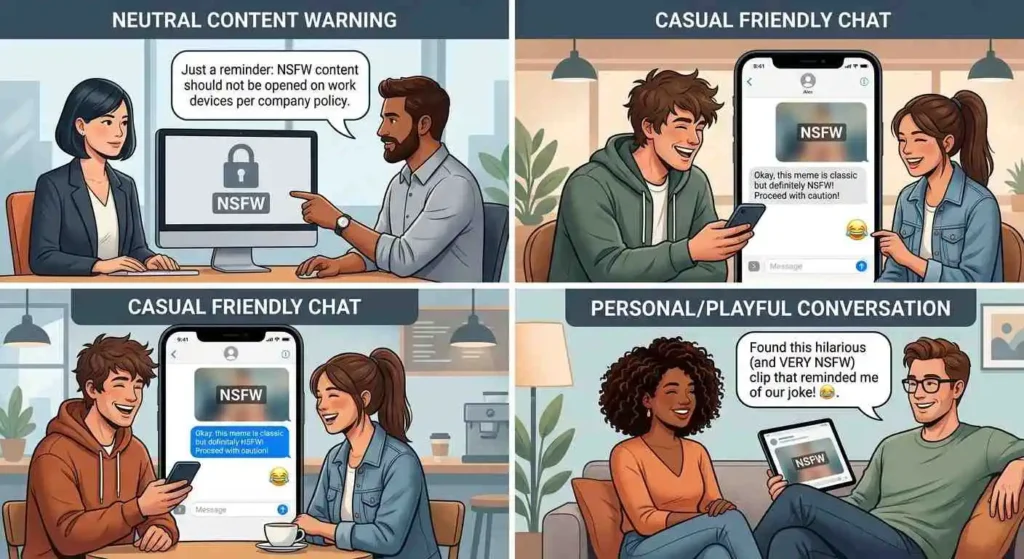
If a guy, girl, friend, crush, or dating partner uses NSFW, the abbreviation still means Not Safe For Work. The relationship may affect the reason for the warning, but it does not create a different definition.
For example, someone might use it casually when sharing something they think is unsuitable for public viewing. In a personal conversation, the surrounding wording could make the message feel playful or suggestive, but the acronym alone does not prove romantic or sexual intent.
Look at:
- The words around NSFW
- What is being discussed
- Punctuation
- Emojis
- The previous messages
- Your relationship with the sender
Context provides the meaning beyond the basic warning.
What Tone Does NSFW Have?
NSFW is usually neutral and cautionary.
Depending on the conversation, it can sound:
- Serious — when warning someone about sensitive material
- Casual — between friends
- Playful — when used jokingly
- Matter-of-fact — when simply labeling content
- Cautionary — when the sender wants you to wait before viewing something
The tone comes mainly from the surrounding conversation, not from the four letters themselves.
Is NSFW Rude or Offensive?
NSFW is not inherently rude or offensive. It is primarily a warning label. Dictionaries define it as an abbreviation used to indicate that online material may not be suitable for viewing at work or in public.
However, sending content that is unsuitable for a particular setting can create a problem even when the NSFW label itself is neutral.
For school, work, professional communication, or formal messages, it is generally better to avoid sharing inappropriate material altogether. In ordinary online conversations, NSFW may simply function as a warning.
Who Uses NSFW?
NSFW is part of general internet slang and digital communication, so it should not automatically be described as belonging to one particular generation.
It can appear in casual conversations, online communities, emails, forums, and other forms of digital messaging. Its basic purpose remains the same: alerting someone that content may not be appropriate to view in their current environment.
Other Meanings of NSFW
There is one dominant meaning relevant to texting and internet communication:
Not Safe For Work.
“Not Suitable For Work” is also used as a near-equivalent wording.
You may occasionally encounter humorous reinterpretations of the letters online, but those are context-specific jokes rather than the standard meaning. They should not be treated as the normal definition.
NSFW vs. Similar Slang
NSFW is sometimes confused with other content-warning terms, but they are not identical.
| Term | Meaning | Difference |
|---|---|---|
| NSFW | Not Safe For Work | Broad warning about unsuitable content |
| SFW | Safe For Work | Indicates content is generally appropriate for a work or public setting |
| NSFL | Not Safe For Life | A much stronger warning associated with extremely disturbing material |
| 18+ | Adults only | Indicates an age restriction rather than simply a workplace/public-setting warning |
The key distinction is that NSFW is about suitability for an environment, while an age label such as 18+ focuses on who should access the material.
Common Mistakes About NSFW
Thinking NSFW Always Means Sexual Content
Not necessarily. NSFW can refer to various forms of material that someone considers inappropriate for a workplace or public setting, including offensive or graphic material.
Thinking NSFW Means Something Illegal
It does not. NSFW is a suitability warning, not a statement about legality.
Assuming NSFW Is an Insult
NSFW is generally a label or warning. It does not describe the character of the person receiving the message.
Assuming NSFW Always Means the Same Thing in Every Conversation
The basic definition stays the same, but what qualifies as NSFW depends on the content and context.
Assuming NSFW Proves Romantic Interest
It does not. If someone sends or mentions NSFW material in a personal conversation, the surrounding conversation is necessary to understand their intent.
Related Internet Slang
| Term | Meaning | Common Use |
|---|---|---|
| SFW | Safe For Work | Indicates content is suitable for a public or work setting |
| NSFL | Not Safe For Life | Strong warning for extremely disturbing material |
| 18+ | Adults only | Indicates an age-related restriction |
| TMI | Too Much Information | Used when someone shares more personal information than expected |
| TW | Trigger Warning | Warns that content may be emotionally difficult or upsetting |
These terms overlap because they all help people understand something about content before they view or engage with it, but each has a different purpose.
Real-World Conversation
Alex: “I found the post you were asking about.”
Sam: “Can you send it?”
Alex: “Sure, but NSFW. Don’t open it around other people.”
Sam: “Got it. I’ll check it later.”
Here, NSFW functions as a simple warning, giving Sam a chance to choose an appropriate time and place to view the post.
People Also Ask
What does NSFW mean in text?
NSFW means “Not Safe For Work.” It is an internet abbreviation used to warn that content may be inappropriate to view in a workplace, school, public place, or around other people.
Does NSFW always mean adult content?
No. Adult material is one possible reason for an NSFW warning, but the label can also refer to graphic, offensive, or otherwise unsuitable content.
Is NSFW a bad word?
No. NSFW itself is a content-warning abbreviation, not a swear word. Whether something is inappropriate depends on the content being labeled.
What does NSFW mean on social media?
It generally means that a post, image, video, link, or other material may not be appropriate to view publicly. The warning encourages people to consider their surroundings before opening it.
What does NSFW mean from a guy or girl?
It has the same basic meaning regardless of the sender’s gender: Not Safe For Work. The surrounding conversation determines whether the message is simply a warning, a joke, or something else.
Does NSFW mean 18+?
Not exactly. NSFW describes content that may be unsuitable for work or public viewing, while 18+ specifically communicates an age restriction.
What is the opposite of NSFW?
SFW, meaning “Safe For Work,” is commonly used as the opposite. It indicates that content is generally considered appropriate for a workplace or public setting.
What should I do if someone sends me something marked NSFW?
Treat the label as a warning and consider whether you are somewhere appropriate to view the material. If the context is unclear, you can simply ask what the warning refers to rather than opening it immediately.
Conclusion
NSFW means “Not Safe For Work.” In text messages and online conversations, it acts as a warning that content may be unsuitable for a workplace, school, public setting, or other shared environment.
The abbreviation itself is generally neutral. Its exact tone and meaning in a personal conversation depend on the surrounding context, while related labels such as SFW, NSFL, and 18+ serve different purposes.

Christopher Hayes has spent five years writing puns and jokes built around the language of specific subjects. His work spans animals, seasonal themes, technology, entertainment, trending topics, and food-related wordplay. He examines terminology and possible word connections, builds joke premises from them, and fine-tunes setups and punchlines for precision, rhythm, and comedic effect.