Reaction slang is informal language people use in texts, comments, DMs, group chats, and social media to quickly express a reaction, emotion, opinion, or response. It includes short words, abbreviations, phrases, and expressive reactions such as LOL, OMG, SMH, BRUH, OOF, W, and “big mood.”
Key Takeaways
- Reaction slang is a category of informal internet language, not one specific abbreviation.
- It helps people show laughter, surprise, disbelief, agreement, frustration, excitement, or relatability quickly.
- Common examples include LOL, OMG, SMH, BRUH, OOF, IKR, W, and “I’m dead.”
- Reaction slang can appear in text messages, DMs, comments, memes, group chats, and gaming communities.
- The same reaction can have different tones depending on the conversation, punctuation, emojis, and relationship.
- Most reaction slang is best suited to casual communication, not formal school or professional writing.
Reaction Slang Meaning in Text
Reaction slang refers to informal words and expressions used to react quickly to something someone says, posts, shares, or does online.
Unlike a single texting abbreviation such as IDK or BRB, reaction slang is a category of internet slang. It can include abbreviations, ordinary words used in new ways, short phrases, emojis, and expressive sounds.
For example:
- LOL → shows laughter
- OMG → shows surprise, excitement, or disbelief
- SMH → shows disappointment or disbelief
- BRUH → reacts to something ridiculous, surprising, or frustrating
- OOF → reacts to something painful, awkward, or uncomfortable
- W → shows approval or celebrates a win
- Big mood → shows strong relatability
- I’m dead → usually means something is extremely funny
The important point is that reaction slang is about responding, rather than simply describing an object, person, or action.
What Does Reaction Slang Stand For?
Reaction slang does not have a full form.
It is a general term for slang used as a quick emotional or conversational reaction. Some individual reaction terms do have full forms.
For example:
| Reaction slang | Meaning |
|---|---|
| LOL | Laughing out loud |
| OMG | Oh my God / Oh my gosh |
| SMH | Shaking my head |
| IKR | I know, right? |
| BRB | Be right back |
| LMAO | Laughing my ass off |
| W | Win / winning |
Not every reaction expression is an acronym. Words such as bruh, oof, shook, cringe, mood, and relatable can function as reaction language without standing for a longer phrase.
How Is Reaction Slang Used?
Reaction slang is mainly used when someone wants to communicate a feeling or response without writing a full sentence.
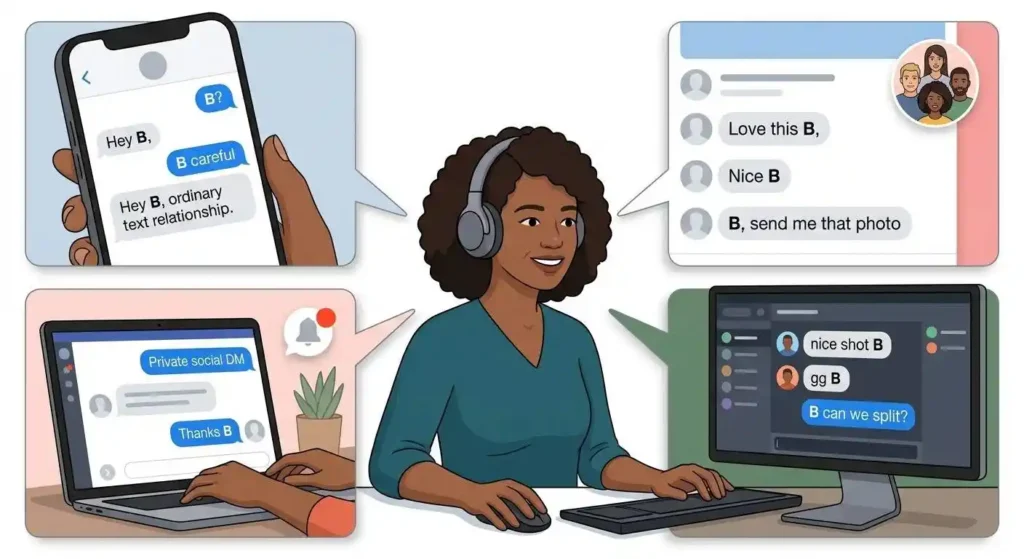
Text Messages
A friend sends:
“I forgot my keys again.”
You might reply:
“Bruh 😭”
The response communicates disbelief or amused frustration without needing a long explanation.
DMs
Reaction slang works naturally in private messages:
“Did you see that ending?”
“OMG yes!”
Group Chats
Group chats often use short reactions because several people may be responding at once.
“He actually showed up wearing that 😂”
“I’m dead.”
Social Media Comments
Short reactions are common under posts, videos, memes, and other content.
Examples include:
- “W”
- “LOL”
- “Big mood”
- “This 😭”
- “No way”
- “Bruh”
- “I’m crying”
Gaming Chats
Gaming communities also use quick reactions when something surprising, funny, impressive, or frustrating happens.
A player makes an unexpected play:
“W!”
A teammate makes an obvious mistake:
“bruh 😭”
Reaction slang is useful in fast-moving conversations because the response can be understood almost instantly.
Reaction Slang in Different Contexts
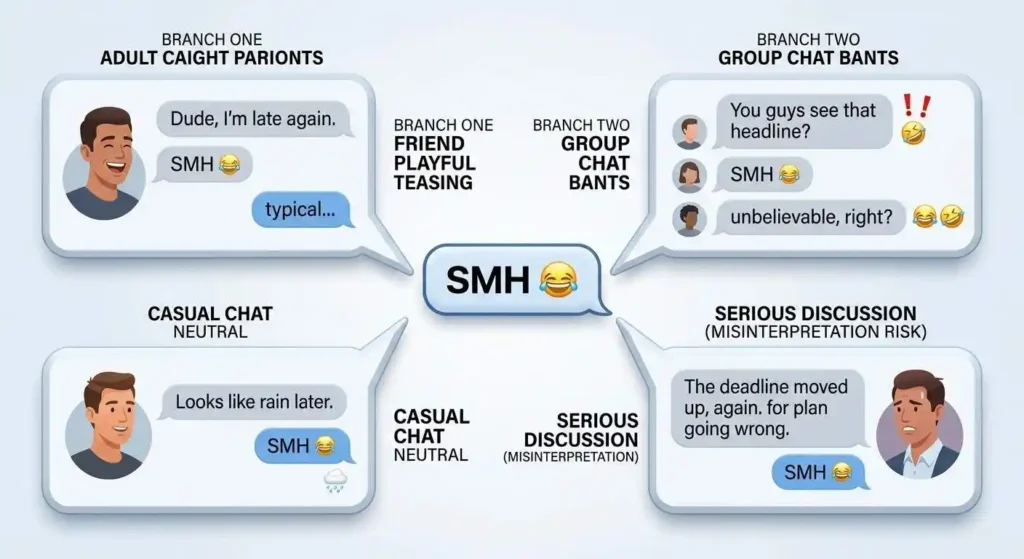
The meaning of a reaction often depends more on context than the word itself.
From a Friend
A friend saying:
“SMH 😂”
may be playfully teasing you rather than seriously criticizing you.
From a Guy
If a guy sends:
“OMG 😂”
the phrase still means surprise, excitement, or another reaction supported by the conversation. Being sent by a guy does not automatically make it romantic.
From a Girl
Likewise, a girl using “I’m dead” or “OMG” is simply reacting to something. Gender does not create a separate slang definition.
From a Crush
A reaction such as:
“Stoppp 😂”
or:
“I’m dead 😭”
can feel playful or flirty in some conversations, but the slang alone does not prove romantic interest.
In Dating or Relationships
Reaction slang can make messages feel more relaxed and expressive:
“You really remembered that? 🥹”
“Of course I did.”
“I’m dead 😂”
The relationship provides the emotional context. The slang itself is not proof of attraction, affection, or any other specific feeling.
In a Group Chat
The same term may be used more dramatically because several people are reacting together:
“BRO WHAT 😭”
“I’m actually dead 💀”
In Social Media Comments
Reaction words can work almost like a mini-review. A simple “W” can signal approval, while “big yikes” can communicate that something feels awkward or uncomfortable.
Common Types of Reaction Slang
Reaction slang covers several different emotional responses.
Laughter and Humor
These show that something is funny:
- LOL
- LMAO
- ROFL
- I’m dead
- I’m crying
- I’m weak
“I’m dead” or “I’m crying” generally refers to laughing extremely hard rather than a literal statement.
Surprise and Shock
These show that something was unexpected:
- OMG
- WHAT
- WAT
- NO WAY
- BRUH
- YO
- SHOOK
The exact intensity depends on punctuation and surrounding text.
Disbelief and Frustration
These reactions communicate that something is difficult to believe or frustrating:
- SMH
- BRUH
- COME ON
- SERIOUSLY?
- OOF
For example, SMH often works as a written reaction to an annoying, disappointing, or ridiculous situation.
Agreement and Relatability
These show that someone strongly agrees or identifies with a statement:
- IKR
- FR
- Same
- Big mood
- Real
- Mood
For example:
“I need a three-day weekend.”
“Big mood.”
The second person is saying that they strongly relate to the first statement.
Approval and Praise
These reactions communicate support or approval:
- W
- Huge W
- Fire
- Ate
- Slay
- Based
A simple “W” can act as a short positive reaction to someone’s success, decision, or achievement.
Awkwardness or Discomfort
These reactions signal that something feels uncomfortable, embarrassing, or difficult to watch:
- Yikes
- Big yikes
- Cringe
- OOF
- I can’t
“Big yikes,” for example, is used as a stronger reaction to something particularly awkward or uncomfortable.
Real Chat Examples
Here are realistic examples of reaction slang in everyday online conversations:
- A: “I accidentally sent the screenshot to him.”
B: “BRUH 😭” - A: “She actually won the whole thing.”
B: “W!”
B: “OMG.”- A: “I forgot my homework at home.”
B: “SMH 😂” - A: “This song is so good.”
B: “FR.” - A: “I could sleep for 12 hours.”
B: “Big mood.” - A: “He wore sunglasses inside the classroom.”
B: “Bruh.” - A: “Did you see that goal?”
B: “WHAT 😭” - A: “I finally passed my test!”
B: “Huge W!” - A: “That joke was actually hilarious.”
B: “I’m dead 😂” - A: “I have three exams next week.”
B: “OOF.” - A: “This is literally me every Monday.”
B: “Mood.” - A: “They canceled the event again.”
B: “Seriously?” - A: “I just tripped in front of everyone.”
B: “NOOO 😭” - A: “This outfit turned out way better than I expected.”
B: “Ate.” - A: “He said pineapple belongs on every pizza.”
B: “Big yikes.” - A: “I stayed up until 3 a.m. watching that show.”
B: “LOL same.” - A: “Look at what my dog just did.”
B: “I’m crying 😂” - A: “I finally finished the project.”
B: “W.” - A: “Why does this always happen to me?”
B: “IKR 😭”
These examples show why tone and context matter. A one-word response can be supportive, funny, sarcastic, surprised, or annoyed depending on what came before it.
How to Reply to Reaction Slang
Because reaction slang is a broad category, the best reply depends on the specific reaction.
Casual Replies
For simple reactions such as “LOL,” “BRUH,” or “OMG”:
- “I know 😂”
- “Right?”
- “Exactly!”
- “I know, wild.”
- “For real.”
Friendly Replies
If someone reacts positively:
- “Haha, glad you liked it!”
- “I knew you’d get it 😂”
- “Same!”
- “That’s what I was thinking.”
- “Exactly!”
Funny Replies
When the conversation is playful:
- “You can’t handle this level of chaos 😂”
- “Don’t act surprised.”
- “I warned you 😭”
- “And it gets worse.”
- “That’s only the beginning.”
Neutral Replies
If you are unsure about the sender’s tone:
- “What do you mean?”
- “Haha, yeah.”
- “Right, exactly.”
- “Yep.”
- “I know what you mean.”
Flirty/Relationship Replies
Only use these when the existing conversation is already romantic:
- “You’re making me laugh 😂”
- “I knew you’d react like that.”
- “You’re cute when you say that.”
- “Glad I got that reaction ❤️”
There is no need to turn an ordinary reaction into a romantic conversation if the context does not support it.
What Tone Does Reaction Slang Have?
Reaction slang is usually casual and expressive, but individual terms can carry very different tones.
Common tones include:
- Funny — “LOL,” “I’m dead”
- Surprised — “OMG,” “WHAT?”
- Disbelief — “BRUH,” “SMH”
- Supportive — “W,” “Ate”
- Relatable — “Mood,” “Big mood”
- Critical — “Yikes,” “Cringe”
- Excited — “Let’s go!”
- Sarcastic — some reactions can sound sarcastic depending on context
Punctuation, capitalization, repeated letters, and emojis can change how a reaction feels. For example, “okay”, “okayyy”, and “OKAY 😭” can communicate different emotions even though the basic word is the same.
Is Reaction Slang Rude or Offensive?
Reaction slang is not automatically rude or offensive. It depends on the specific expression and how it is directed at someone.
Generally, casual reactions work well in:
- Text messages
- Friend group chats
- Personal DMs
- Social media comments
- Casual online communities
Be more careful in:
- School assignments
- Professional emails
- Job-related messages
- Formal writing
- Serious conversations
Some reaction terms are mild, while others contain profanity or can sound insulting. Even a harmless-looking word such as “bruh” can feel dismissive in a serious conversation.
When the setting is formal, writing a complete sentence is usually clearer than relying on internet slang.
Other Meanings of Reaction Slang
Reaction Slang as a General Internet-Language Category
Reaction slang is not a specific acronym with an alternate technical expansion. It is a descriptive category for informal online expressions used to communicate reactions.
It can overlap with:
- Texting slang
- Internet slang
- Social media slang
- Meme language
- Emoji reactions
- Gaming chat language
Some terms can belong to more than one category. For example, LOL is both a texting abbreviation and a reaction expression.
Common Mistakes About Reaction Slang
Treating Reaction Slang Like One Acronym
There is no single full form for “reaction slang.” It describes a category of expressions.
Assuming Every Reaction Has One Fixed Tone
“BRUH,” “SMH,” “LOL,” and “W” can feel different depending on the situation. Context matters.
Assuming a Reaction Is Always Positive
Some reactions show approval, while others show frustration, disbelief, awkwardness, or criticism.
Assuming Slang Proves Romantic Interest
A reaction from a crush, guy, or girl does not automatically reveal romantic feelings. The broader conversation matters more than the slang itself.
Using Casual Reaction Slang in Formal Writing
Expressions such as LOL, LMAO, BRUH, and W generally belong in informal communication. They may look out of place in a school paper, formal email, or professional document.
Confusing Reaction Slang With Emojis
Emojis and reaction slang overlap, but they are not identical. An emoji is a visual symbol, while reaction slang can be a word, phrase, abbreviation, or expressive text.
Reaction Slang and Related Slang
| Term | Meaning | Common Use |
|---|---|---|
| Texting slang | Informal language used in digital messages | Casual messaging |
| Internet slang | Informal language developed or used online | Web conversations |
| Social media slang | Slang commonly used on social platforms | Comments and posts |
| Meme language | Expressions associated with online jokes and memes | Humor and reactions |
| Emoji reaction | A visual symbol used to communicate emotion or response | Messages and social posts |
| Reaction word | A short word used to express an immediate response | Texts and comments |
Reaction slang is therefore best understood as one part of the larger world of internet and texting language.
People Also Ask About Reaction Slang
What is reaction slang?
Reaction slang is informal online language used to quickly communicate a reaction or emotion. It can include abbreviations, words, phrases, emojis, and meme-style expressions.
What are examples of reaction slang?
Common examples include LOL, OMG, SMH, BRUH, OOF, IKR, W, “big mood,” “I’m dead,” and “yikes.” Each one communicates a somewhat different reaction.
What does “W” mean as a reaction?
W usually means “win” or “winning” and is used as a quick sign of approval or praise. For example, someone might comment “W” after a friend shares good news or achieves something.
What does “BRUH” mean as a reaction?
BRUH can express disbelief, frustration, surprise, disappointment, or amused confusion. The tone can range from playful among friends to dismissive in a serious conversation.
What does “SMH” mean as a reaction?
SMH stands for “shaking my head.” It is commonly used to react to something disappointing, frustrating, obvious, or difficult to believe.
Can reaction slang be used in professional messages?
Some very mild expressions may be understood, but reaction slang is generally better suited to casual communication. In professional settings, a clear sentence is usually safer and more appropriate.
Why can the same reaction slang mean different things?
Digital messages do not include the same facial expressions or voice cues as face-to-face conversations. The surrounding words, punctuation, emojis, timing, and relationship can therefore affect how a short reaction is understood.
Conclusion
Reaction slang is a broad category of informal online language used to express quick reactions, emotions, opinions, and responses. It does not have one full form because it includes many different words, abbreviations, phrases, and expressive forms.
Examples such as LOL, OMG, SMH, BRUH, OOF, IKR, W, and “big mood” can communicate laughter, surprise, disbelief, frustration, agreement, approval, or relatability.
Reaction slang is mainly suited to casual texting, DMs, group chats, comments, memes, and other informal online communication. Its exact tone depends on the expression and the surrounding context, so it is important not to read too much into one short reaction.

Writing puns and jokes for three and a half years has given Grace Collins experience working with language across varied subjects. As a writer, she covers food, animals, seasonal themes, technology, entertainment, and trending topics. Grace gathers subject-specific terms, explores word associations, and polishes joke structures to improve phrasing, punchlines, and comedic timing.