
Relationship slang is informal language used to describe dating, romantic connections, communication patterns, and relationship situations. Terms such as “situationship,” “talking stage,” “ghosting,” “breadcrumbing,” “soft launch,” and “DTR” help people describe modern relationship experiences in a few words. These terms can appear in texts, DMs, social media posts, and everyday conversations.
Key Takeaways
- Relationship slang describes dating situations, behaviors, feelings, and relationship stages.
- A situationship is a romantic connection without a clearly defined relationship label.
- The talking stage generally describes getting to know someone before becoming an official couple.
- Ghosting means suddenly ending communication without explanation.
- Breadcrumbing describes giving someone occasional attention without clearly moving the relationship forward.
- Terms such as soft launch, hard launch, DTR, red flag, and green flag are commonly used when discussing relationships online.
- Context matters because slang can have different meanings depending on the conversation.
What Is Relationship Slang?
Relationship slang is a collection of informal words and phrases used to talk about dating and romantic relationships.
Some terms describe a relationship stage, while others describe a person’s behavior or how a relationship is presented online.
For example:
- Talking stage — getting to know someone before becoming official.
- Situationship — a romantic connection without a clearly defined label.
- Ghosting — suddenly stopping communication.
- Breadcrumbing — giving occasional attention that keeps someone interested without clearly progressing the relationship.
- Soft launch — subtly showing that you may be dating someone without fully revealing their identity.
- Hard launch — publicly announcing a relationship.
These expressions are especially useful in digital communication because they can summarize complicated social situations quickly. Contemporary relationship vocabulary includes terms such as situationship, ghosting, and breadcrumbing, while newer expressions continue to appear in online dating conversations.
What Does Relationship Slang Mean in Text?
In text messages, relationship slang works as short conversational language for describing dating situations or relationship behavior.
Someone might text:
“I think we’re still in the talking stage.”
Or:
“He ghosted me after we talked every day.”
The person is using slang to describe a relationship experience without giving a long explanation.
The meaning usually becomes clear from the surrounding conversation, previous messages, and the relationship between the people involved.
What Are the Most Common Relationship Slang Terms?
Here are some of the most useful relationship terms to know:
| Term | Meaning | Common Use |
| Talking stage | Getting to know someone before becoming official | Early dating |
| Situationship | A romantic connection without a clear label | Undefined relationships |
| Ghosting | Suddenly ending communication | Dating conversations |
| Breadcrumbing | Giving occasional attention without clear progress | Uncertain dating situations |
| Orbiting | Remaining visible through social media after communication stops | Social media |
| Soft launch | Hinting at a relationship online | Instagram/social media |
| Hard launch | Publicly announcing a relationship | Social media |
| DTR | Define the relationship | Relationship conversations |
| Red flag | A concerning behavior or sign | Dating discussions |
| Green flag | A positive or reassuring quality | Dating discussions |
| Beige flag | A mildly unusual or neutral trait | Dating/social media |
| Cuffing season | A period when people may be especially interested in having a partner | Seasonal dating talk |
These terms are not all interchangeable. Each describes a different aspect of dating, communication, or relationship status.
Relationship Slang for Dating Stages
Talking Stage
The talking stage describes the period when two people are getting to know each other romantically but have not necessarily become an official couple.
It can involve texting, calls, spending time together, or going on dates.
Example:
“We’re still in the talking stage, so we’re taking things slowly.”
Situationship
A situationship describes a romantic connection that exists somewhere between casual dating and a defined relationship.
The people involved may spend time together and have romantic feelings, but the relationship does not have a clearly established label or commitment.
Example:
“We talk every day, but we’re still in a situationship.”
The term is widely used when people want to describe an undefined romantic connection.
Cuffing Season
Cuffing season is informal language for the colder months when people may talk more about finding or having a romantic partner.
Example:
“Looks like cuffing season is here.”
It is often used jokingly on social media rather than as a precise description of someone’s relationship.
Relationship Slang for Communication
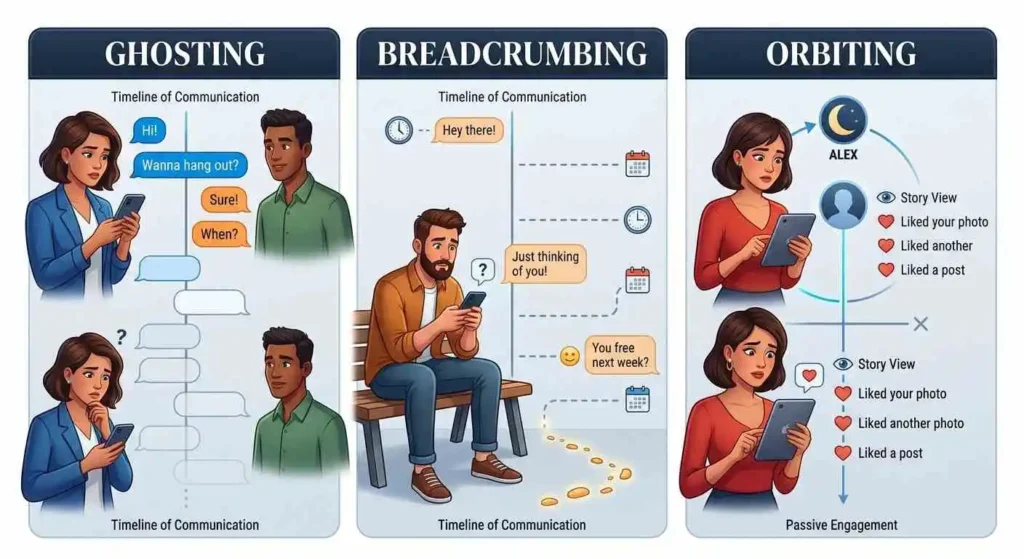
Ghosting
Ghosting means suddenly stopping communication with someone without giving a clear explanation.
Example:
“We were talking every day, then they ghosted me.”
The term can describe dating situations as well as some other social relationships.
Breadcrumbing
Breadcrumbing describes giving someone occasional attention or communication that keeps them interested without clearly moving the relationship forward.
Example:
“They message me every few days but never make actual plans. It feels like breadcrumbing.”
The important idea is the pattern of limited attention without meaningful progress, rather than one slow reply.
Orbiting
Orbiting describes a situation where someone stops directly communicating but continues interacting with or viewing another person’s social-media presence.
For example, someone might stop messaging but continue watching Stories or liking posts.
Example:
“They stopped texting me but still watch every Story. It’s basically orbiting.”
Relationship Slang for Defining the Relationship
DTR
DTR stands for “define the relationship.”
It refers to having a conversation about what two people are, what they want, and whether the relationship should become more clearly defined.
Example:
“We’ve been seeing each other for a while. Maybe it’s time to DTR.”
A DTR conversation does not automatically mean that two people must become an official couple. It simply means they are discussing the relationship and expectations.
Exclusive
Exclusive usually means two people have agreed not to date other people.
Example:
“We’re exclusive, but we haven’t announced anything online.”
The exact meaning can vary between people, which is why communication is important.
Official
When people say they are official, they generally mean they have mutually recognized the relationship as a romantic partnership.
Example:
“We finally made it official.”
Relationship Slang on Social Media
Soft Launch
A soft launch is a subtle way of suggesting that someone is in a relationship without making a full public announcement.

A person might post:
- Two coffee cups
- A photo showing another person’s hand
- A picture from a date
- A partially hidden photo of their partner
The person may choose not to reveal the partner’s identity immediately.
Hard Launch
A hard launch is a more direct public announcement of a relationship.
For example, someone might post a clear photo with their partner and explicitly identify them as their boyfriend, girlfriend, or partner.
The difference is simple:
Soft launch = subtle hint.
Hard launch = clear public announcement.
Relationship Slang for Positive and Negative Signs
Green Flag
A green flag is a positive quality or behavior that suggests a person or relationship is healthy, respectful, or compatible.
Example:
“They respect my boundaries. That’s a huge green flag.”
Red Flag
A red flag is a behavior or characteristic that may indicate a potential problem.
Example:
“Constantly ignoring boundaries would be a red flag for me.”
Calling something a red flag does not automatically prove that a relationship is unhealthy. It describes a potential concern that should be considered in context.
Beige Flag
A beige flag describes something unusual, quirky, boring, or mildly strange that is not necessarily positive or negative.
Example:
“Their beige flag is that they organize their snacks by color.”
The term is often used humorously.
Relationship Slang for Social-Media Behavior
Modern dating language often overlaps with social-media language. A relationship may be discussed through posts, Stories, comments, likes, or DMs.
Terms such as soft launch, hard launch, orbiting, and breadcrumbing can therefore describe both relationship behavior and online behavior.
For example:
“We stopped talking, but they still view every Story.”
Someone might describe that as orbiting.
However, social-media activity alone does not tell you exactly what another person feels or intends. Context matters.
How Is Relationship Slang Used in Texting?
Relationship slang appears in many forms of digital communication:
Text Messages
People use relationship terms to describe dating situations quickly.
“Are you two official yet?”
“No, we’re still in the talking stage.”
DMs
Dating and relationship slang is especially common in informal direct messages.
“Are you going to soft launch them?”
Group Chats
Friends may use relationship slang when discussing someone’s dating life.
“That sounds like a situationship.”
Social Media
Terms such as soft launch, hard launch, red flag, green flag, and beige flag often appear in captions, comments, and posts.
Real Chat Examples
Here are realistic examples of relationship slang in conversation:
- A: “Are you dating?”
B: “We’re still in the talking stage.” - A: “What are you two?”
B: “Honestly, it’s a situationship.” - A: “Why did they disappear?”
B: “I think I got ghosted.” - A: “They text every few days but never make plans.”
B: “That sounds like breadcrumbing.” - A: “They stopped texting but still watch my Stories.”
B: “That’s basically orbiting.” - A: “Are you going to post them?”
B: “Maybe a soft launch first.” - A: “Did you finally tell everyone?”
B: “Yep. Hard launch.” - A: “Should we talk about what we are?”
B: “Yeah, let’s DTR.” - A: “They always respect your boundaries.”
B: “Definitely a green flag.” - A: “They keep canceling at the last minute.”
B: “That would be a red flag for me.” - A: “What’s their weird habit?”
B: “They name every houseplant. Beige flag.” - A: “Are you exclusive?”
B: “We talked about it, and yes.” - A: “Are you two official?”
B: “Not yet.” - A: “Why is your relationship still private?”
B: “We’re not ready for a hard launch.” - A: “So what exactly are you?”
B: “We’re figuring it out.”
How to Reply to Relationship Slang
The best response depends on the exact term and the conversation.
Casual Replies
- “That makes sense.”
- “I get what you mean.”
- “Sounds like you’re figuring things out.”
- “Okay, that clears it up.”
Friendly Replies
- “Hope it works out for you.”
- “That sounds exciting.”
- “Take your time with it.”
- “You two seem happy.”
Funny Replies
- “We need a dictionary for modern dating.”
- “That’s a whole relationship vocabulary lesson.”
- “The group chat needs an explanation 😂”
Neutral Replies
When you’re unsure what someone means:
- “What do you mean by that?”
- “Do you mean you’re officially dating?”
- “Are you saying you’re in the talking stage?”
- “What does that look like for you?”
Relationship Replies
If someone uses a relationship term to describe your situation, it is often better to ask what they mean rather than assuming.
For example:
“When you say we’re exclusive, what does that mean to you?”
Clear communication is more reliable than trying to decode every slang term.
Context & Relationship Meaning
Relationship slang can sound different depending on who says it, where it appears, and what happened before the message.
From a Guy
A guy using a relationship term does not automatically give the term a different meaning.
For example:
“We’re in the talking stage.”
has the same basic meaning regardless of who says it.
From a Girl
The same principle applies when a girl uses relationship slang. The meaning comes from the term and the surrounding context, not gender.
From a Friend
Friends often use relationship slang when discussing someone else’s dating life.
“Girl, that’s a situationship.”
The statement may be casual commentary rather than a precise description.
From a Crush
If a crush uses relationship slang, don’t assume the term itself proves romantic interest.
For example, someone asking:
“Are you seeing anyone?”
may simply be asking about your dating status. The broader conversation provides the important clues.
In Dating
Relationship slang can make complicated situations easier to describe, but labels are not always exact.
Two people may use the same word differently, especially when discussing exclusive dating, commitment, or relationship status.
What Tone Does Relationship Slang Have?
Relationship slang is generally casual and conversational.
Depending on the term, it can sound:
- Playful
- Humorous
- Curious
- Critical
- Supportive
- Informal
- Self-aware
For example, beige flag is often humorous, while red flag can be more serious.
The same word can also sound different depending on punctuation and surrounding language.
Compare:
“That’s a red flag.”
with:
“Lol that’s such a red flag 😂”
The second sounds more playful, even though the basic expression is the same.
Is Relationship Slang Rude or Offensive?
Most common relationship slang is informal rather than inherently rude.
However, some terms can sound judgmental when they are used to label another person’s behavior.
For example, calling someone a red flag may feel critical.
Similarly, telling someone:
“You’re breadcrumbing them.”
can sound accusatory.
In formal situations, standard language is usually clearer than slang.
For school, work, or professional communication, it is better to explain the situation directly instead of assuming everyone understands relationship slang.
Who Uses Relationship Slang?
Relationship slang is widely encountered in online conversations, social media, dating discussions, and everyday informal speech.
However, it is not accurate to assume that every relationship term belongs exclusively to one generation.
Some expressions become popular through social media and digital culture, while others become common enough to appear in broader everyday conversation. Research and current dating glossaries continue to document terms such as situationship, ghosting, breadcrumbing, and other relationship expressions.
Relationship Slang vs. Similar Terms
| Term | Meaning | Difference |
| Talking stage | Getting to know someone romantically | Usually describes an early stage |
| Situationship | Romantic connection without a clear label | Focuses on an undefined relationship |
| Official | Clearly recognized romantic relationship | Indicates a defined relationship |
| Exclusive | Agreement to date only each other | Focuses on dating boundaries |
| DTR | Define the relationship | Describes the conversation about relationship status |
These terms can overlap, but they are not identical.
For example, two people can be in the talking stage without being in a situationship. Likewise, a couple can be exclusive without having publicly announced their relationship.
Common Mistakes About Relationship Slang
Assuming every term has one exact definition
Slang changes depending on context and community. A word can have a broad meaning rather than one strict definition.
Treating slang as proof of someone’s feelings
A label such as situationship or talking stage does not reveal everything about what two people feel.
Assuming social-media behavior explains a relationship
A Story view, like, or post can have multiple explanations. Online activity alone does not prove someone’s romantic intentions.
Confusing relationship stages
The talking stage, exclusivity, and being official describe different ideas. They should not automatically be treated as synonyms.
Assuming slang replaces communication
Relationship terms can describe situations, but they cannot replace an honest conversation about expectations, boundaries, and feelings.
Related Relationship Slang
| Term | Meaning | Common Use |
| Talking stage | Early romantic getting-to-know-you period | Dating |
| Situationship | Undefined romantic connection | Dating |
| Ghosting | Suddenly ending communication | Communication |
| Breadcrumbing | Occasional attention without clear progress | Dating behavior |
| Orbiting | Staying visible on social media without direct communication | Social media |
| Soft launch | Subtle relationship reveal | Social media |
| Hard launch | Public relationship announcement | Social media |
| DTR | Define the relationship | Relationship conversations |
| Red flag | Potential warning sign | Dating |
| Green flag | Positive relationship quality | Dating |
| Beige flag | Quirky or neutral trait | Dating/social media |
Real-World Conversation
Imagine two friends discussing a new relationship:
Friend 1: “So, are you two official?”
Friend 2: “Not really. We’re still in the talking stage.”
Friend 1: “Do you think it’s becoming a situationship?”
Friend 2: “Maybe. We haven’t talked about what we want yet.”
Friend 1: “Then maybe it’s time to DTR.”
Here, each term describes a different part of the situation: the talking stage describes where the connection is, situationship describes uncertainty about the relationship, and DTR describes the conversation that could clarify it.
People Also Ask
What is the most common relationship slang?
Common relationship slang includes terms such as talking stage, situationship, ghosting, breadcrumbing, soft launch, hard launch, red flag, and green flag. Their exact popularity can change over time and across platforms.
What is a situationship?
A situationship is a romantic connection that does not have a clearly defined relationship label or commitment. It generally describes something more involved than ordinary friendship but less clearly defined than an official relationship.
What does talking stage mean?
The talking stage is the period when two people are getting to know each other romantically before deciding whether to become an official couple. It may involve texting, calls, dates, or spending time together.
What does ghosting mean in a relationship?
Ghosting means suddenly stopping communication with someone without providing an explanation. The term is commonly used when discussing dating and online communication.
What does breadcrumbing mean in dating?
Breadcrumbing refers to giving someone occasional attention or communication without clearly moving the relationship forward. The pattern, rather than one isolated message, is what makes the term relevant.
What does soft launch mean in a relationship?
A soft launch is a subtle way of showing or hinting that you are dating someone online without making a full public announcement.
What does hard launch mean in dating?
A hard launch is a clear public announcement of a romantic relationship, often through a social-media post or photo.
What does DTR mean in relationships?
DTR means “define the relationship.” It refers to a conversation about relationship status, expectations, or what each person wants.
Conclusion
Relationship slang gives people quick ways to describe dating stages, communication patterns, relationship behavior, and social-media announcements.
Terms such as talking stage, situationship, ghosting, breadcrumbing, soft launch, hard launch, DTR, red flag, and green flag each describe a different idea.
The most important thing is context. Slang can help describe a relationship, but it does not automatically reveal someone’s feelings, intentions, or level of commitment. When a term is unclear, asking the person directly is usually more reliable than guessing.

Emma Brooks is a writer whose work centers on puns, jokes, and topic-specific wordplay. Across four and a half years of experience, she has covered subjects involving food, animals, seasonal occasions, technology, entertainment, and trending topics. Emma identifies useful terms, tests different joke angles, and revises setups and punchlines to strengthen wording and comedic delivery.