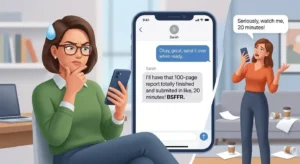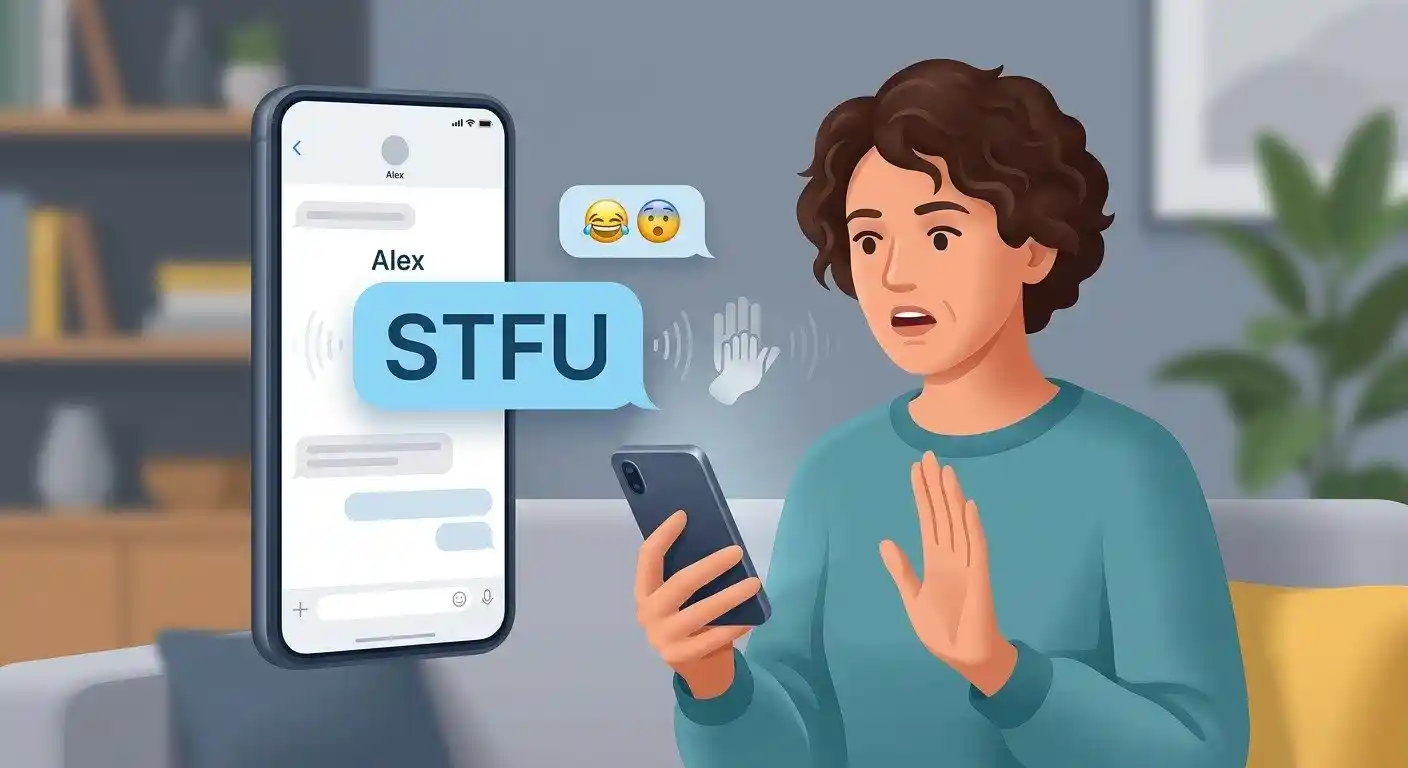
STFU in text means “Shut the f* up.”** It is a vulgar internet-slang abbreviation used to tell someone to stop talking or be quiet. Depending on context, close friends may also use it jokingly to express surprise, disbelief, or amusement.
Key Takeaways
- STFU stands for “Shut the f* up.”**
- It is a texting abbreviation and internet slang used mainly in informal communication.
- Its literal meaning is a strong way of telling someone to stop talking or be quiet.
- Friends may sometimes use STFU playfully to express shock, disbelief, or excitement rather than literally demanding silence.
- The abbreviation contains profanity, so it can sound rude, aggressive, or offensive depending on the situation.
- STFU is not appropriate for most professional or formal communication.
STFU Meaning in Text
The main STFU meaning in text is “Shut the f* up.”**
It is a strong, informal expression telling someone to stop talking, stop commenting, or be quiet. Because it contains profanity, STFU is considerably harsher than simply saying “be quiet.”
In online communication, however, the phrase does not always function as a literal command. Close friends sometimes use “STFU!” as a dramatic reaction to surprising or exciting news.
For example:
“STFU! You actually got tickets?”
Here, the sender may not be asking the person to become silent. Instead, STFU can communicate something closer to “No way!” or “You’re kidding!”
That distinction comes from context. The same abbreviation can be playful in one conversation and genuinely insulting in another.
What Does STFU Stand For?
STFU stands for “Shut the f* up.”**
The letters represent:
| Letter | Word |
|---|---|
| S | Shut |
| T | The |
| F | F*** |
| U | Up |
STFU is an initialism, meaning it is formed from the initial letters of a phrase and is normally read letter by letter.
You may see it written as STFU, stfu, or occasionally with periods such as S.T.F.U. Capitalization does not normally change the meaning.
How Is STFU Used?
STFU is mainly found in casual and informal digital communication.
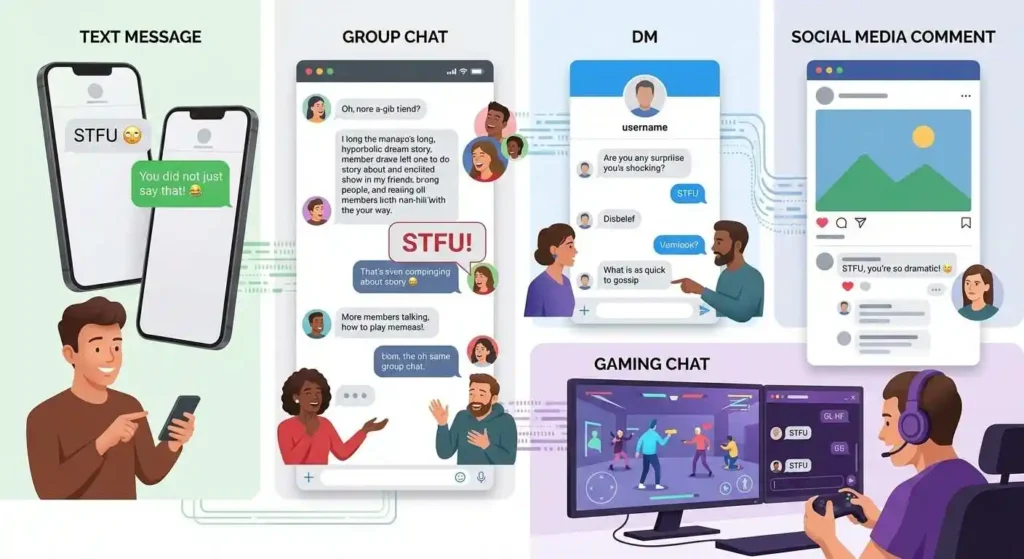
Text Messages
Someone might send STFU when they are genuinely annoyed:
“STFU and let me finish.”
In this situation, the meaning is direct and confrontational.
DMs
Friends may use it more playfully:
“STFU 😂 You actually did that?”
The surrounding emoji and relationship can make the message feel more like teasing.
Group Chats
STFU can appear as a quick reaction:
“STFU, no way 😭”
Here, it may communicate disbelief rather than a literal request for silence.
Social Media Comments
People may use STFU in comments or replies when they strongly disagree with, react to, or mock something someone has posted. It remains vulgar and informal, even when used jokingly.
Gaming Chats
STFU can also appear in fast-paced online conversations, particularly when players are arguing or teasing each other. In a heated exchange, it is more likely to sound aggressive than playful.
STFU in Different Contexts
The basic meaning stays the same, but context can completely change how the message feels.
From a Friend
If a close friend says:
“STFU 😂 I can’t believe you actually won.”
they may be expressing surprise or excitement rather than telling you to stop talking.
Among friends who regularly joke this way, the phrase can be playful.
From a Guy
If a guy sends STFU, it still means “Shut the f* up.”** Gender does not create a separate definition.
Whether he is joking, annoyed, or being disrespectful depends on the surrounding conversation.
From a Girl
The same applies when a girl uses STFU. The abbreviation itself does not become softer or harsher because of the sender’s gender.
From a Crush
If someone you like sends:
“STFU 😂”
after you share surprising news, it could be playful disbelief.
However, STFU alone does not prove flirting or romantic interest. Look at the rest of the conversation, your relationship, punctuation, emojis, and the situation.
In Dating
STFU can appear during playful teasing or an argument.
For example:
“You really think I’m going to believe that? STFU 😂”
With a close relationship and playful context, this might be teasing. During a serious disagreement, the same phrase can feel insulting.
In a Group Chat
In group conversations, STFU may be used as a dramatic reaction:
“STFU 😭 You met your favorite actor?”
In this type of message, it can function like “No way!”
In Social Media Comments
STFU may be used as a blunt response to a post, opinion, joke, or comment. Because readers cannot hear the sender’s voice, it can be difficult to tell whether it is playful or hostile without additional context.
Real Chat Examples
Here are realistic examples showing different uses of STFU:
- A: “You know I can finish this whole project in ten minutes.”
B: “STFU 😂” - A: “I actually won the contest!”
B: “STFU! Seriously?” - A: “I ate the last slice.”
B: “STFU 😭” - A: “He says he didn’t see your message.”
B: “STFU, his phone was right there.” - A: “I just got tickets to the concert.”
B: “STFU! No way!” - A: “I’m going to wake up at 5 every morning.”
B: “STFU 😂 You said that yesterday.” - A: “This is the easiest test ever.”
B: “STFU, don’t jinx it.” - A: “I finished the entire season last night.”
B: “STFU 😭 You were supposed to wait!” - A: “I forgot my homework again.”
B: “STFU 💀” - A: “I can beat you at this game.”
B: “STFU and prove it.” - A: “Guess who I ran into today?”
B: “STFU. Who?” - A: “I accidentally sent the screenshot to the person we were talking about.”
B: “STFU 😭” - A: “I’m not nervous at all.”
B: “STFU, you look terrified.” - A: “I just found twenty dollars in my old jacket.”
B: “STFU 😂 That’s lucky.” - A: “I finally finished the assignment.”
B: “STFU, already?” - A: “He said pineapple pizza is his favorite.”
B: “STFU 😂” - A: “Can you stop interrupting me?”
B: “STFU and listen to me.” - A: “I got the job!”
B: “STFU! That’s amazing!” - A: “I’m definitely going to bed early tonight.”
B: “STFU 😂 We both know that’s not happening.” - A: “You seriously believe that?”
B: “STFU.”
These examples show an important difference: STFU can be a literal command or an exaggerated reaction. The conversation determines which interpretation makes sense.
How to Reply to STFU
Your best response depends on whether the sender appears to be joking or genuinely upset.
Casual Replies
If the message seems playful:
- “LOL okay 😂”
- “I’m being serious!”
- “You know I’m right.”
- “Fine, fine.”
- “Okay, you got me.”
Friendly Replies
If a friend is teasing you:
- “You’re so dramatic 😂”
- “I knew you’d say that.”
- “Okay, fair.”
- “I was just joking.”
- “You really had to say that? 😂”
Funny Replies
If the conversation is clearly joking:
- “Make me 😂”
- “Nope, I have more to say.”
- “You’ll have to keep listening.”
- “That sounds like a you problem.”
- “I refuse 😭”
Neutral Replies
If you are unsure whether the sender is serious:
- “Are you joking?”
- “What happened?”
- “I was just saying.”
- “Okay, I’ll give you a second.”
- “Did I upset you?”
If someone seems genuinely angry, a calm response is usually better than escalating the conversation.
Flirty/Relationship Replies
Only use a playful response like these when the relationship already has that tone:
- “You love hearing me talk 😂”
- “You’re cute when you’re dramatic.”
- “You don’t really want me to stop.”
- “Okay, okay 😂”
STFU itself does not automatically create a romantic meaning.
What Tone Does STFU Have?
STFU has a strong, direct, and informal tone.
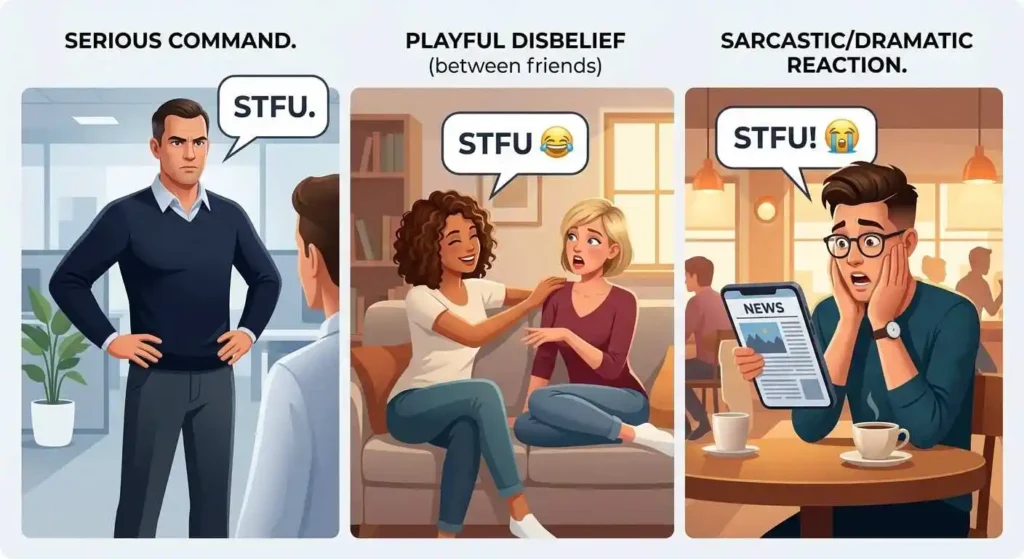
Depending on context, it can be:
- Aggressive
- Blunt
- Annoyed
- Playful
- Sarcastic
- Disbelieving
- Teasing
- Confrontational
The literal phrase is rude because it tells someone to stop talking using profanity. But friends sometimes use it in a joking way to express surprise or disbelief.
Compare:
“STFU.”
This can sound like a serious command.
With:
“STFU 😂 You actually did it?”
The emoji and question make a playful interpretation much more likely.
Is STFU Rude or Offensive?
Yes, STFU can be rude or offensive. The full expression contains profanity and directly tells another person to stop talking.
It may be acceptable in some:
- Casual conversations between close friends
- Private jokes
- Informal group chats
- Meme-style conversations
It is generally inappropriate for:
- School assignments
- Messages to teachers
- Workplace communication
- Professional emails
- Formal writing
- Conversations with people you do not know well
Even when abbreviated, STFU still carries the meaning and force of the full phrase.
If you want to tell someone to stop talking without using profanity, softer choices include “please be quiet,” “hold on,” “let me finish,” or “can we pause for a second?”
Other Meanings of STFU
STFU in Gaming
In gaming slang, STFU normally has the same meaning: “Shut the f* up.”** It may be used during arguments, teasing, or reactions in game chats.
STFU as a Title or Name
STFU can also appear as an unrelated acronym or title in specialized contexts. For example, Slang.net lists Super Time Force Ultra, a video game, as another meaning. This is not the normal interpretation when someone sends STFU in an ordinary text message.
Common Mistakes About STFU
Confusing STFU With STHU
These are similar but not identical:
- STFU = Shut the f*** up
- STHU = Shut the hell up
STFU contains stronger profanity.
Assuming STFU Is Always Serious
Friends may use it jokingly to express shock, excitement, or disbelief.
Assuming It Is Always a Joke
The opposite mistake is also possible. If someone sends STFU during an argument, they may genuinely be telling you to stop talking.
Assuming STFU Means “I Hate You”
STFU is a strong expression, but it does not automatically mean hatred. The sender could be annoyed, joking, surprised, or reacting dramatically.
Assuming It Is Romantic
STFU does not inherently mean flirting or affection. Relationship context can affect the tone, but the abbreviation itself has no romantic definition.
Using STFU in Formal Communication
Because it contains profanity and can sound hostile, STFU is a poor choice for professional, academic, or formal communication.
STFU and Related Slang
| Term | Meaning | Common Use |
|---|---|---|
| STFU | Shut the f*** up | Strong demand for silence or dramatic reaction |
| STHU | Shut the hell up | Similar but less profane |
| STFD | Shut the f*** down | Telling someone to stop or end something |
| BFFR | Be f***ing for real | Challenging an unbelievable or unrealistic statement |
| SMH | Shaking my head | Disbelief or disappointment |
| BRUH | Informal reaction to something surprising or ridiculous | Disbelief, frustration, or humor |
| WTF | What the f*** | Strong surprise, confusion, or disbelief |
People Also Ask About STFU
What does STFU mean in texting?
STFU means “Shut the f* up.”** It is an informal and vulgar expression telling someone to stop talking or be quiet. In some friendly conversations, it can instead be used as an exaggerated reaction to surprising news.
Is STFU a bad word?
STFU is considered vulgar slang because its full form contains profanity. Even when someone uses it jokingly, it is still much stronger than a polite request to be quiet.
What does STFU mean from a girl?
From a girl, STFU normally means “Shut the f* up.”** Whether she is joking, annoyed, or reacting with disbelief depends on the conversation and relationship, not her gender.
What does STFU mean from a guy?
From a guy, STFU has the same basic meaning. It can be serious or playful depending on the context, punctuation, emojis, and what was said immediately before it.
Is STFU always rude?
No, but it is always informal and potentially rude. Close friends may use it jokingly, while the same phrase from a stranger or during an argument can be clearly disrespectful.
What is the difference between STFU and STHU?
STFU means “Shut the f*** up,” while STHU means “Shut the hell up.” Both tell someone to be quiet, but STFU contains stronger profanity.
What does STFU mean on social media?
On social media, STFU can be a literal command to stop talking or a dramatic reaction meaning something like “No way!” or “You’re kidding!” Context determines which interpretation fits.
Conclusion
STFU means “Shut the f* up”** and is a vulgar texting and internet-slang abbreviation used to tell someone to stop talking or be quiet.
Its tone can range from serious and aggressive to playful and sarcastic. Close friends may use it as an exaggerated reaction to surprising or exciting news, while the same abbreviation can sound genuinely insulting during an argument.
STFU is best kept within informal conversations where the people involved understand each other’s communication style. Because it contains profanity and can be confrontational, it is not suitable for most school, workplace, professional, or formal situations.
The key is context: STFU does not automatically mean anger, hatred, or romance. The surrounding conversation, relationship, punctuation, and emojis provide the clues needed to understand what the sender actually meant.

Writing puns and jokes for three and a half years has given Grace Collins experience working with language across varied subjects. As a writer, she covers food, animals, seasonal themes, technology, entertainment, and trending topics. Grace gathers subject-specific terms, explores word associations, and polishes joke structures to improve phrasing, punchlines, and comedic timing.