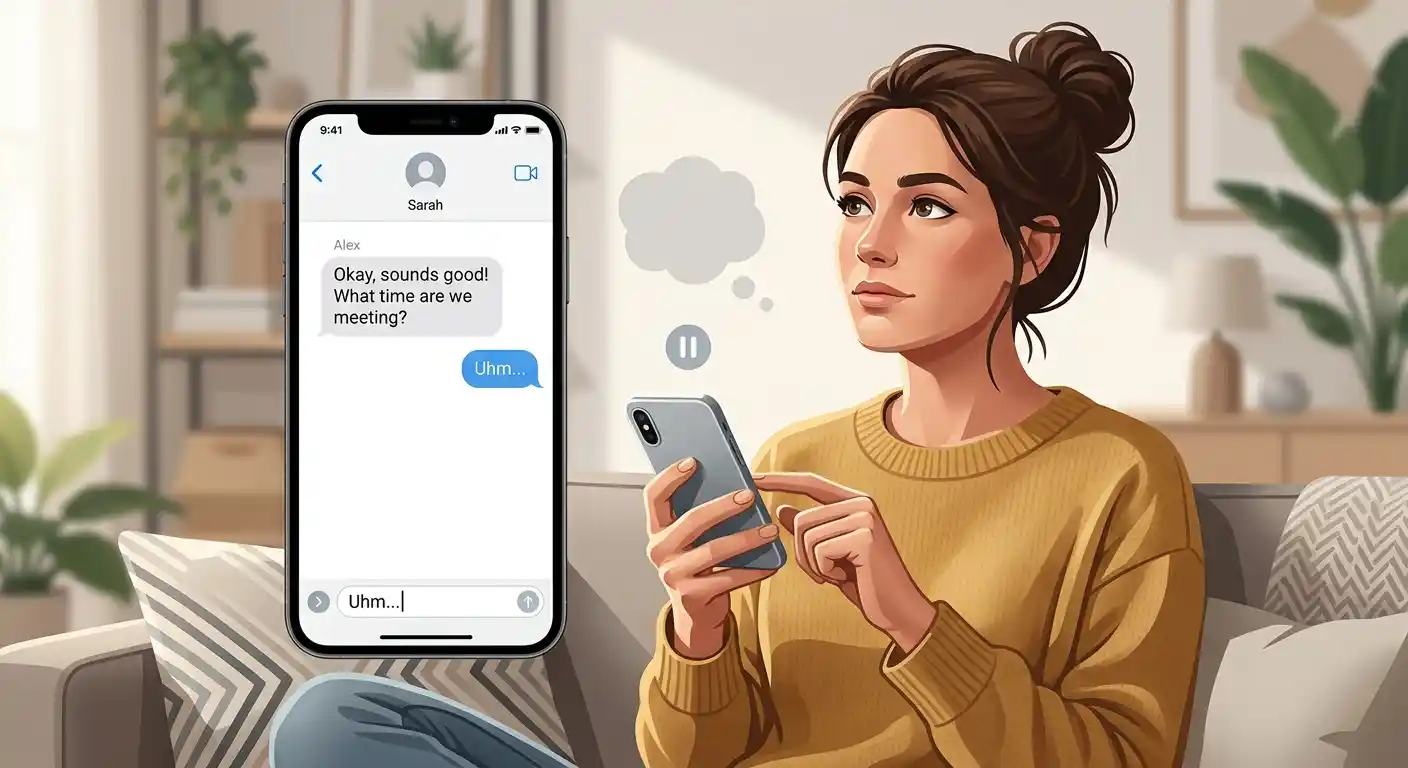
UHM in text is a hesitation sound, similar to “um” or “uhm.” It usually shows that someone is thinking, unsure, confused, surprised, or pausing before responding. It is not normally an acronym or abbreviation with a fixed full form.
Key Takeaways
- UHM is a written hesitation sound, not usually an acronym.
- It can mean “I’m thinking,” “I’m not sure,” or “Give me a second.”
- Depending on context, it can also express confusion, awkwardness, doubt, or surprise.
- Punctuation and spelling can change the feeling: “uhm…” may sound hesitant, while “UHM?!” can show surprise.
- It is mainly suited to casual texting and online conversations, rather than formal writing.
- Uhm does not automatically signal flirting or romantic interest when sent by a guy, girl, friend, or crush.
UHM Meaning in Text
In texting, uhm is an informal filler word or interjection that represents the pause people make when speaking. It is similar to saying “um” or “uh” while deciding what to say next.
The most common meanings include:
- Thinking: “Let me think.”
- Hesitation: “I’m not sure.”
- Uncertainty: “I don’t know what to say.”
- Confusion: “Wait, what do you mean?”
- Awkwardness: “That feels a little uncomfortable.”
- Surprise: “I wasn’t expecting that.”
- Soft disagreement: “I’m not sure I agree.”
For example:
“Uhm, I don’t know if that’s a good idea.”
Here, uhm gives the sender a moment to think and makes the response sound less immediate.
Unlike abbreviations such as LOL or BRB, uhm does not have a fixed expansion. It is simply a written representation of a sound used in natural conversation.
What Does UHM Stand For?
UHM does not stand for a phrase. It is not normally an acronym.
Instead, uhm is an alternative spelling of “um,” a conversational interjection used to express hesitation, doubt, deliberation, or interest.
So if someone asks:
“What is the full form of UHM?”
The simplest answer is: there is no official full form.
It functions more like a written speech sound than a texting abbreviation.
You may also see similar spellings such as:
- um
- umm
- uhm
- uhmm
- uhmmm
There is no strict texting rule that gives each spelling a completely different definition. Usually, extra letters or punctuation are used to make the pause feel longer or more expressive.
How Is UHM Used?
In Text Messages
Someone may type uhm before answering a question when they need a moment to think.
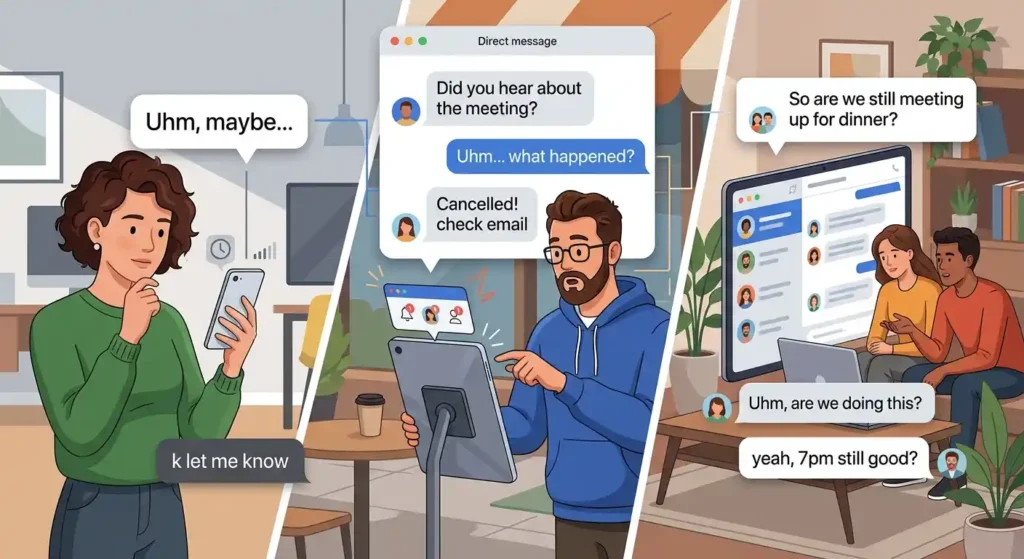
“Do you want to go with us?”
“Uhm, maybe. Let me check.”
Here, it suggests hesitation or consideration.
In DMs
In a direct message, uhm can introduce a reaction to something unexpected.
“Uhm… what just happened?”
The sender may be confused or surprised.
In Group Chats
A person might use it when a group conversation suddenly becomes awkward.
“Uhm, are we seriously doing this?”
The exact tone depends on the messages around it.
On Social Media
In comments or replies, uhm can act as a quick reaction.
“Uhm… that was unexpected.”
It may communicate surprise, doubt, or mild confusion without requiring a longer explanation.
In Casual Online Conversation
Because uhm resembles a sound from spoken conversation, it can make a message feel more like natural speech. It helps communicate a pause that would normally be heard through someone’s voice.
UHM in Different Contexts
The meaning of uhm can shift depending on what comes before and after it. The word itself does not provide enough information to determine someone’s exact feelings.
From a Friend
A friend saying:
“Uhm, I’m not sure.”
usually sounds like hesitation or uncertainty.
From a Guy
If a guy texts “uhm…”, it could mean he is thinking, unsure how to respond, confused, or reacting to something unexpected.
The fact that he is a guy does not give uhm a special meaning.
From a Girl
A girl using “uhm” may similarly be hesitating, thinking, questioning something, or reacting to an awkward situation.
Gender does not automatically change the meaning.
From a Crush
If your crush sends “uhm…”, it is easy to overthink it. However, uhm alone does not prove flirting, attraction, rejection, or romantic interest.
Look at the whole conversation, including the topic, wording, punctuation, and previous messages.
In Dating Conversations
In a dating-related chat, “uhm…” could indicate uncertainty or that someone is carefully choosing their words.
For example:
“Do you want to meet this weekend?”
“Uhm… maybe Saturday?”
This sounds more like consideration than a definite yes or no.
In a Group Chat
In a group conversation, “uhm?” may signal confusion or ask others to explain what is happening.
In Social Media Comments
A comment such as “UHM?!” can be a dramatic reaction to something surprising or unexpected.
Punctuation and Spelling Matter
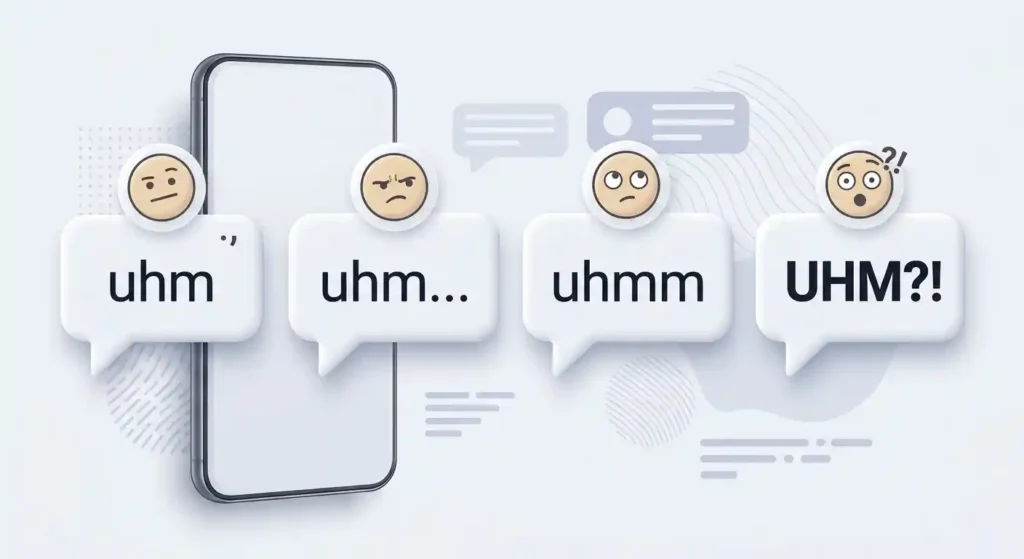
Compare these:
- “uhm” — simple hesitation
- “uhm…” — longer pause or uncertainty
- “uhmm” — may suggest a more noticeable hesitation
- “uhmmm…” — can emphasize a long pause or discomfort
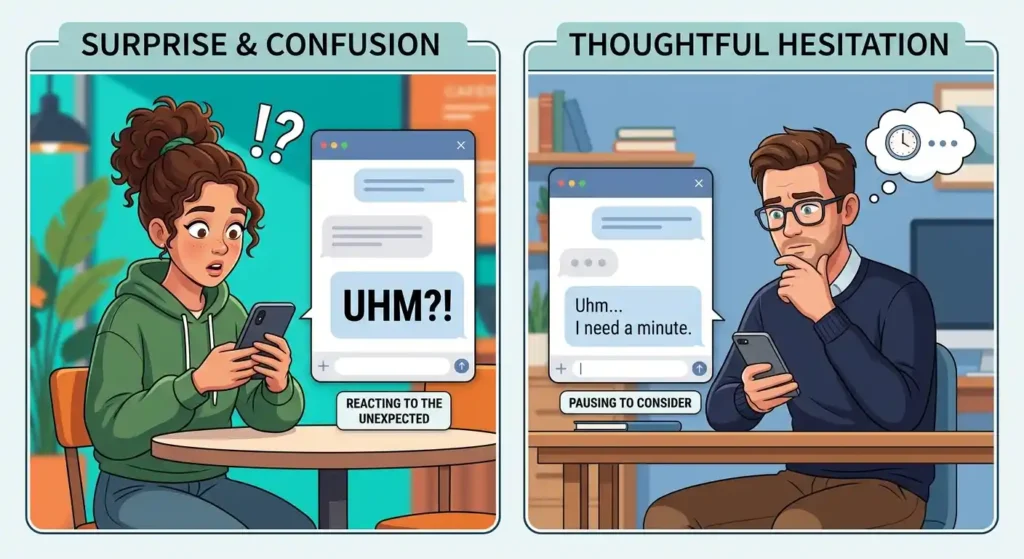
- “UHM?!” — stronger surprise, confusion, or disbelief
These are informal style choices, not strict definitions. Context remains more important than the number of letters.
Real Chat Examples
Here are natural ways uhm can appear in everyday messaging:
- A: “Are you coming tonight?”
B: “Uhm, I think so.” - A: “Did you finish the assignment?”
B: “Uhm… not exactly.” - A: “I think we should leave now.”
B: “Uhm, why?” - A: “Guess what I bought.”
B: “Uhm… what?” - A: “You remember that thing I told you?”
B: “Uhm, kind of.” - A: “Would you eat this?”
B: “Uhm, probably not 😂” - A: “I accidentally sent it to the wrong person.”
B: “UHM WHAT?!” - A: “Can we talk later?”
B: “Uhm… sure.” - A: “I think this is the right answer.”
B: “Uhm, are you sure?” - A: “Want to come with us?”
B: “Uhm, let me ask my parents.” - A: “I have something to tell you.”
B: “Uhm… okay?” - A: “That movie was amazing.”
B: “Uhm, I actually didn’t like it.” - A: “You said you weren’t going to buy anything.”
B: “Uhm… about that.” - A: “Did you just say you hate pizza?”
B: “Uhm, yes?” - A: “I have an idea.”
B: “Uhm, should I be worried?” - A: “We’re doing a presentation tomorrow.”
B: “Uhm, tomorrow?!” - A: “Can you explain that again?”
B: “Uhm, sure.” - A: “You seriously did that?”
B: “Uhm… maybe.” - A: “So, what do you think?”
B: “Uhm, I need a minute.” - A: “Everything okay?”
B: “Uhm… yeah, I think so.”
How to Reply to UHM
Your best reply depends on what the sender appears to be communicating.
Casual Replies
- “What’s up?”
- “Haha, what?”
- “Take your time.”
- “What are you thinking?”
- “You okay?”
Friendly Replies
- “No rush, think about it.”
- “Haha, I know what you mean.”
- “Want me to explain?”
- “What happened?”
- “Tell me what you’re thinking.”
Funny Replies
- “That ‘uhm’ sounds suspicious 😂”
- “I’m listening… 👀”
- “Uh-oh, what did I say?”
- “That pause was LOUD 😂”
Neutral Replies
- “What do you mean?”
- “Could you clarify?”
- “Take a moment.”
- “Is something wrong?”
- “What are you unsure about?”
Flirty/Relationship Replies
If the conversation is already clearly romantic, you can keep the response light without assuming what uhm means:
- “That sounded like a very serious uhm 😄”
- “Take your time.”
- “What are you thinking?”
- “Okay, now I’m curious.”
What Tone Does UHM Have?
Uhm is highly context-dependent. It does not have one fixed emotional tone.
It can sound:
- Neutral when someone is simply thinking
- Hesitant when someone is unsure
- Curious when asking for clarification
- Confused when something does not make sense
- Awkward when the conversation feels uncomfortable
- Playful when used dramatically
- Skeptical when questioning someone’s statement
- Surprised when combined with stronger punctuation
For example:
“Uhm, let me think.”
This sounds thoughtful.
“Uhm… okay.”
This could sound uncertain or slightly awkward.
“UHM?!”
This is much more likely to communicate surprise or disbelief.
Because text does not carry voice tone or facial expressions, punctuation and surrounding words can help clarify the intended feeling.
Is UHM Rude or Offensive?
Uhm is not inherently rude or offensive. It is a normal informal expression used to represent hesitation or a conversational pause.
However, it can sound dismissive, skeptical, or annoyed in certain situations.
For casual conversations, texting, DMs, and social media, it is generally fine.
For school or work communication, a message containing uhm may sound too casual depending on the situation. In formal writing, it is better to state the thought directly.
For example:
Casual:
“Uhm, I’m not sure.”
More professional:
“I’m not sure about that yet.”
The issue is usually tone and formality, not offensiveness.
Common Mistakes About UHM
Mistake 1: Assuming UHM Is an Acronym
It usually is not. Uhm is a written hesitation sound, not a phrase whose letters represent separate words.
Mistake 2: Assuming It Always Means Confusion
Uhm can indicate confusion, but it can also simply mean someone is thinking or hesitating.
Mistake 3: Assuming It Means Someone Is Mad
A short “uhm” does not automatically mean anger. The surrounding conversation matters.
Mistake 4: Assuming It Means Flirting
If someone you like sends “uhm,” don’t treat the word alone as proof of romantic interest.
Mistake 5: Treating Every Spelling as a Different Slang Term
“Um,” “umm,” “uhm,” and “uhmm” are generally variations of the same conversational idea. Extra letters may change the emphasis, but there is no universal rule for interpreting them.
Mistake 6: Ignoring Punctuation
“uhm” and “UHM?!” can feel very different because capitalization and punctuation add emotional emphasis.
UHM and Related Slang
| Term | Meaning | Common Use |
|---|---|---|
| Um | Hesitation or thinking | Spoken and written conversation |
| Umm | Extended hesitation | Casual texting |
| Hmm | Thinking, uncertainty, or consideration | Texts and chats |
| Uh | Hesitation or uncertainty | Casual conversation |
| IDK | I don’t know | Texting and DMs |
| HUH | Confusion or request for clarification | Texts and comments |
Uhm is closest to um, umm, and uh because they represent similar speech pauses. Hmm can overlap with uhm but often places more emphasis on thinking or consideration.
People Also Ask About UHM
What does uhm mean in texting?
Uhm usually represents a hesitation sound, similar to “um.” It can show that someone is thinking, unsure, confused, surprised, or deciding how to respond.
Is uhm an acronym?
No. Uhm is not normally an acronym and does not have an official full form. It is a written representation of a natural speech sound.
What is the difference between um and uhm?
There is generally no major difference in meaning. Both can represent hesitation or a pause, while “uhm” is simply one spelling variation of the same type of speech sound.
What does uhm mean from a girl?
It generally has the same basic meaning from a girl: hesitation, thinking, uncertainty, confusion, or a reaction. The sender’s gender does not automatically change the meaning.
What does uhm mean from a guy?
A guy using uhm may be thinking, unsure what to say, reacting to something unexpected, or hesitating before answering. The surrounding conversation is more useful than gender for interpreting it.
Does uhm mean someone is confused?
Sometimes. Uhm can signal confusion, especially in messages such as “uhm, what?” But it can also simply indicate a pause or uncertainty.
Does uhm mean someone is mad?
Not necessarily. A message such as “uhm…” might sound uncomfortable or skeptical, but you need the surrounding conversation to determine whether the sender is actually upset.
What does uhm with dots mean?
“Uhm…” usually emphasizes a pause or hesitation. Depending on the conversation, it can suggest uncertainty, awkwardness, doubt, or that the sender is carefully choosing what to say.
Conclusion
UHM in text means a hesitation or pause, similar to the spoken word “um.” It is not normally an acronym and has no official full form. People use it in casual messages to show thinking, uncertainty, confusion, awkwardness, surprise, or mild doubt.
Its tone depends heavily on context, punctuation, capitalization, and the surrounding conversation. While it is natural in texting and social media, it is usually too informal for formal writing. Most importantly, don’t assume that “uhm” automatically means someone is angry, flirting, or interested—the conversation itself provides the real context.

Writing puns and jokes for three and a half years has given Grace Collins experience working with language across varied subjects. As a writer, she covers food, animals, seasonal themes, technology, entertainment, and trending topics. Grace gathers subject-specific terms, explores word associations, and polishes joke structures to improve phrasing, punchlines, and comedic timing.