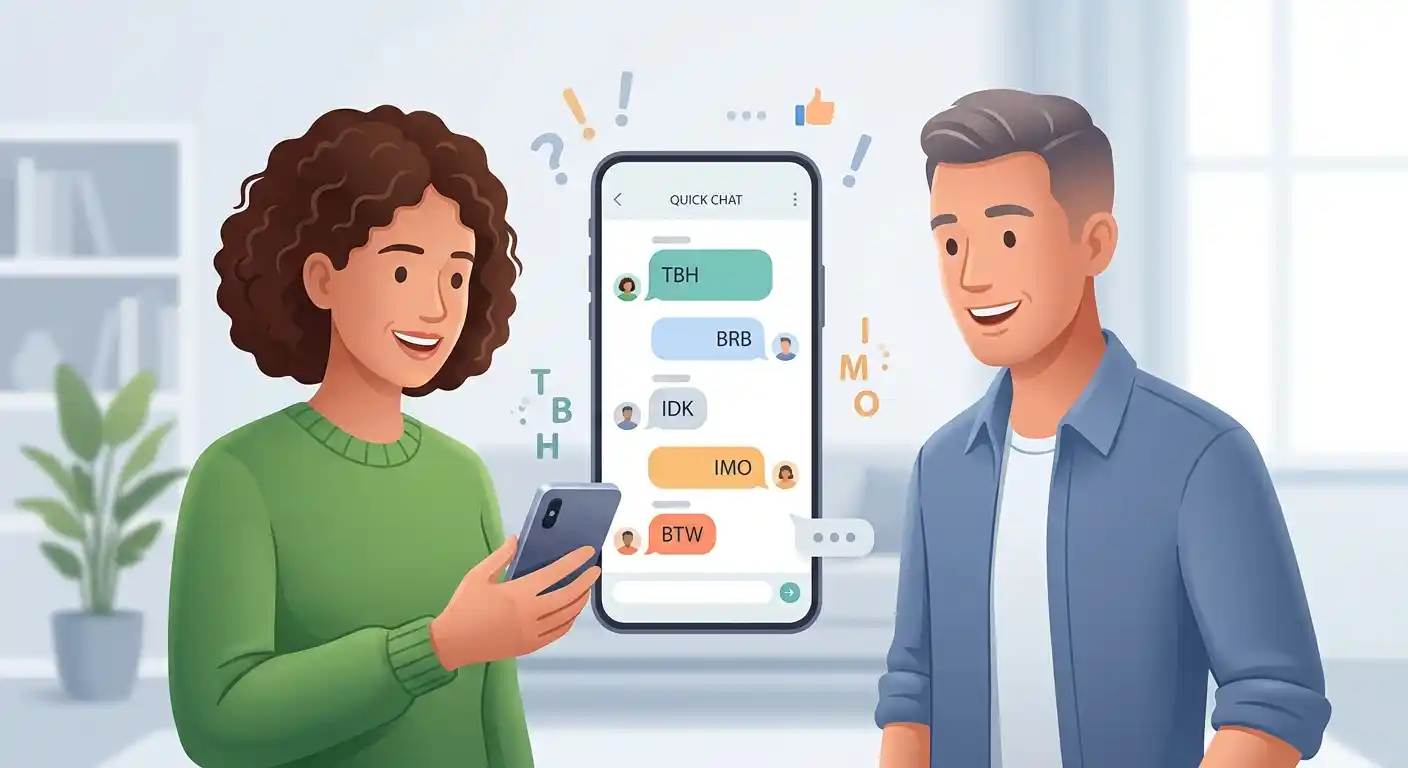
Common initialisms in slang are shortened phrases made from the first letters of words, especially in texting and online communication. Examples include IDK, BTW, BRB, TBH, IMO, SMH, and TTYL. They make casual digital conversations quicker and more concise.
Key Takeaways
- Initialisms are shortened forms built from the initial letters of multiple words.
- In texting, they are commonly used as internet slang and messaging shorthand.
- Examples include IDK, BTW, BRB, TBH, IMO, IRL, and TTYL.
- Initialisms are generally pronounced letter by letter, unlike acronyms that are pronounced as words.
- Most slang initialisms are informal and work best in texts, DMs, group chats, comments, and other casual settings.
- Context matters, because some initialisms can have different meanings outside slang or online communication.
Common Initialisms Slang Meaning
Common initialisms slang refers to shortened expressions used in informal digital communication. An initialism takes the first letters of the words in a phrase, with the resulting letters usually spoken separately.
For example:
- IDK = I Don’t Know
- BTW = By The Way
- BRB = Be Right Back
- TBH = To Be Honest
- IMO = In My Opinion
- IRL = In Real Life
- LMK = Let Me Know
- TTYL = Talk To You Later
- SMH = Shaking My Head
- OMG = Oh My God
These are part of a broader category of texting abbreviations, internet slang, chat shorthand, and online communication.
The term initialism is more precise than simply calling every shortened online expression an “acronym.” However, everyday internet users often use “acronym” as a broad label for these kinds of terms.
What Do Common Initialisms Stand For?
There is no single full form for “common initialisms slang.” It describes a category, not one specific abbreviation.
Each initialism has its own expansion. Here are some widely recognized examples:
| Initialism | Meaning | Typical Function |
|---|---|---|
| IDK | I Don’t Know | Shows uncertainty |
| BTW | By The Way | Adds another point |
| BRB | Be Right Back | Signals a short absence |
| TBH | To Be Honest | Introduces an honest opinion |
| IMO | In My Opinion | Gives a personal view |
| IRL | In Real Life | Refers to offline life |
| LMK | Let Me Know | Requests information |
| TTYL | Talk To You Later | Ends or pauses a conversation |
| SMH | Shaking My Head | Shows disapproval or disbelief |
| OMG | Oh My God | Expresses surprise or excitement |
| NGL | Not Gonna Lie | Introduces a candid statement |
| FYI | For Your Information | Shares information |
These examples show that initialisms can perform different jobs: they can express emotion, opinion, uncertainty, information, or conversation management.
Initialism vs. Acronym: What’s the Difference?
This is one of the most common points of confusion.
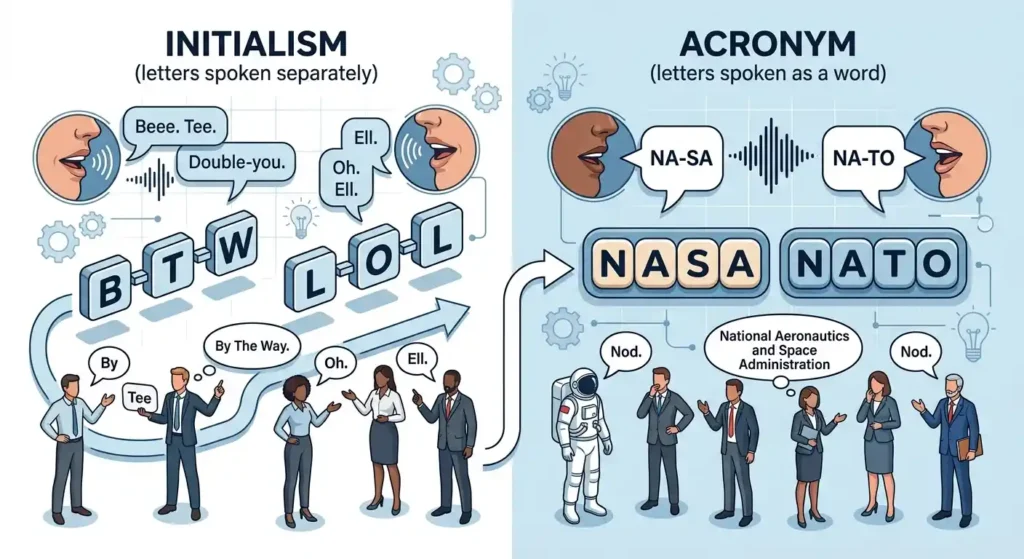
An initialism is generally pronounced by saying each letter separately.
For example:
B-T-W = By The Way
An acronym is traditionally pronounced as a word.
For example:
NASA is pronounced as a word rather than as individual letters.
In everyday texting, however, people frequently use the word “acronym” broadly for internet shorthand, even when a term is technically an initialism.
So if someone says “texting acronyms” and gives examples such as IDK or BTW, they are usually referring to the broader category of shortened online expressions.
How Are Common Initialisms Used?
Initialisms are especially useful when a phrase appears frequently in casual conversation.
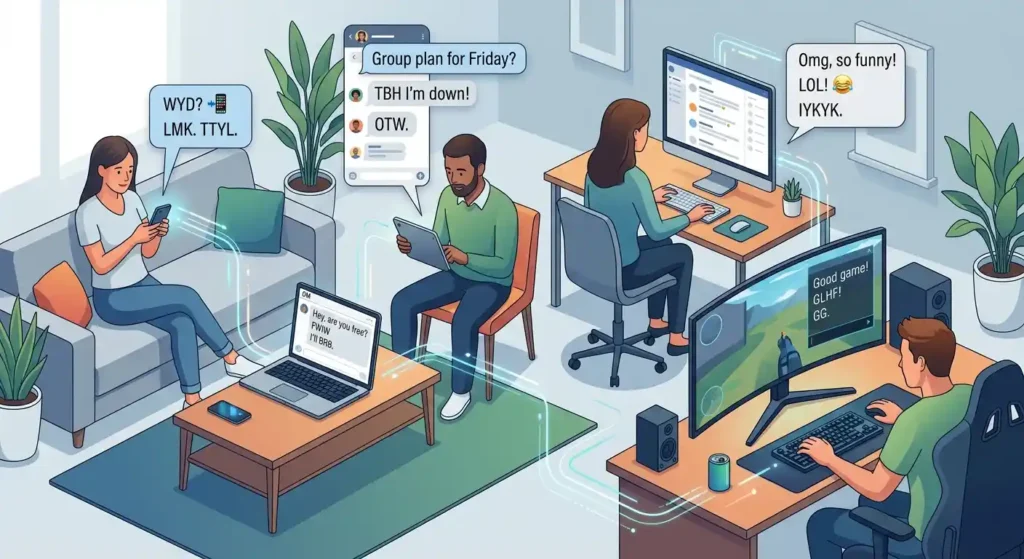
Text Messages
People use them to keep messages short:
“IDK what time I’ll be home.”
“BRB, grabbing something to eat.”
DMs
Direct messages often contain informal initialisms:
“TBH, I wasn’t expecting that.”
“LMK when you’re free.”
Group Chats
Initialisms can help people respond quickly:
“OMG 😂”
“BTW, are we still meeting tomorrow?”
Social Media
Comments, posts, replies, and captions can contain expressions such as TBH, IRL, NGL, IMO, and SMH.
Gaming Chats
Gaming conversations can use shorthand such as BRB, AFK, GG, and GL, particularly when players need to communicate quickly.
Online Communities
Forums and community chats can develop their own shorthand. A specialized group may use an initialism that is perfectly familiar to its members but confusing to someone outside that community.
That’s why the topic and audience matter when interpreting an unfamiliar set of letters.
Common Initialisms in Different Contexts
The meaning of an initialism normally comes from the phrase it represents, but its tone can change with context.
From a Friend
“IDK lol”
This usually feels relaxed and casual.
From a Guy
If a guy writes TBH or IDK, the initialism itself does not have a special meaning because of his gender.
From a Girl
The same applies when a girl uses an initialism. The letters generally retain their normal meaning.
From a Crush
If your crush sends “TBH…” or “NGL…”, don’t assume the initialism itself proves romantic interest.
The surrounding message, conversation topic, punctuation, emojis, and previous interactions provide more useful context.
In Dating Conversations
Initialisms can make messages feel more relaxed:
“TBH, I had a good time.”
The TBH simply means “to be honest.” Whether the complete message has romantic meaning depends on the conversation, not the initialism alone.
In a Group Chat
A short initialism can communicate a reaction quickly:
“SMH, you guys 😂”
The exact feeling depends on the rest of the conversation.
In Social Media Comments
Someone might comment:
“OMG, this is amazing!”
Here, OMG expresses surprise or excitement.
Real Chat Examples
Here are realistic examples of common slang initialisms in everyday messages:
- A: “What time are you getting here?”
B: “IDK yet.” - A: “BTW, don’t forget your jacket.”
- A: “BRB, my food is here.”
- A: “TBH, that movie was better than I expected.”
- A: “IMO, the second option is better.”
- A: “LMK when you get home.”
- A: “TTYL, I have to go.”
- A: “OMG, you actually won!”
- A: “NGL, that was pretty funny.”
- A: “SMH, I can’t believe you forgot.”
- A: “FYI, the meeting starts at 3.”
- A: “IRL, he’s much quieter.”
- A: “IDK what you’re talking about 😂”
- A: “TBH, I need more time to decide.”
- A: “BTW, did you finish the assignment?”
- A: “LMK if you need help.”
- A: “OMG! Did you see that?”
- A: “NGL, I’m a little nervous.”
- A: “TTYL! I’ll message you later.”
- A: “SMH 😂 You really did that?”
These examples show how initialisms can replace familiar phrases without changing the basic meaning of the sentence.
How to Reply to Common Initialisms Slang
You generally don’t need to comment on the initialism itself. Respond to what the person is saying.
Casual Replies
- “Gotcha.”
- “Yep, makes sense.”
- “Lol, same.”
- “Okay!”
- “Sounds good.”
Friendly Replies
- “Thanks for letting me know!”
- “No worries.”
- “I’ll keep you posted.”
- “Haha, I get you.”
- “Talk to you later!”
Funny Replies
- “Okay, abbreviation expert 😂”
- “I understood all of that somehow.”
- “Translation complete 😂”
- “You really love your shortcuts.”
Neutral Replies
- “Got it.”
- “Thanks for the update.”
- “What do you mean?”
- “Could you clarify?”
- “Okay, understood.”
Flirty/Relationship Replies
An initialism alone does not require a romantic response. If the conversation is already clearly personal, you can keep your reply natural:
- “Haha, I get what you mean.”
- “Okay, now I’m curious.”
- “Tell me more.”
- “That’s actually sweet.”
What Tone Do Common Initialisms Have?
Most slang initialisms have a casual, informal tone.
Depending on the specific expression, they can sound:
- Friendly — “TY!”
- Playful — “JK 😂”
- Honest — “TBH…”
- Uncertain — “IDK”
- Surprised — “OMG!”
- Opinionated — “IMO”
- Disapproving — “SMH”
- Neutral — “FYI”
- Conversational — “BTW”
The same initialism can also feel different depending on punctuation and the rest of the message.
Compare:
“IDK.”
with:
“idk lol”
The first may feel more direct or closed off, while the second sounds more relaxed. But you should not determine someone’s attitude from capitalization alone.
Are Common Initialisms Rude or Offensive?
Initialisms are not inherently rude or offensive. Most common forms such as IDK, BTW, BRB, TBH, IMO, and TTYL are simply informal shortcuts.
However, some internet initialisms contain profanity or insulting language, so the individual term matters.
With Friends
Common slang initialisms are generally appropriate in casual conversations.
On Social Media
They can work naturally in comments, replies, posts, and DMs.
At School
They may be fine in casual messages to friends, but formal assignments should normally use standard language.
At Work
Some initialisms are common in professional communication, including forms such as FYI. Others may sound too casual or unclear.
In Formal Writing
Avoid slang initialisms unless the context specifically calls for them. Writing the complete phrase is usually clearer and more professional.
Other Meanings of Common Initialisms
“Common initialisms slang” is a broad category, so individual initialisms may also have non-slang meanings.
Initialisms in Technology
Technology uses many initialisms that are not internet slang.
Examples include:
- URL — Uniform Resource Locator
- HTTP — Hypertext Transfer Protocol
- API — Application Programming Interface
- CPU — Central Processing Unit
- PDF — Portable Document Format
These are technical terms rather than casual texting slang.
Initialisms in Business
Business communication commonly uses forms such as:
- CEO — Chief Executive Officer
- HR — Human Resources
- VP — Vice President
- SLA — Service-Level Agreement
Again, these are initialisms, but they are not necessarily slang.
The important distinction is that “initialism” describes how a term is formed, while “slang” describes its informal language use.
Common Mistakes About Common Initialisms
Mistake 1: Calling Every Initialism an Acronym
The terms are related, but they are not technically identical. An initialism is generally spoken as individual letters, while an acronym is traditionally pronounced as a word.
Mistake 2: Assuming Every Initialism Is Slang
Not all initialisms are informal.
FBI, CEO, URL, and CPU are examples of initialisms used in ordinary or professional language.
Mistake 3: Assuming One Meaning Always Applies
Some combinations of letters have multiple meanings. Always consider the sentence, topic, and communication setting before choosing an expansion.
Mistake 4: Assuming an Initialism Shows Romantic Interest
Words such as TBH, LOL, IDK, or BTW do not automatically communicate flirting or attraction.
Mistake 5: Using Slang Initialisms in Formal Writing
A term that works perfectly in a group chat may look too casual in a school assignment, formal email, or professional document.
Mistake 6: Thinking Capitalization Creates a New Meaning
IDK, idk, and Idk generally represent the same initialism. Capitalization can affect visual tone, but it does not automatically create a different expansion.
Common Initialisms Slang and Related Terms
| Term | Meaning | Common Use |
|---|---|---|
| Initialism | Short form pronounced as individual letters | Texts and general language |
| Acronym | Short form commonly pronounced as a word | General language |
| Text abbreviation | Shortened word or phrase used in messages | Texting |
| Internet slang | Informal language used online | Social media and chats |
| Textese | Highly shortened digital language | Texting and online communication |
| Chat shorthand | Condensed language used in chats | Messaging and online communities |
These terms overlap, but they describe slightly different things. Initialism refers to the form of the word, while internet slang refers more broadly to informal language used online.
People Also Ask About Common Initialisms Slang
What is an initialism in slang?
An initialism in slang is a shortened phrase made from the first letters of its words and used informally in communication. Examples include IDK, BTW, BRB, TBH, and SMH.
What is the difference between an initialism and an abbreviation?
Abbreviation is the broader term for a shortened word or phrase. An initialism is one specific type of abbreviation formed from initial letters and generally pronounced letter by letter.
Are initialisms the same as texting slang?
Not exactly. Initialisms can be part of texting slang, but texting slang also includes shortened words, slang expressions, numbers, and other forms of shorthand.
Why are initialisms used in texting?
They provide a quick way to communicate familiar phrases without typing every word. They can also make casual messages feel more conversational and efficient.
Can an initialism have more than one meaning?
Yes. Some combinations of letters can have different meanings depending on the subject, audience, or setting. Reading the entire message is often necessary to identify the intended meaning.
Are internet initialisms still used outside texting?
Yes. Internet shorthand can appear in social media, online communities, gaming, comments, and sometimes informal spoken conversation. Some expressions have also become familiar outside digital communication.
Are all common initialisms informal?
No. Initialism is a linguistic form, not a synonym for slang. Professional and technical terms such as CEO, HR, URL, and CPU are initialisms without being internet slang.
How can I understand an initialism I don’t recognize?
Start with the whole sentence and conversation topic. Then consider whether the setting is texting, gaming, social media, school, work, or a technical discussion. This usually narrows down the intended meaning.
Conclusion
Common initialisms in slang are shortened phrases formed from the first letters of words and used in informal communication. Examples include IDK, BTW, BRB, TBH, IMO, SMH, and TTYL.
Most slang initialisms are useful in texts, DMs, group chats, social media, and other casual online conversations. Their tone can be friendly, playful, neutral, direct, or expressive depending on the specific term and context.
Remember that not every initialism is slang, and not every internet abbreviation is technically an initialism. Understanding that difference makes online communication easier to interpret and helps you choose the right language for casual, school, professional, and formal situations.

Writing puns and jokes for three and a half years has given Grace Collins experience working with language across varied subjects. As a writer, she covers food, animals, seasonal themes, technology, entertainment, and trending topics. Grace gathers subject-specific terms, explores word associations, and polishes joke structures to improve phrasing, punchlines, and comedic timing.