General internet abbreviations are shortened forms of words, phrases, or expressions used in online communication. They include texting shorthand, initialisms, acronyms, and shortened words such as LOL, BRB, IDK, BTW, and TTYL.
Key Takeaways
- Internet abbreviations make online messages shorter and quicker to type.
- They can appear in texts, DMs, group chats, comments, social media, gaming, and casual online communication.
- Some are initialisms or acronyms, while others are simply shortened words or phrases.
- Common examples include LOL, BRB, IDK, BTW, FYI, IMO, TTYL, and TL;DR.
- Most internet abbreviations are informal, so they are not appropriate for every school, work, or professional situation.
- Context matters because the same abbreviation can have different meanings in different conversations.
General Internet Abbreviations Meaning in Text
General internet abbreviations are short forms people use to communicate more efficiently online. They are part of the broader world of text slang, internet slang, texting shorthand, and online communication.
For example:
| Abbreviation | Meaning | Typical Use |
|---|---|---|
| LOL | Laughing out loud | Reaction to something funny |
| BRB | Be right back | Temporarily leaving a chat |
| IDK | I don’t know | Showing uncertainty |
| BTW | By the way | Adding another point |
| FYI | For your information | Sharing information |
| IMO | In my opinion | Giving a personal opinion |
| TTYL | Talk to you later | Ending a conversation |
| OMG | Oh my God | Surprise or excitement |
| NVM | Never mind | Dropping or correcting a topic |
| TL;DR | Too long; didn’t read | Giving or requesting a short summary |
These terms are not all technically the same type. Abbreviation is the broader category, while acronyms, initialisms, shortened words, and texting shorthand can fall underneath it.
What Do General Internet Abbreviations Stand For?
There is no single full form for “general internet abbreviations.” The phrase describes a category rather than one specific abbreviation.
Each short form has its own meaning. For example:
- IDK = I Don’t Know
- BRB = Be Right Back
- BTW = By The Way
- IMO = In My Opinion
- FYI = For Your Information
- ASAP = As Soon As Possible
- DM = Direct Message
- IRL = In Real Life
- ICYMI = In Case You Missed It
- JK = Just Kidding
Some are read as individual letters, while others may be pronounced more like ordinary words. The broader term abbreviation includes several different ways of shortening language.
Common Types of Internet Abbreviations
Understanding the different types makes online shorthand easier to recognize.
Initialisms
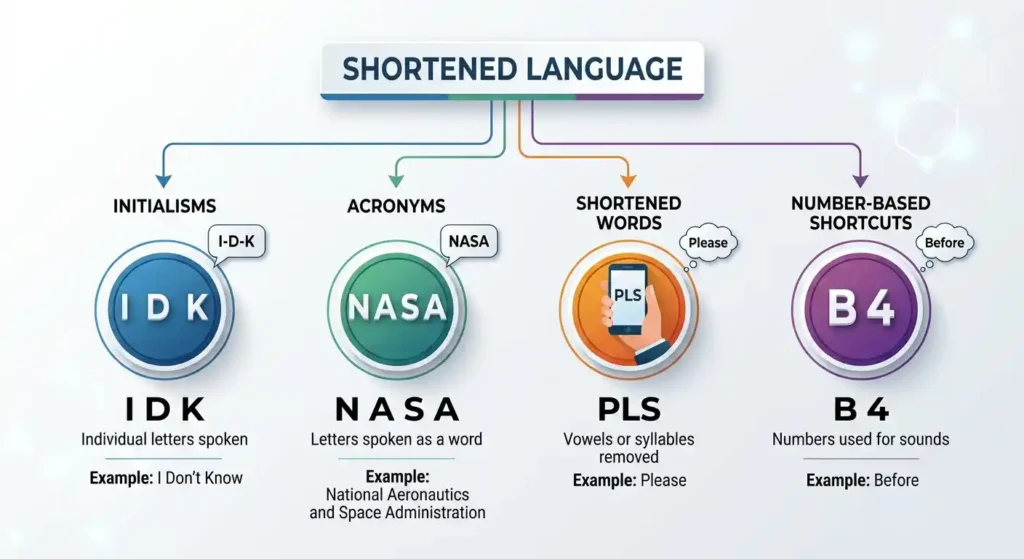
An initialism is formed from the first letters of words and is generally pronounced letter by letter.
Examples include:
- IDK — I Don’t Know
- BTW — By The Way
- FYI — For Your Information
- IMO — In My Opinion
- IRL — In Real Life
Acronyms
In everyday internet language, people often use “acronym” broadly for short forms made from multiple words. Technically, an acronym is typically pronounced as a word.
Internet communication contains many different short forms, so not every item called an “internet acronym” is technically an acronym.
Shortened Words
Some online expressions simply remove letters or shorten a familiar word.
Examples include:
- pls — please
- thx — thanks
- msg — message
- info — information
Number-Based Shortcuts
Some older texting shorthand uses numbers because they resemble sounds or words.
Examples include:
- 2 — to/too
- 4 — for
- B4 — before
- W8 — wait
These forms are still recognizable, although their use depends heavily on the person and context.
How Are General Internet Abbreviations Used?
Internet abbreviations appear in many forms of casual digital communication.
Text Messages
Texting is one of the clearest places to encounter abbreviations.
“IDK what time we’re leaving.”
“BRB, getting some food.”
“TTYL!”
They allow people to communicate quickly without typing every word.
DMs
Direct messages often contain casual shorthand such as BTW, LOL, IDK, TBH, and FYI.
For example:
“BTW, did you see the new post?”
Group Chats
Group conversations can move quickly, so short forms can make replies more efficient.
“OMG 😂 that was hilarious.”
“BRB guys.”
Social Media
Comments, captions, replies, and posts may use abbreviations such as LOL, POV, FYI, ICYMI, TBH, and IRL.
Gaming Chats
Online gaming conversations often favor short messages because players may have little time to type.
Terms such as BRB, AFK, GG, GL, and G2G can appear in gaming-related communication.
Casual Online Conversation
Internet abbreviations can also appear in forums, comments, community discussions, and other informal digital spaces.
The exact vocabulary depends on the community, platform, topic, and people involved.
General Internet Abbreviations in Different Contexts
The same abbreviation can feel different depending on who uses it and how it appears.
From a Friend
A friend might write:
“IDK lol”
This usually feels casual and conversational.
From a Guy
If a guy sends “TBH” or “IDK,” the abbreviation itself does not reveal a special romantic meaning. You need to consider the rest of the conversation.
From a Girl
The same principle applies when a girl uses an internet abbreviation. The short form generally keeps its normal meaning.
From a Crush
If a crush sends “BTW,” “LOL,” or “IDK,” don’t assume the abbreviation itself proves flirting or attraction.
Look at the complete message, the conversation topic, punctuation, emojis, and previous interactions.
In Dating
Internet shorthand can make a dating conversation feel more relaxed, but individual abbreviations do not automatically indicate romantic interest.
For example:
“LOL that was actually funny.”
The LOL mainly signals a reaction to something funny; the surrounding conversation determines whether anything more is intended.
In a Group Chat
Abbreviations can help people respond quickly:
“FYI, the meeting moved to 3.”
Here, FYI simply introduces useful information.
In Social Media Comments
Short forms can work as quick reactions:
“OMG this is amazing!”
Here, OMG communicates strong surprise or excitement.
Real Chat Examples
Here are realistic examples of common internet abbreviations in everyday conversations:
- A: “Are you coming over?”
B: “IDK yet.” - A: “I’ll BRB.”
B: “Okay.” - A: “BTW, your package arrived.”
- A: “LOL I can’t believe you did that.”
- A: “FYI, the schedule changed.”
- A: “IMO, the first movie was better.”
- A: “I’m heading out. TTYL!”
- A: “OMG, did you see that?”
- A: “NVM, I figured it out.”
- A: “TL;DR: the event was canceled.”
- A: “TBH, I wasn’t expecting that.”
- A: “JK 😂 I was just messing with you.”
- A: “IRL, he’s actually really funny.”
- A: “DM me the details.”
- A: “ASAP would be great if possible.”
- A: “ICYMI, the deadline changed.”
- A: “G2G, my ride is here.”
- A: “NP, no worries.”
- A: “YW! Glad I could help.”
- A: “WYD tonight?”
These examples show why context matters. The same short style can communicate humor, information, uncertainty, agreement, or a simple conversational transition.
How to Reply to General Internet Abbreviations
You usually do not need a special reply just because someone uses an abbreviation. Reply to the meaning of the message, not the fact that it is shortened.
Casual Replies
- “Yep, got it.”
- “Lol same.”
- “Okay, sounds good.”
- “Gotcha.”
- “No worries.”
Friendly Replies
- “Haha, I know what you mean.”
- “Thanks for letting me know!”
- “Sounds good 😊”
- “I’ll let you know.”
- “Talk to you later!”
Funny Replies
- “Okay, abbreviation overload 😂”
- “I understood every letter somehow.”
- “Translation accepted 😂”
- “You’re really making me decode this today.”
Neutral Replies
- “Got it.”
- “Thanks for the update.”
- “What do you mean by that?”
- “Could you explain?”
- “Okay, I understand.”
Flirty/Relationship Replies
There is no universal romantic response to an internet abbreviation. If the conversation is already clearly personal or romantic, you can respond naturally:
- “Haha, I know what you mean.”
- “You’re funny 😂”
- “Okay, now I’m curious.”
- “Tell me more.”
What Tone Do General Internet Abbreviations Have?
Internet abbreviations are generally casual and informal, but their tone depends on the specific abbreviation and the surrounding message.
They can communicate:
- Friendliness: “TY!”
- Humor: “LOL”
- Uncertainty: “IDK”
- Surprise: “OMG!”
- Personal opinion: “IMO”
- Information: “FYI”
- Conversation closure: “TTYL”
- Playfulness: “JK”
- Directness: “ASAP”
Punctuation can also change how a short message feels.
Compare:
“k”
with:
“k lol”
or:
“OMG!”
The words are short, but punctuation and additional context can affect how the reader interprets the message.
Are General Internet Abbreviations Rude or Offensive?
Internet abbreviations are not automatically rude or offensive. Most everyday forms such as BTW, FYI, IDK, BRB, LOL, and TTYL are simply informal shortcuts.
However, some abbreviations contain profanity, insults, or language that may be inappropriate in certain settings.
With Friends
Common casual abbreviations are generally natural in friendly conversations.
On Social Media
They are widely suited to informal comments, replies, and messages, although the specific abbreviation matters.
At School
Casual shorthand may be fine in an informal chat with friends, but assignments and formal communication should use standard language unless your teacher says otherwise.
At Work
Some abbreviations such as FYI, ASAP, and EOD may be appropriate in professional communication, while slang-heavy forms may sound too casual. Always consider your workplace and the person you’re messaging.
In Formal Writing
Internet slang such as LOL, BRB, or IDK generally does not belong in formal writing. Use the complete phrase when clarity and professionalism matter.
Other Meanings of General Internet Abbreviations
The phrase general internet abbreviations is a category, so individual abbreviations can have completely different meanings outside online slang.
General Internet Abbreviations in Technology
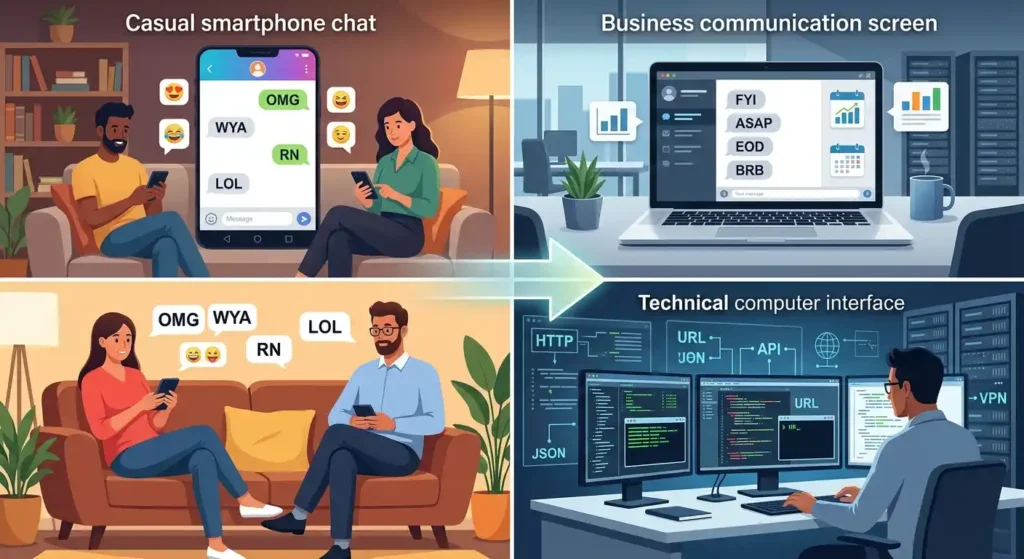
Some widely used internet-related abbreviations are technical rather than slang.
Examples include:
- HTTP — Hypertext Transfer Protocol
- URL — Uniform Resource Locator
- HTML — HyperText Markup Language
- VPN — Virtual Private Network
- IP — Internet Protocol
These are technical abbreviations, not necessarily texting slang.
General Internet Abbreviations in Business
Business communication also uses abbreviations such as:
- ASAP — As Soon As Possible
- FYI — For Your Information
- EOD — End of Day
- OOO — Out of Office
- FAQ — Frequently Asked Questions
The key difference is context. A business abbreviation does not necessarily function as internet slang.
General Internet Abbreviations in Gaming
Gaming communities may use terms such as:
- GG — Good Game
- GL — Good Luck
- AFK — Away From Keyboard
- G2G — Got To Go
Gaming shorthand can overlap with ordinary texting abbreviations.
Common Mistakes About General Internet Abbreviations
Mistake 1: Calling Every Short Form an Acronym
Not every abbreviation is technically an acronym. Abbreviation is a broader term that can include different types of shortened language.
Mistake 2: Assuming Every Abbreviation Is Slang
Some abbreviations are ordinary technical, business, or professional terms.
For example, HTML is a technical abbreviation, while LOL is commonly used as informal online language.
Mistake 3: Assuming One Meaning Always Applies
Some abbreviations have multiple meanings. Context helps determine which interpretation makes sense.
Mistake 4: Assuming Abbreviations Show Romantic Interest
An abbreviation such as LOL, IDK, BTW, or TBH does not automatically indicate flirting or attraction.
Mistake 5: Using Every Abbreviation Everywhere
A short form that works in a group chat may not belong in a school assignment, formal email, or professional document.
Mistake 6: Confusing Slang With Standard English
Internet shorthand changes quickly, while formal English has different conventions. Knowing both helps you choose the right style for the situation.
General Internet Abbreviations and Related Slang
| Term | Meaning | Common Use |
|---|---|---|
| Text slang | Informal language used in texts | Casual messaging |
| Internet slang | Informal language used online | Social media and chats |
| Textese | Highly shortened digital language | Texting and online communication |
| Chat shorthand | Shortened words or phrases | Chat rooms and messaging |
| Initialism | Short form based on initial letters | IDK, BTW, FYI |
| Acronym | Short form formed from multiple words | Varies by term |
| Emoticon | Characters representing an expression | 🙂 |
| Emoji | Graphic symbol used in digital communication | Texts and social media |
These categories can overlap, but they are not interchangeable in every technical sense.
People Also Ask About General Internet Abbreviations
What are internet abbreviations?
Internet abbreviations are shortened forms of words, phrases, or expressions used in digital communication. They can appear in texts, chats, social media, gaming, comments, and other online conversations.
What are the most common internet abbreviations?
Common examples include LOL, BRB, IDK, BTW, FYI, IMO, TTYL, OMG, and NVM. The exact set changes by community and context, so a useful list should focus on terms that are actually relevant to the conversation.
What is the difference between internet slang and internet abbreviations?
Internet abbreviations are shortened forms of words or phrases, while internet slang is a broader category of informal online language. An abbreviation can be part of internet slang, but internet slang also includes words and expressions that are not shortened.
Why do people use internet abbreviations?
They can make messages shorter, faster, and more conversational. They also provide a quick way to express reactions, opinions, greetings, warnings, or other common ideas.
Are internet abbreviations appropriate for school?
It depends on the situation. They can be fine in casual messages between friends, but formal assignments and school communication usually call for standard English unless informal language is specifically requested.
Are internet abbreviations appropriate at work?
Some are perfectly normal in professional communication, especially established business shorthand such as FYI, ASAP, EOD, and OOO. Slang-heavy abbreviations should be used more carefully because workplace expectations vary.
Do internet abbreviations have the same meaning everywhere?
No. Context matters. An abbreviation may have a slang meaning in a text but a technical or professional meaning somewhere else.
How can I understand an abbreviation I don’t know?
Start with the full sentence and conversation topic. Consider who sent it, where it appeared, and whether the surrounding words suggest texting slang, gaming terminology, social media language, or a technical meaning.
Conclusion
General internet abbreviations are shortened forms used to make digital communication quicker and more convenient. They include texting shorthand, initialisms, acronyms, shortened words, and other forms of online language.
Common examples include LOL, BRB, IDK, BTW, FYI, IMO, and TTYL. Most are informal, although some abbreviations are also common in business or technical communication.
The most important rule is context. An abbreviation can sound friendly, funny, direct, neutral, or professional depending on the term and situation. Use casual internet shorthand with the right audience, and switch to standard language when communicating in formal or professional settings.

Emma Brooks is a writer whose work centers on puns, jokes, and topic-specific wordplay. Across four and a half years of experience, she has covered subjects involving food, animals, seasonal occasions, technology, entertainment, and trending topics. Emma identifies useful terms, tests different joke angles, and revises setups and punchlines to strengthen wording and comedic delivery.