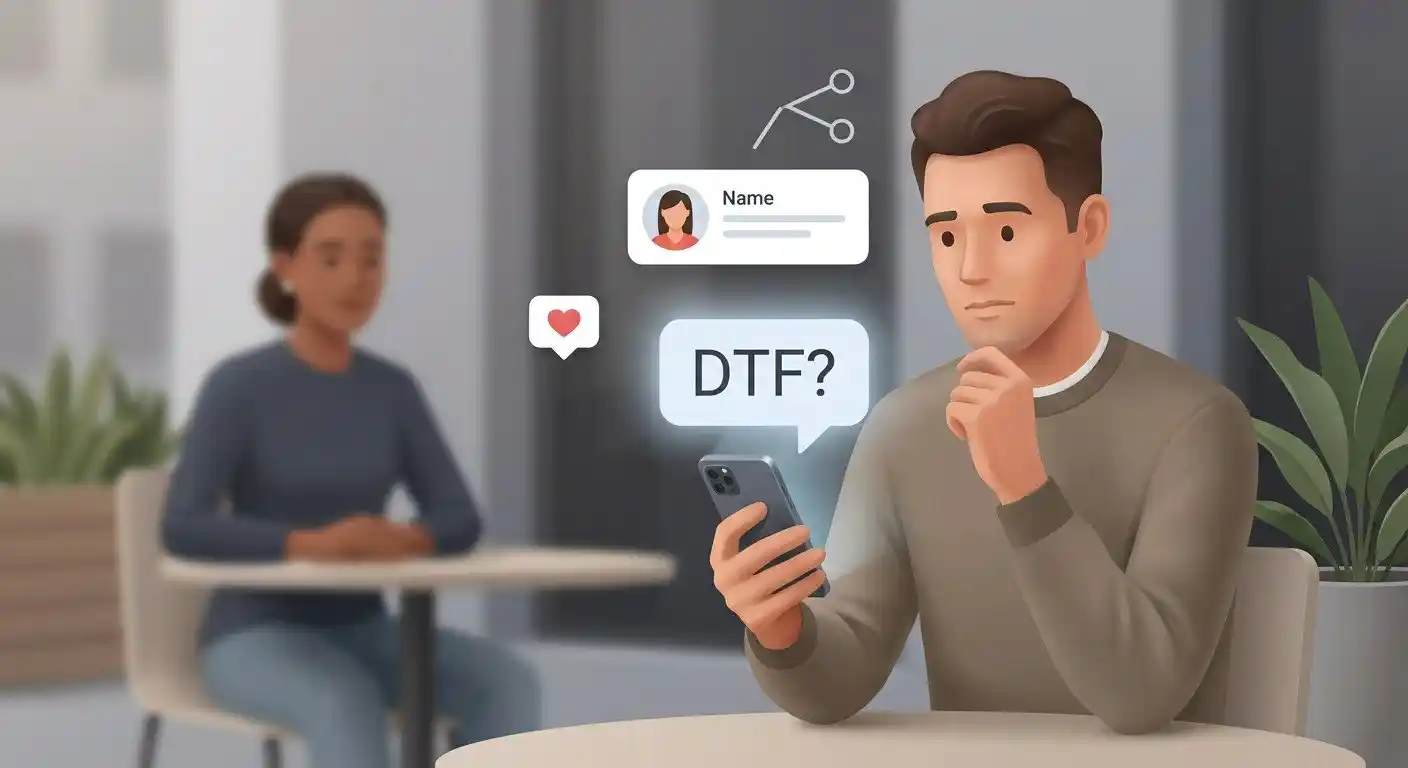
DTF is an adult slang abbreviation that usually refers to being open to a casual sexual encounter. It is considered vulgar and is mainly associated with adult conversations, dating contexts, and internet slang rather than ordinary friendly texting.
Key Takeaways
- DTF is an abbreviation with an adult, sexually suggestive meaning.
- In texting, its usual interpretation is an expression of interest in a casual sexual encounter.
- The term is informal and vulgar, so it is not appropriate for school, work, or formal communication.
- Context matters: it can sometimes appear as a joke, meme, or deliberately altered phrase.
- Seeing DTF in a message does not by itself establish someone’s feelings, relationship intentions, or consent.
- If the meaning is unclear, context or clarification is more reliable than guessing.
DTF Meaning in Text
In text messages and online conversations, DTF is adult internet slang used to express or ask about willingness for a casual sexual encounter.
It is an example of messaging shorthand: several words are reduced to three letters to make a message shorter and more direct. Because the underlying expression contains vulgar language, DTF can sound blunt, suggestive, or offensive, depending on the situation.
If you encounter DTF unexpectedly, the surrounding conversation is important. A dating-related message may use the conventional slang meaning, while a meme or joke may deliberately give the letters a different interpretation.
What Does DTF Stand For?
DTF is traditionally understood as an abbreviation of “down to f*.”** The phrase “down to” in informal English can mean willing or interested in doing something, while the final word makes this particular abbreviation explicitly sexual.
Because the full expression is vulgar, people sometimes write it as DTF, D.T.F., or with the final word partially censored.
It is best understood as adult slang rather than a neutral texting abbreviation.
How Is DTF Used?
DTF can appear in private messages, online discussions, dating-related conversations, memes, or social-media content. Its meaning is generally clear from the surrounding context when the conversation is about adult dating or attraction.
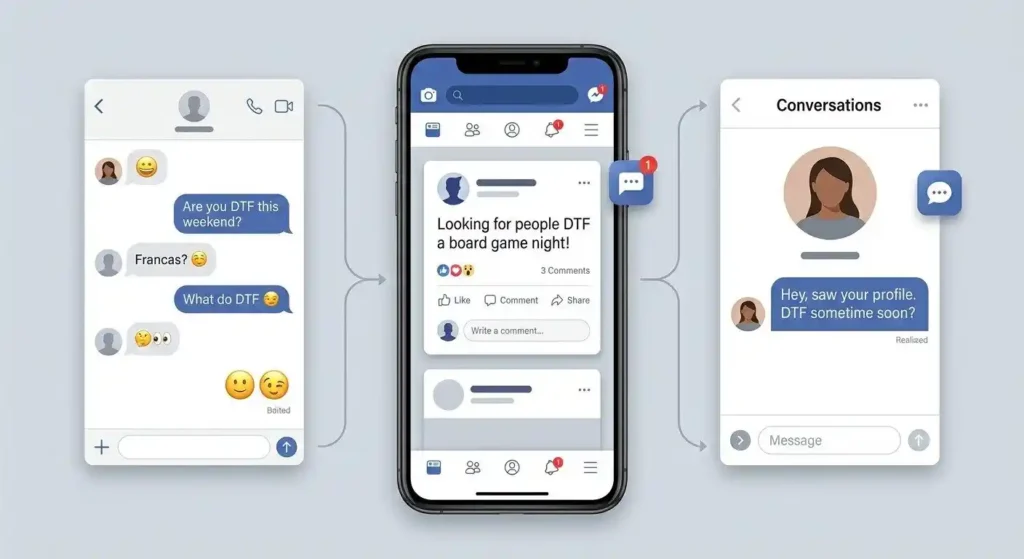
It is not a normal substitute for phrases such as “Are you free?” or “Do you want to hang out?” Using DTF in an ordinary conversation can therefore create a very different impression from what the sender intended.
In Text Messages
A person might use DTF as a very direct question or statement about sexual interest. Because the expression is explicit, it can significantly change the tone of an otherwise ordinary conversation.
On Social Media
DTF can appear in posts, comments, memes, or captions. In those situations, it may be used literally or as an adult-humor reference.
In Dating Contexts
The abbreviation is strongly associated with casual dating and adult conversations. However, the abbreviation itself does not tell you whether someone wants a relationship, has romantic feelings, or intends anything beyond the specific message.
Real Chat Examples
Because DTF refers to adult sexual content, examples are best kept non-graphic and contextual:
- “He sent me ‘DTF?’ and I wasn’t sure what he meant.”
- “I had to look up DTF because I’d never seen the abbreviation before.”
- “That DTF joke changed the tone of the conversation quickly.”
- “I wouldn’t use DTF in a school group chat.”
- “The message used DTF as an adult slang reference.”
- “She asked what DTF meant because the abbreviation was unfamiliar.”
- “That post uses DTF as a joke rather than literally.”
- “I recognized DTF as adult slang from the context.”
- “Don’t assume every use of DTF has the same intention.”
- “The conversation became uncomfortable after someone used DTF.”
- “He clarified what he meant instead of assuming I understood DTF.”
- “DTF is not an abbreviation I’d use in a formal message.”
- “The meme used DTF as wordplay.”
- “I wasn’t familiar with that slang term, so I asked what DTF meant.”
- “The abbreviation was clearly being used in an adult context.”
These examples show an important point: the letters alone do not tell you the sender’s emotions or intentions beyond the conventional slang reference.
How to Reply to DTF
If you receive DTF in a message, you do not have to respond in any particular way. Your response can depend on whether you understand the context and whether you are comfortable with the conversation.
Casual Replies
For simply clarifying the meaning:
- “What do you mean by DTF?”
- “I’m not familiar with that abbreviation.”
Friendly Replies
If you want to keep the conversation appropriate:
- “I’d rather keep the conversation friendly.”
- “Let’s talk about something else.”
Funny Replies
If the context is clearly a harmless joke, you can redirect the conversation with humor without engaging with the adult meaning.
Neutral Replies
A simple response can be:
- “I’m not comfortable with that.”
- “No, thanks.”
- “I’d rather not discuss that.”
Flirty/Relationship Replies
There is no need to provide a sexual response just because someone uses DTF. If a message makes you uncomfortable, it is completely reasonable to change the subject, stop responding, or set a clear boundary.
Context & Relationship Meaning
DTF does not change definition simply because it comes from a guy, girl, friend, or crush.
However, the relationship between the people can affect how the message feels. For example, a message from a stranger may seem more intrusive, while the same abbreviation appearing in an established adult conversation may be interpreted differently.
Other clues include:
- The messages immediately before and after it
- Punctuation
- Emojis
- Whether the conversation is serious or joking
- Whether the term appears in a meme
- The relationship between the people involved
Most importantly, DTF alone does not prove love, attraction, commitment, or consent. Context matters.
What Tone Does DTF Have?
DTF generally has a direct, blunt, vulgar, and sexually suggestive tone.
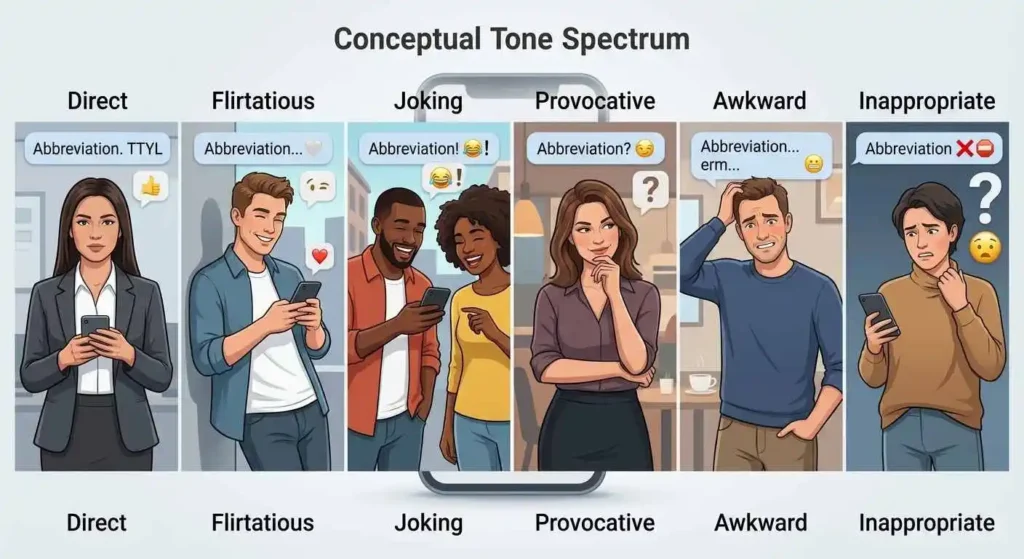
Depending on context, it can also be:
- Flirtatious in an adult dating conversation
- Joking in a meme or humorous post
- Provocative when deliberately used to get attention
- Awkward or inappropriate when directed at someone unexpectedly
The surrounding conversation is often the best clue to the intended tone.
Is DTF Rude or Offensive?
DTF can be considered vulgar or offensive, particularly when used toward someone who has not invited that kind of conversation.
It is not suitable for school assignments, professional emails, workplace communication, formal writing, or other situations where respectful language is expected.
Even in casual online communication, using adult slang without considering the audience can lead to misunderstandings. When in doubt, neutral language is safer.
Who Uses DTF?
DTF is recognized as adult internet slang, especially in contexts involving dating or casual relationships. It should not automatically be labeled as specifically Gen Z, Millennial, or belonging to one particular generation.
People may also encounter the abbreviation through memes or older internet culture without personally using it.
Other Meanings of DTF
DTF has meanings outside of texting slang, so context can matter.
DTF in Printing
In the printing industry, DTF can mean “Direct-to-Film,” referring to a printing method used for transferring designs onto garments and other materials.
This meaning has nothing to do with the adult slang expression.
DTF in Science
In scientific contexts, DTF can also appear as an abbreviation for “deuterium–tritium fusion.” This is a technical term and is unrelated to internet slang.
Therefore, if you see DTF in a technical document rather than a personal message, the surrounding subject should determine the meaning.
DTF vs. Similar Slang
DTF can be confused with other dating and relationship abbreviations, but they do not mean exactly the same thing.
| Term | Meaning | Difference |
|---|---|---|
| DTF | Adult slang concerning casual sexual interest | Direct and sexually suggestive |
| FWB | Friends with benefits | Describes a type of relationship arrangement |
| LTR | Long-term relationship | Refers to a longer-term romantic relationship |
| NSA | No strings attached | Describes a relationship without expected commitment |
| ONS | One-night stand | Refers to a particular type of casual encounter |
These terms can appear in similar adult contexts, but they are not interchangeable.
Common Mistakes About DTF
Assuming it is harmless slang
DTF is not a neutral abbreviation like “BRB” or “IDK.” Its conventional meaning is adult and vulgar.
Assuming the letters always have the slang meaning
A technical document about printing or science may use DTF for something completely different.
Assuming it proves romantic interest
DTF is associated with sexual or casual interest, but it does not establish someone’s broader feelings or relationship goals.
Using it in formal communication
Because of its vulgar meaning, DTF is inappropriate for professional and formal settings.
Assuming context does not matter
A meme, technical document, private conversation, and dating-related message can use the same three letters differently.
DTF and Related Slang
| Term | Meaning | Common Use |
|---|---|---|
| FWB | Friends with benefits | Relationship terminology |
| LTR | Long-term relationship | Dating profiles and conversations |
| NSA | No strings attached | Casual relationship terminology |
| ONS | One-night stand | Dating and relationship discussions |
| IDK | I don’t know | Everyday texting |
| BRB | Be right back | Casual messaging |
Real-World Conversation
Here is a short, non-graphic example showing how someone might encounter the abbreviation:
Person A: “I got a message saying ‘DTF?’ What does that mean?”
Person B: “It’s adult slang. In that context, it refers to casual sexual interest.”
Person A: “Oh, okay. I didn’t know that.”
Person B: “If you’re uncomfortable with the message, you don’t have to engage with it.”
People Also Ask
What does DTF mean in texting?
DTF is an adult slang abbreviation referring to being open to a casual sexual encounter. It is vulgar and should not be treated like an ordinary texting abbreviation.
Is DTF a bad word?
DTF contains vulgar adult language, so it can be considered inappropriate or offensive depending on the audience and context. It is especially unsuitable for formal, school, or professional communication.
What does DTF mean on social media?
On social media, DTF usually has the same adult slang meaning. However, memes and jokes can sometimes use the letters differently, so surrounding context matters.
Does DTF mean dating?
Not necessarily. DTF generally refers to casual sexual interest rather than a commitment to dating or a long-term relationship.
Does DTF mean someone likes you?
Not necessarily. The abbreviation can indicate a particular type of adult interest, but it does not establish romantic feelings or a desire for a relationship.
Can DTF have a non-slang meaning?
Yes. In contexts such as clothing printing and science, DTF can represent technical terms unrelated to internet slang. The subject of the conversation usually makes the intended meaning clear.
Is DTF appropriate for school or work?
No. Because its common slang meaning is vulgar and adult, it is inappropriate for school assignments, workplace messages, professional emails, and formal communication.
Conclusion
DTF is an adult texting abbreviation with a vulgar meaning associated with casual sexual interest. Its tone is generally direct and sexually suggestive, although it can also appear in jokes or memes. Context is important, and the abbreviation should not be interpreted as proof of someone’s romantic feelings or intentions. In formal, school, or professional communication, it is best avoided.

Emma Brooks is a writer whose work centers on puns, jokes, and topic-specific wordplay. Across four and a half years of experience, she has covered subjects involving food, animals, seasonal occasions, technology, entertainment, and trending topics. Emma identifies useful terms, tests different joke angles, and revises setups and punchlines to strengthen wording and comedic delivery.