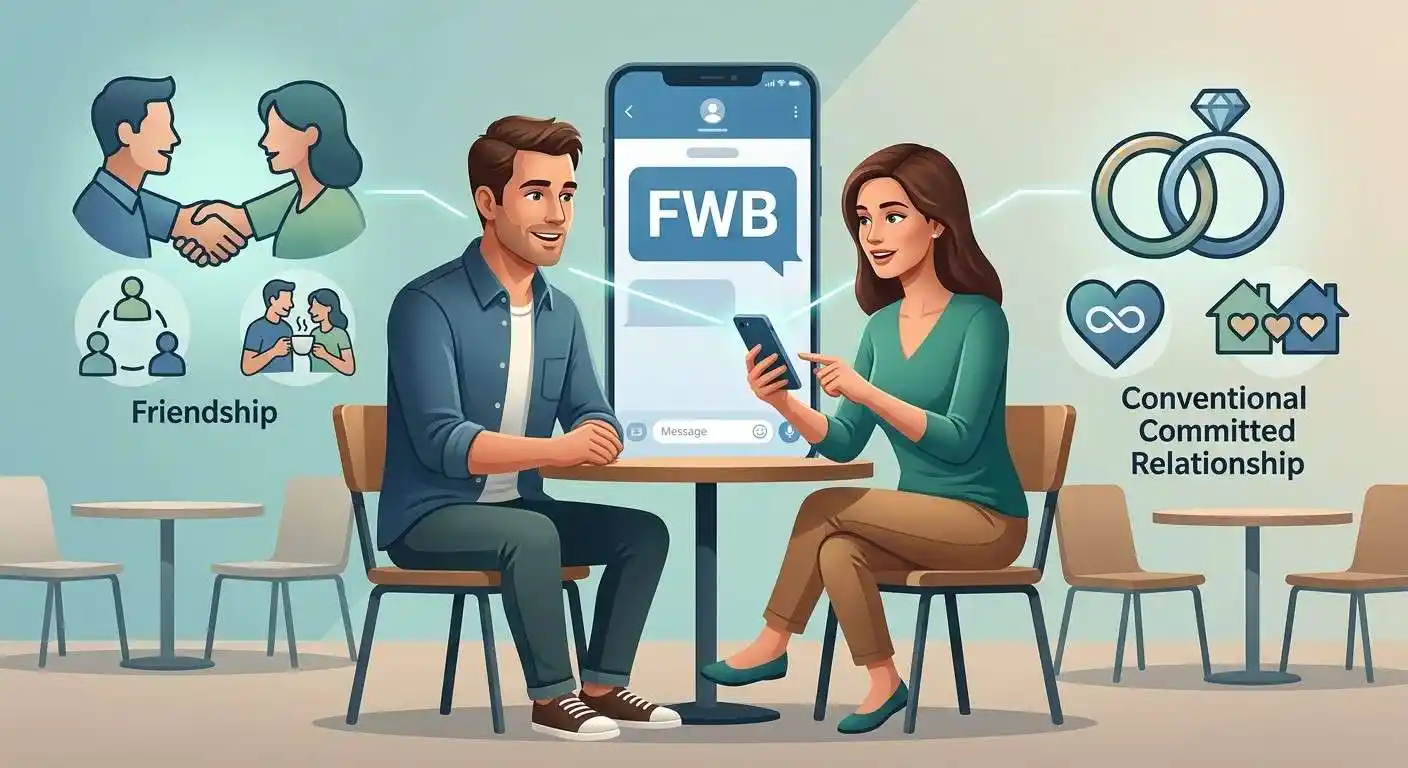
FWB usually means “friends with benefits” in texting and online conversations. It refers to a friendship that includes an intimate or sexual aspect without being a traditional committed romantic relationship. The term is informal and is mainly used when discussing relationship arrangements.
Key Takeaways
- FWB stands for Friends With Benefits.
- It is a relationship-related texting abbreviation, not a general everyday abbreviation.
- The term describes a friendship with an intimate aspect but without the usual expectations of a committed romantic relationship.
- Its meaning is generally clear in personal conversations, but the exact expectations can vary between people.
- FWB is informal and is not appropriate for professional or formal communication.
- Seeing FWB in a message does not by itself reveal someone’s feelings, intentions, or level of commitment.
FWB Meaning in Text
In text messages, FWB means “friends with benefits.” It is an internet and relationship abbreviation used to describe a connection that combines friendship with physical intimacy while remaining outside a conventional committed relationship.
Unlike simple friendship slang such as BFF, FWB refers to a more specific relationship situation. The phrase is generally used in personal conversations, relationship discussions, dating-related conversations, and social media.
Because FWB describes a particular type of relationship, the surrounding conversation matters. Someone might use it to describe their own situation, ask about another person’s relationship, or explain that they are not looking for a conventional relationship.
What Does FWB Stand For?
FWB stands for “Friends With Benefits.”
The abbreviation takes the first letters of the three main words:
- F = Friends
- W = With
- B = Benefits
Here, “benefits” refers to an intimate aspect of the relationship. In ordinary texting, FWB is understood as an informal relationship term rather than a professional acronym.
How Is FWB Used?
FWB can appear in text messages, private chats, DMs, social media conversations, and relationship discussions. It is normally used when people are talking about whether a connection is friendship, dating, or something in between.
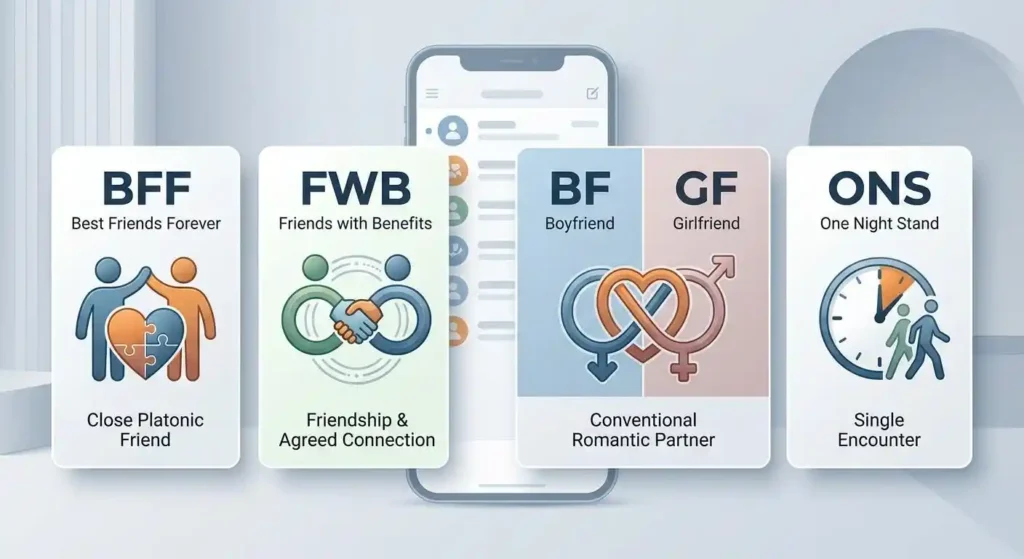
Examples of how the abbreviation can function include:
- Describing an existing relationship
- Asking whether two people are officially dating
- Explaining that someone wants something casual rather than a committed relationship
- Discussing relationship expectations
- Talking about relationship labels
For example:
“Are you two dating?”
“No, we’re FWB.”
The abbreviation keeps the conversation short while communicating that the relationship is not being described as a conventional romantic partnership.
FWB on Social Media
On social platforms, FWB may appear in comments, posts, private messages, or discussions about relationships. The meaning normally remains “friends with benefits,” although the tone can range from serious to joking depending on the surrounding conversation.
FWB in Text Messages
In ordinary texting, someone might write “FWB” instead of spelling out the complete phrase. Because the abbreviation refers to a personal relationship, it is generally used in informal conversations rather than school, workplace, or official messages.
Real Chat Examples
Because FWB is an adult relationship term, these examples focus on understanding the language rather than describing intimate activity.
- A: “Are they actually dating?”
B: “No, they said they’re FWB.” - A: “What does FWB mean?”
B: “Friends with benefits.” - A: “He said he isn’t looking for a serious relationship.”
B: “Did he mention FWB?” - A: “Are you two together?”
B: “Not officially. We call it FWB.” - A: “She said she wants something casual.”
B: “That could mean she is talking about an FWB arrangement.” - A: “What does ‘FWB only’ mean?”
B: “It usually means the person is describing a casual relationship arrangement.” - A: “They’re always together. Are they a couple?”
B: “Apparently they’re FWB.” - A: “I saw FWB in their profile. What is it?”
B: “It stands for friends with benefits.” - A: “So you’re not officially dating?”
B: “No, we’re just FWB.” - A: “Is FWB the same as being boyfriend and girlfriend?”
B: “No. FWB usually describes a different, less traditional relationship arrangement.” - A: “She said they’re just friends.”
B: “Then don’t assume they’re FWB unless she actually says that.” - A: “What kind of relationship do they have?”
B: “They describe it as FWB.” - A: “He mentioned FWB in the conversation.”
B: “That sounds like he was talking about a relationship arrangement.” - A: “Is FWB a dating term?”
B: “Yes, it’s commonly used when discussing casual relationship arrangements.” - A: “I didn’t understand that abbreviation.”
B: “FWB means friends with benefits.”
How to Reply to FWB
The best response depends on why the person used the abbreviation. If you’re simply asking what it means, a straightforward explanation is enough. If someone is using it to describe a personal relationship, you do not have to assume what they want or how they feel.
Casual Replies
- “Got it.”
- “Okay, I understand.”
- “Thanks for explaining.”
- “I wasn’t familiar with that abbreviation.”
Friendly Replies
- “Thanks for clarifying.”
- “That makes sense.”
- “I understand what you mean now.”
Funny Replies
If the conversation is clearly joking, a light response such as “Three letters with a lot of context” can work.
Neutral Replies
- “What do you mean by FWB in this situation?”
- “Are you talking about friends with benefits?”
- “I want to make sure I understand what you mean.”
Flirty/Relationship Replies
Because FWB refers to an adult relationship arrangement, it is better not to assume that someone mentioning it is automatically flirting with you. If the context is unclear, asking what they mean is more reliable than trying to interpret the acronym alone.
Context & Relationship Meaning
FWB has the same basic definition regardless of whether it comes from a guy, a girl, a friend, or someone you’re talking to.
What changes is the context.
For example, someone might use FWB:
- To describe their own relationship
- To ask whether another person is dating someone
- To discuss relationship preferences
- As part of a joke or casual conversation
- To clarify that a relationship does not have a traditional romantic label
If a crush or someone you’re dating uses FWB, the abbreviation alone does not prove romantic interest. The surrounding conversation, wording, previous messages, and clearly stated intentions matter more than the acronym itself.
What Tone Does FWB Have?
FWB is generally casual and informal. Depending on the conversation, it can sound:
- Neutral
- Matter-of-fact
- Personal
- Casual
- Serious when discussing relationship expectations
- Playful when used jokingly
The three letters themselves do not determine whether the speaker is joking, serious, or emotionally involved.
Is FWB Rude or Offensive?
FWB is informal relationship slang, so it can be inappropriate in professional or formal communication.
In casual conversations, the abbreviation is generally understandable to people familiar with the term. However, because it concerns an adult relationship topic, it may not be suitable for every audience or setting.
For school, workplace, official, or professional communication, avoid using FWB unless there is a specific legitimate reason to discuss the term itself.
Who Uses FWB?
FWB can appear in online conversations and informal discussions about relationships. It should not automatically be labeled as a particular generation’s slang.
The abbreviation is best understood as relationship shorthand used in informal digital communication rather than as a term belonging exclusively to one age group.
Other Meanings of FWB
In a personal text, social-media post, or relationship conversation, FWB overwhelmingly points to “friends with benefits.” Other uses can exist in specialized contexts, but they are not the normal interpretation of FWB in everyday texting.
If you see FWB in a technical, business, transportation, or other specialized document, the surrounding subject should be used to determine whether a different abbreviation is intended.
FWB vs. Similar Slang
Some relationship abbreviations can sound similar even though they describe different situations.
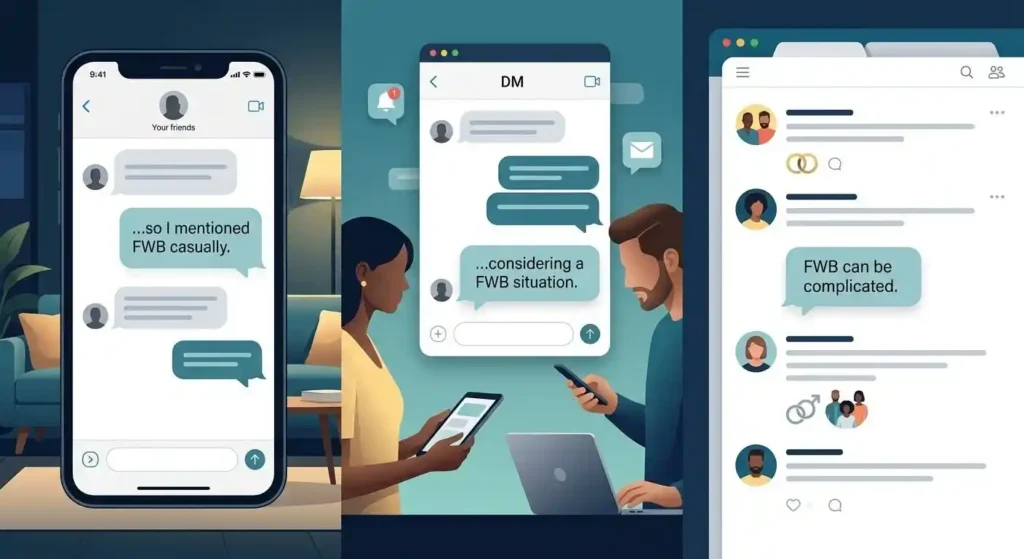
| Term | Meaning | Difference |
|---|---|---|
| FWB | Friends With Benefits | Describes friendship combined with an intimate aspect without a conventional committed relationship |
| BFF | Best Friends Forever | Describes a close friendship, with no relationship meaning implied |
| BF | Boyfriend | Usually refers to a male romantic partner |
| GF | Girlfriend | Usually refers to a female romantic partner |
| ONS | One-Night Stand | Refers to a one-time intimate encounter rather than an ongoing friendship arrangement |
These abbreviations should not be treated as interchangeable. The surrounding conversation helps establish which meaning is intended.
Common Mistakes About FWB
Assuming FWB means dating
FWB does not automatically mean that two people are officially dating. It describes a different type of relationship arrangement.
Assuming the abbreviation proves romantic feelings
The word “friends” is important. Someone using FWB is describing a label or arrangement, not automatically declaring romantic feelings.
Assuming every friendship is FWB
Two people being close friends does not make them FWB. The term has a specific relationship meaning.
Assuming the meaning changes by gender
FWB means the same basic thing whether a guy, girl, or another person uses it.
Treating FWB as formal language
FWB is informal messaging shorthand. It is not a suitable replacement for more formal relationship terminology in professional writing.
Related Internet Slang
| Term | Meaning | Common Use |
|---|---|---|
| BFF | Best Friends Forever | Close friendship |
| BF | Boyfriend | Romantic relationship |
| GF | Girlfriend | Romantic relationship |
| ONS | One-Night Stand | Describing a one-time encounter |
| NSA | No Strings Attached | Describing a casual relationship arrangement |
Real-World Conversation
Here is a simple example of how FWB can appear naturally:
Alex: “Are Sam and Jordan dating?”
Taylor: “Not exactly. They said they’re FWB.”
Alex: “Oh, so they’re using a different relationship label.”
Taylor: “Exactly.”
The important point is that FWB describes how the people involved label their relationship. It should not be used to guess someone’s private feelings without additional context.
People Also Ask
What does FWB mean in texting?
FWB means “friends with benefits.” In texting, it refers to a friendship that includes an intimate aspect without being described as a conventional committed romantic relationship.
What does FWB stand for?
FWB stands for Friends With Benefits. It is an abbreviation commonly used in informal conversations about relationships.
Is FWB the same as dating?
Not necessarily. FWB usually describes a relationship arrangement that is different from a conventional committed romantic relationship.
Does FWB mean someone likes you?
Not by itself. The abbreviation describes a type of relationship arrangement, but it does not prove that someone has romantic feelings for you.
Is FWB a bad word?
FWB is not inherently a swear word, but it refers to an adult relationship topic. It is informal and may not be appropriate for every audience or setting.How Is FWB Used?
Is FWB the same as BFF?
No. BFF means “best friends forever” and refers to close friendship, while FWB describes a specific adult relationship arrangement.
Can FWB mean something else?
In specialized contexts, the letters can have other meanings. However, in an ordinary personal text or relationship conversation, FWB generally means friends with benefits.
Why do people write FWB instead of the full phrase?
FWB is shorter and convenient for informal digital communication. Like many texting abbreviations, it allows people to refer to a longer phrase quickly.
Conclusion
FWB means “friends with benefits” in text, referring to a friendship with an intimate aspect without the usual label of a committed romantic relationship. It is informal relationship slang commonly encountered in personal digital conversations.
The exact context still matters. FWB does not automatically reveal someone’s feelings or intentions, and it should not be confused with ordinary friendship or a conventional dating relationship.

Writing puns and jokes for three and a half years has given Grace Collins experience working with language across varied subjects. As a writer, she covers food, animals, seasonal themes, technology, entertainment, and trending topics. Grace gathers subject-specific terms, explores word associations, and polishes joke structures to improve phrasing, punchlines, and comedic timing.