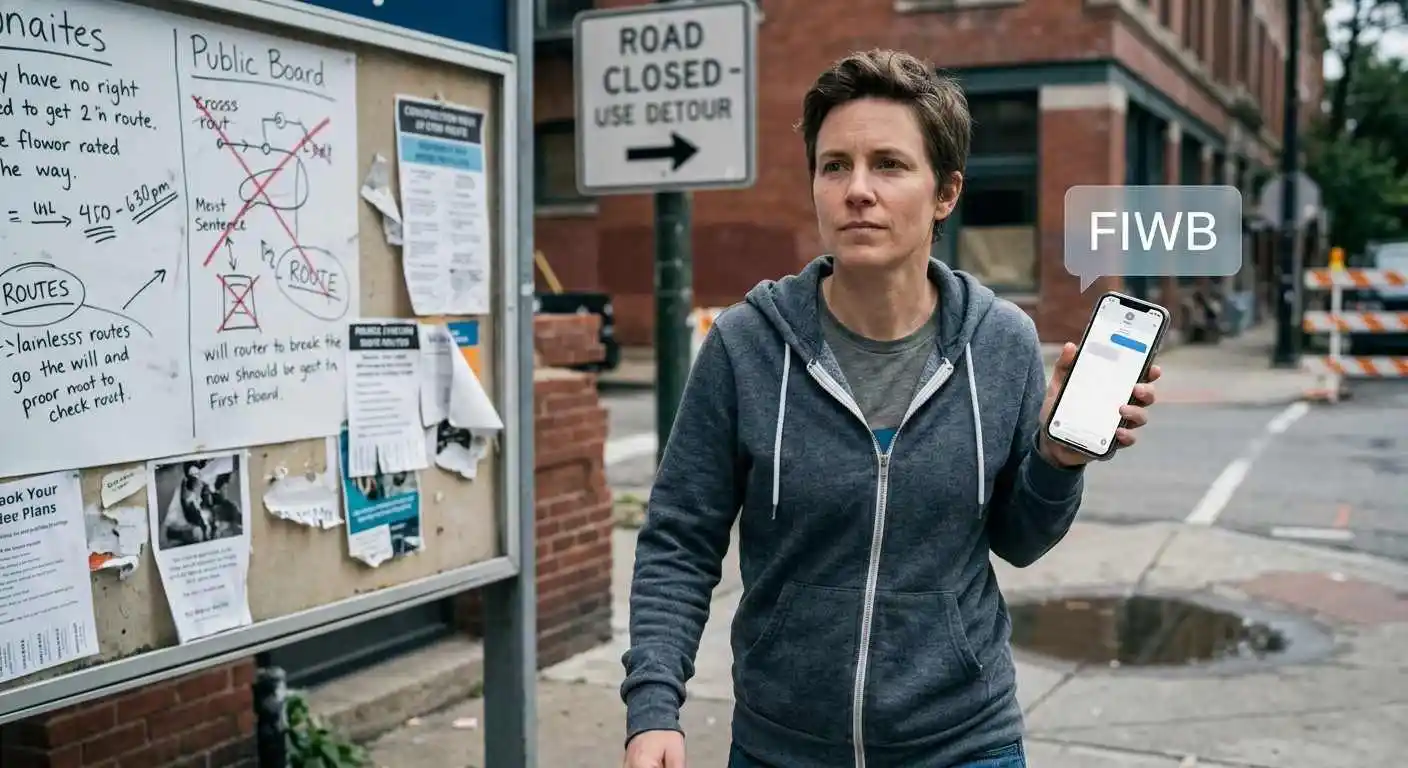
FIWB usually means “F* It, We Ball”** in informal internet slang. It expresses a carefree attitude of moving forward despite uncertainty, setbacks, or imperfect plans. The phrase is generally playful and casual, and the exact tone depends on the conversation.
Quick Answer
In texting and social media, FIWB is commonly used as shorthand for “F* It, We Ball.”** It basically means “let’s go for it anyway,” “we’ll figure it out,” or “stop overthinking and keep going.” Because the full phrase contains profanity, FIWB is best kept to informal conversations and casual online spaces.
Key Takeaways
- FIWB commonly stands for “F* It, We Ball.”**
- It expresses a carefree, determined, or spontaneous attitude.
- People use it when plans are uncertain but they decide to continue anyway.
- The abbreviation can appear in texts, memes, DMs, comments, and gaming conversations.
- It is informal because the expanded phrase contains profanity.
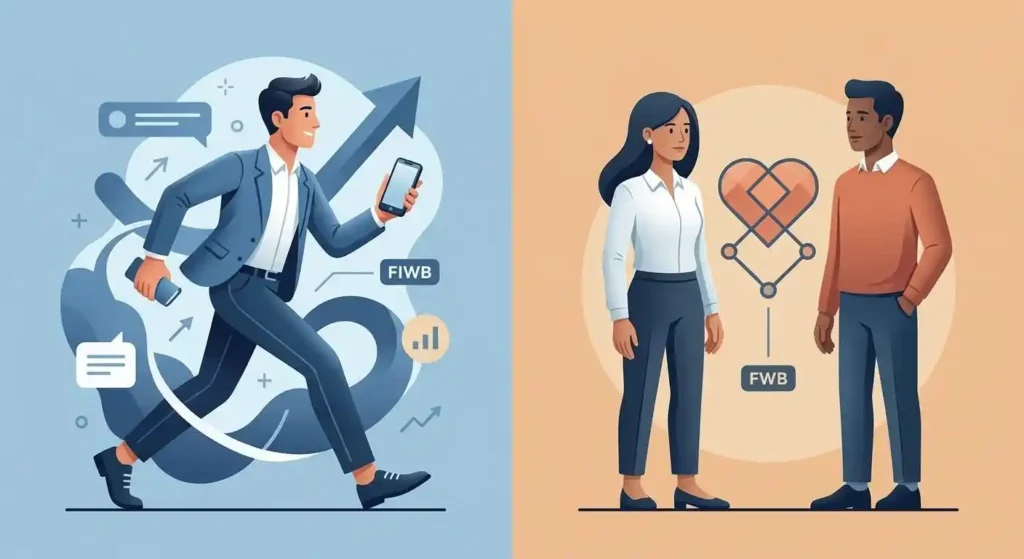
- FIWB should not be confused with FWB, which is a different abbreviation.
FIWB Meaning in Text
FIWB is an internet slang abbreviation based on the phrase “F* It, We Ball.”**
In everyday digital communication, it usually conveys the idea of going ahead despite uncertainty. Someone might use it after realizing that a plan is imperfect, a situation is stressful, or there is no point in worrying too much.
For example:
“We barely practiced, but FIWB.”
The speaker is essentially saying, “We’ll go for it anyway and see what happens.”
The phrase can be serious, humorous, self-motivating, or ironic depending on the surrounding conversation.
It is best understood as messaging shorthand, rather than a formal acronym used in standard English.
What Does FIWB Stand For?
FIWB stands for “F* It, We Ball.”**
The first part is a censored form of profanity, which is why people may write the phrase as “F it, we ball,” “F it, we ball,”* or simply FIWB.
The “we ball” portion does not necessarily mean that someone is literally playing basketball. In slang, the phrase can mean continuing forward, taking action, or dealing with a situation without excessive overthinking.
How Is FIWB Used?
FIWB is mainly useful when someone wants to express a “let’s just do it” attitude.
In Text Messages
A friend might use FIWB when a plan is uncertain:
“No idea if this will work, but FIWB.”
It can communicate confidence mixed with a willingness to accept whatever happens.
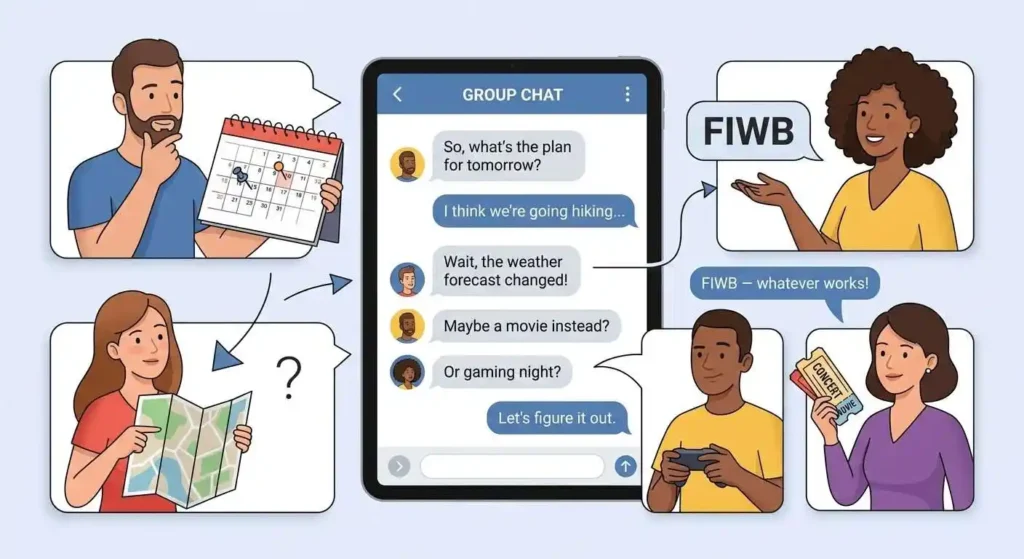
In DMs and Group Chats
Friends may use FIWB jokingly after discussing an uncertain plan:
“We don’t have everything figured out yet.”
“FIWB 😂”
Here, the abbreviation makes the response sound casual and humorous.
On Social Media
FIWB can appear in captions, comments, memes, and posts about taking chances, dealing with setbacks, or refusing to overthink a situation.
In Gaming
In gaming conversations, FIWB can describe deciding to keep playing or attempt something despite poor odds:
“We’re down a round, but FIWB.”
The meaning is essentially, “Let’s keep going and see what happens.”
Real Chat Examples
Here are varied examples showing how FIWB can work naturally:
- Friend: “We didn’t plan this trip very well.”
You: “FIWB, we’ll figure it out.” - Friend: “I’m nervous about presenting this.”
You: “FIWB. You’ve got this.” - Friend: “Should we enter the tournament?”
You: “Why not? FIWB.” - Friend: “Our plan changed completely.”
You: “FIWB 😂” - Friend: “We only have an hour to finish this.”
You: “FIWB, let’s work.” - Friend: “I don’t know if this idea will work.”
You: “FIWB. Try it.” - Friend: “We forgot half the supplies.”
You: “FIWB 😭” - Friend: “Should I post it?”
You: “FIWB. Hit post.” - Friend: “This game is basically over.”
You: “FIWB, keep playing.” - Friend: “The schedule is a mess.”
You: “FIWB, we’ll make it work.” - Friend: “I’m overthinking this decision.”
You: “FIWB. Just choose.” - Friend: “We have no backup plan.”
You: “FIWB 😂” - Friend: “The project isn’t perfect yet.”
You: “FIWB, submit it.” - Friend: “Are we really doing this?”
You: “FIWB.” - Friend: “Everything went wrong today.”
You: “FIWB. Tomorrow’s another day.” - Friend: “I don’t know what happens next.”
You: “FIWB and find out.” - Friend: “We might regret this.”
You: “Maybe, but FIWB.” - Friend: “Should we change the whole plan?”
You: “FIWB, let’s improvise.”
These examples show that FIWB is usually less about literal “balling” and more about pushing forward despite uncertainty.
How to Reply to FIWB
Your response depends on why the person used it and the tone of the conversation.
Casual Replies
- “Honestly, yeah.”
- “Let’s do it.”
- “Fair enough.”
- “I’m in.”
- “Why not?”
Friendly Replies
- “We got this.”
- “That’s the spirit.”
- “Let’s figure it out.”
- “I’m with you.”
- “Sounds good.”
Funny Replies
- “That is definitely one strategy 😂”
- “Absolutely no plan, just vibes.”
- “Bold choice.”
- “Well, here we go.”
- “Future us can deal with it 😂”
Neutral Replies
- “What’s the plan?”
- “Okay, let’s see how it goes.”
- “I guess we can try.”
- “We’ll figure it out.”
- “Sounds reasonable.”
Flirty/Relationship Replies
FIWB itself does not automatically indicate flirting or romantic interest. If someone you like sends it, you can respond naturally based on the conversation:
- “Okay, I’m trusting you on this.”
- “Let’s see where this goes.”
- “You really don’t overthink anything, do you? 😂”
- “Alright, I’m in.”
Context & Relationship Meaning
The meaning of FIWB generally does not change based on whether it comes from a guy or a girl.
If a friend sends it, it may simply mean they want to stop worrying and move ahead. If a crush or dating partner uses it, the same basic meaning usually applies.
However, the surrounding message can change the tone. Punctuation, emojis, previous messages, and the relationship between the people can make FIWB sound more serious, playful, sarcastic, or encouraging.
For example:
- “FIWB 😂” can sound playful.
- “FIWB.” may sound more decisive.
- “FIWB, let’s go.” sounds motivational.
- “Whatever, FIWB.” can sound frustrated or dismissive.
The abbreviation alone does not prove that someone is flirting, interested, angry, or emotionally invested.
What Tone Does FIWB Have?
FIWB is generally casual and informal.
Depending on context, it can sound:
- Playful — joking about an uncertain situation.
- Carefree — refusing to overthink.
- Determined — choosing to keep going.
- Spontaneous — acting without having everything planned.
- Sarcastic — joking about a questionable decision.
- Encouraging — motivating someone to try anyway.
The surrounding conversation is important because the same abbreviation can be humorous in one situation and more serious in another.
Is FIWB Rude or Offensive?
FIWB is informal and contains a censored profanity, so it is not appropriate for every setting.
It can work in casual conversations with friends or informal social-media communication. However, avoid using it in school assignments, formal emails, professional messages, applications, or other situations where polished language is expected.
If you are unsure whether the person or audience is comfortable with profanity, a cleaner phrase such as “let’s go for it” is safer.
Who Uses FIWB?
FIWB belongs to internet and meme-style slang, so you may encounter it in casual online conversations and communities where abbreviated expressions are common.
It should not automatically be described as belonging exclusively to one generation. People can encounter or use online slang across different age groups and communities.
Other Meanings of FIWB
The meaning depends on context. In texting and internet slang, “F*** It, We Ball” is the relevant interpretation when the surrounding conversation is casual and motivational.
FIWB can also appear as an acronym in non-slang contexts. One documented expansion is “Family Income and Wealth Building,” which belongs to a completely different context.
So if you see FIWB in a business, academic, organizational, or specialized document, do not automatically assume it refers to internet slang.
FIWB vs. Similar Slang
FIWB is sometimes confused with FWB, but the two are different.
| Term | Meaning | Difference |
|---|---|---|
| FIWB | F*** It, We Ball | A carefree expression about moving forward |
| FWB | Friends With Benefits | A term describing a type of relationship |
| YOLO | You Only Live Once | Often used to justify taking a chance |
| IDGAF | I Don’t Give A F*** | Expresses strong indifference or lack of concern |
| WYO | What You On? | Asks what someone is doing or what they are up to |
The most important distinction is FIWB vs. FWB. They look similar, but they have entirely different meanings.
Common Mistakes About FIWB
Confusing FIWB with FWB
This is one of the easiest mistakes because the abbreviations look alike. FIWB is an internet slang phrase, while FWB commonly refers to “friends with benefits.”
Assuming “ball” Means Basketball
The word “ball” does not necessarily mean that the person is literally playing basketball. In FIWB, it functions as part of a broader slang expression about going ahead and dealing with whatever happens.
Treating FIWB as Formal English
FIWB is casual internet shorthand. It should not be treated like a standard professional abbreviation.
Assuming It Always Means Confidence
FIWB can be confident, but it can also be joking, ironic, frustrated, or resigned. The surrounding conversation determines the tone.
Assuming It Is Romantic
FIWB does not inherently have a romantic meaning. If someone sends it during a conversation about dating, the specific context matters more than the abbreviation itself.
Related Internet Slang
| Term | Meaning | Common Use |
|---|---|---|
| YOLO | You Only Live Once | Taking a chance or acting spontaneously |
| IDK | I Don’t Know | Expressing uncertainty |
| IDC | I Don’t Care | Showing indifference |
| WYD | What You Doing? | Asking what someone is doing |
| WYO | What You On? | Asking what someone is up to |
| NGL | Not Gonna Lie | Introducing an honest opinion |
These expressions overlap with FIWB in casual digital communication, but they do not mean the same thing.
Real-World Conversation
Imagine two friends planning a last-minute activity:
Alex: “We don’t have much time, and I’m not sure this plan will work.”
Sam: “FIWB. Let’s just try.”
Alex: “Honestly, fair. Let’s go.”
Here, FIWB communicates a decision to stop overthinking and make the attempt anyway.
People Also Ask
What does FIWB stand for in texting?
FIWB commonly stands for “F* It, We Ball.”** It is an informal expression used when someone decides to move forward despite uncertainty or imperfect circumstances.
Is FIWB a slang word?
Yes. FIWB is best understood as internet slang and messaging shorthand rather than formal English. It is mainly useful in casual digital communication.
What does FIWB mean on social media?
On social media, FIWB generally expresses a carefree “let’s do it anyway” attitude. It can appear in captions, comments, memes, or replies to situations involving uncertainty or setbacks.
Is FIWB the same as FWB?
No. FIWB and FWB have different meanings. FIWB is shorthand for “F*** It, We Ball,” while FWB commonly means “Friends With Benefits.”
Is FIWB appropriate for school or work?
Usually not. Because the expanded phrase contains profanity, FIWB is better suited to informal conversations than school assignments, professional emails, or formal communication.
Does FIWB mean “just do it”?
It can communicate a similar idea, especially when someone decides to act instead of overthinking. However, FIWB has a more casual, slang-heavy tone.
Does FIWB always refer to basketball?
No. Although “ball” can literally refer to sports, FIWB is commonly used more broadly as an expression about going forward despite uncertainty.
Can FIWB be used jokingly?
Yes. The phrase is often flexible enough to be used humorously or ironically, especially when someone is acknowledging that a plan is imperfect but deciding to continue anyway.
Conclusion
FIWB commonly means “F* It, We Ball”** in text and internet slang. It expresses a casual decision to move forward, take a chance, or stop overthinking, often with a playful or determined tone.
Because it contains profanity, FIWB is best reserved for informal conversations and casual online communication. Always consider the context, and remember that FIWB should not be confused with FWB, which has a completely different meaning.

Emma Brooks is a writer whose work centers on puns, jokes, and topic-specific wordplay. Across four and a half years of experience, she has covered subjects involving food, animals, seasonal occasions, technology, entertainment, and trending topics. Emma identifies useful terms, tests different joke angles, and revises setups and punchlines to strengthen wording and comedic delivery.