WTV usually means “whatever” in text messages and online chats. It is an informal texting abbreviation used to show indifference, flexibility, or that something does not matter much. Depending on context, it can sound casual, playful, dismissive, or slightly annoyed.
Key Takeaways
- WTV means “whatever” in most texting and internet-slang contexts.
- It can mean “I don’t mind,” “it’s up to you,” or “I don’t care,” depending on the conversation.
- WTV is a form of informal messaging shorthand, so it fits casual communication better than formal writing.
- A standalone “wtv” can sound dismissive, especially during an argument.
- The sender’s wording, punctuation, emojis, and relationship with you can help reveal the intended tone.
- WTV can also appear with other meanings, including “Watching TV” in some casual abbreviation lists and .wtv, a Windows Recorded TV Show file format.
WTV Meaning in Text
The main WTV meaning in text is “whatever.”
It is a shortened form of a common word used in everyday conversation. In texting, people may use WTV when they:
- Do not have a strong preference
- Are okay with either choice
- Want to show that something does not matter
- Do not want to keep discussing an issue
- Feel mildly annoyed or dismissive
For example:
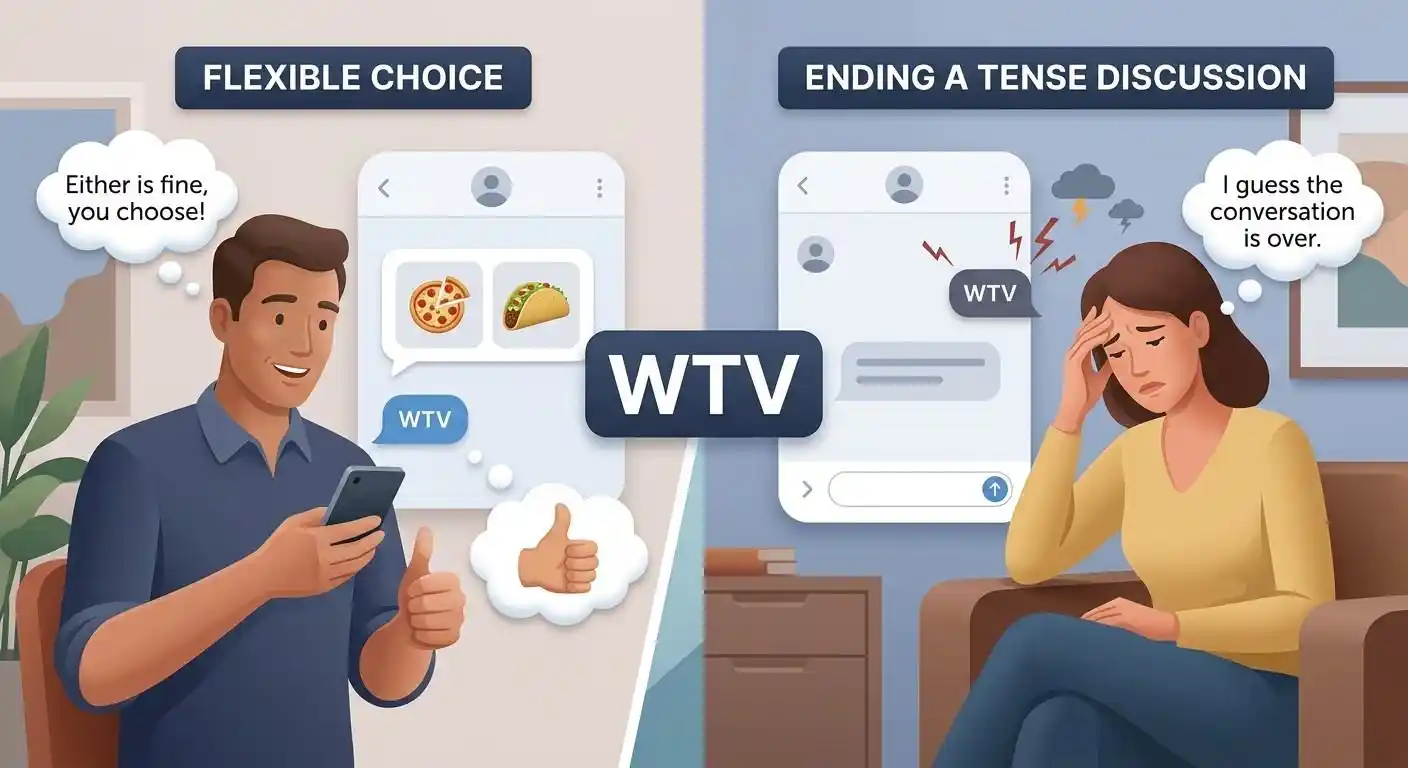
“Pizza or burgers?”
“wtv, you choose.”
Here, WTV probably means “whatever, I’m fine with either.”
But consider:
“You never listen to me.”
“wtv.”
In this situation, WTV may sound more like “whatever, I’m done talking about this.”
So the abbreviation itself does not determine the emotion. Context gives WTV its tone.
WTV is best understood as internet slang, texting shorthand, or a messaging abbreviation rather than formal English.
What Does WTV Stand For?
WTV stands for “whatever.”
It is not usually treated like a traditional acronym with a separate formal expansion. Instead, it is a shortened texting form of the word whatever.
The lowercase form “wtv” and uppercase form “WTV” generally carry the same meaning. The capitalization usually reflects the sender’s normal typing style rather than a different definition.
What Can “Whatever” Mean?
The underlying word can express slightly different ideas:
- “I don’t mind.”
- “It’s up to you.”
- “Anything is fine.”
- “I don’t care.”
- “Let’s drop the subject.”
That is why two messages containing WTV can feel completely different.
How Is WTV Used?
WTV is mainly used in casual digital communication, including text messages, group chats, DMs, and social-media conversations. Current slang references also associate it with online chat and messaging.
In Text Messages
Someone may use WTV when they do not care which option is chosen.
“What time should we meet?”
“wtv works for me.”
In Group Chats
WTV can be a quick way to avoid making a decision.
“Movie or bowling?”
“Wtv y’all pick.”
In DMs and Social Media
It can also appear in short replies or comments.
“She said you copied her.”
“wtv 😂”
Here, the emoji may make the response feel more playful than serious.
In Online Arguments
WTV can become more dismissive when the conversation is tense.
“Can we please talk about what happened?”
“wtv.”
In that setting, the sender may be signaling that they do not want to continue the discussion.
WTV in Different Contexts
The meaning of WTV stays centered on “whatever,” but its emotional tone can change with the situation.
From a Friend
A friend saying:
“Wtv, you pick.”
may simply mean “I’m okay with whatever you choose.”
From a Guy
If a guy texts “wtv,” the abbreviation itself does not prove anything about his feelings. It could mean he is indifferent, flexible, annoyed, or simply being casual.
Look at the surrounding conversation rather than assuming romantic meaning.
From a Girl
The same applies if a girl sends WTV. The abbreviation does not automatically indicate flirting, anger, rejection, or interest.
The previous messages and overall situation matter more than the sender’s gender.
From a Crush
If someone you have a crush on sends “wtv,” do not automatically read it as a romantic signal.
For example:
“Where do you want to eat?”
“wtv, you choose.”
This probably means they are flexible about the restaurant—not necessarily that they are sending a hidden relationship message.
In Dating or a Relationship
WTV can be harmless in a relaxed conversation:
“Beach or movie tonight?”
“wtv, I’m good with either.”
But during a disagreement, it may sound cold:
“I thought you wanted to talk about it.”
“wtv.”
In that case, the person may be trying to end the discussion or showing frustration.
In a Group Chat
WTV can simply mean “I don’t have a preference.”
“Should we meet at 6 or 7?”
“wtv works.”
In Social Media Comments
A short “wtv” comment can communicate indifference or dismissal. Emojis and the rest of the comment can make the intended attitude easier to understand.
Real Chat Examples
Here are natural examples showing how WTV can work in different situations:
- Friend: “Where should we eat?”
You: “wtv, I’m good anywhere.” - Friend: “Movie or bowling?”
You: “WTV you want.” - Group chat: “6 or 7?”
Reply: “wtv works for me.” - Friend: “Do you want pizza?”
Reply: “Yeah, wtv.” - Friend: “Blue shirt or black shirt?”
Reply: “wtv looks good.” - Sibling: “Are you coming with us?”
Reply: “wtv, maybe.” - Friend: “Should we go today or tomorrow?”
Reply: “Wtv is fine.” - Friend: “You pick the restaurant.”
Reply: “wtv 😂” - Friend: “Why are you still arguing about this?”
Reply: “wtv.” - Friend: “I told you what happened.”
Reply: “Wtv, I’m over it.” - Group chat: “Beach or park?”
Reply: “wtv y’all decide.” - Friend: “Do you want to watch a comedy?”
Reply: “Wtv you want.” - Friend: “Are you mad?”
Reply: “wtv, it’s fine.” - Friend: “Pick any dessert.”
Reply: “Wtv works.” - Friend: “Should I call you later?”
Reply: “wtv.” - Friend: “You seriously believe that?”
Reply: “WTV 😂” - Friend: “Can we stop talking about this?”
Reply: “wtv.” - Group chat: “Who wants to choose the playlist?”
Reply: “wtv, someone else pick.” - Friend: “Does 8 PM work?”
Reply: “Yeah, wtv.” - Friend: “Okay, do what you want.”
Reply: “Wtv.”
These examples show why WTV cannot always be translated into one exact emotional meaning. The basic idea is “whatever,” while the situation determines whether it feels relaxed, indifferent, playful, or dismissive.
How to Reply to WTV
Your response should depend on what the sender appears to mean.
Casual Replies
- “Cool, you pick then.”
- “Works for me.”
- “Okay, either is fine.”
- “Sounds good.”
- “You decide 😂”
Friendly Replies
- “Haha okay, I’ll choose.”
- “Fair enough.”
- “No worries.”
- “Got you.”
- “Alright, let’s do it.”
Funny Replies
- “Wow, such enthusiasm 😂”
- “That was a very passionate answer.”
- “Okayyy, Mr./Ms. Whatever 😂”
- “I’ll take that as a vote for everything.”
- “Your decision-making skills are impressive 😂”
Neutral Replies
- “Okay.”
- “No problem.”
- “Got it.”
- “Which option works better for you?”
- “Let me know if you change your mind.”
Flirty/Relationship Replies
WTV does not automatically have a romantic meaning, so a flirty response is only appropriate when the overall conversation is already clearly romantic or playful.
- “You’re letting me choose? Dangerous move 😄”
- “Okay, then I’m picking.”
- “Fine, but you’re coming with me.”
- “Deal.”
What Tone Does WTV Have?
WTV is informal and context-dependent.
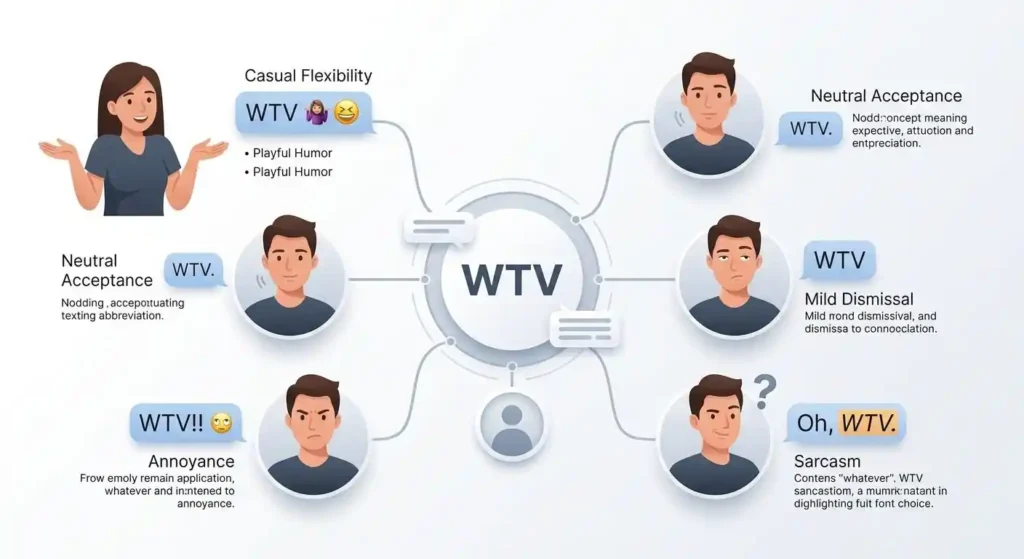
It can sound:
- Casual — “WTV works for me.”
- Flexible — “Pick wtv you want.”
- Playful — “WTV 😂”
- Neutral — “WTV is fine.”
- Dismissive — “Wtv.”
- Annoyed — “WTV, I’m done arguing.”
- Sarcastic — “WTV 🙄”
A useful clue is how much is written around the abbreviation.
“wtv lol” may feel lighter than a standalone “wtv.” Likewise, emojis, punctuation, and the conversation immediately before it can change how the message is interpreted.
Is WTV Rude or Offensive?
WTV is not inherently rude or offensive. It is informal slang, and its tone depends heavily on context.
With friends, it can be completely harmless:
“Wtv, you choose 😂”
During an argument, however, a one-word “wtv” may sound dismissive or like the sender does not want to continue the conversation.
Casual Conversations
Generally fine when everyone understands the informal tone.
Social Media
It can work in casual comments, replies, and DMs.
School
It is better kept out of assignments and formal school writing. A teacher or classmate may understand it in a casual message, but “whatever” is clearer in formal communication.
Work
Avoid WTV in professional emails, workplace documents, and formal messages. Writing the full word is clearer and more professional.
Formal Writing
Use “whatever” rather than WTV in essays, reports, applications, and other formal writing.
Other Meanings of WTV
The texting meaning “whatever” is the main meaning relevant to casual messaging, but WTV can have other uses in specific contexts.
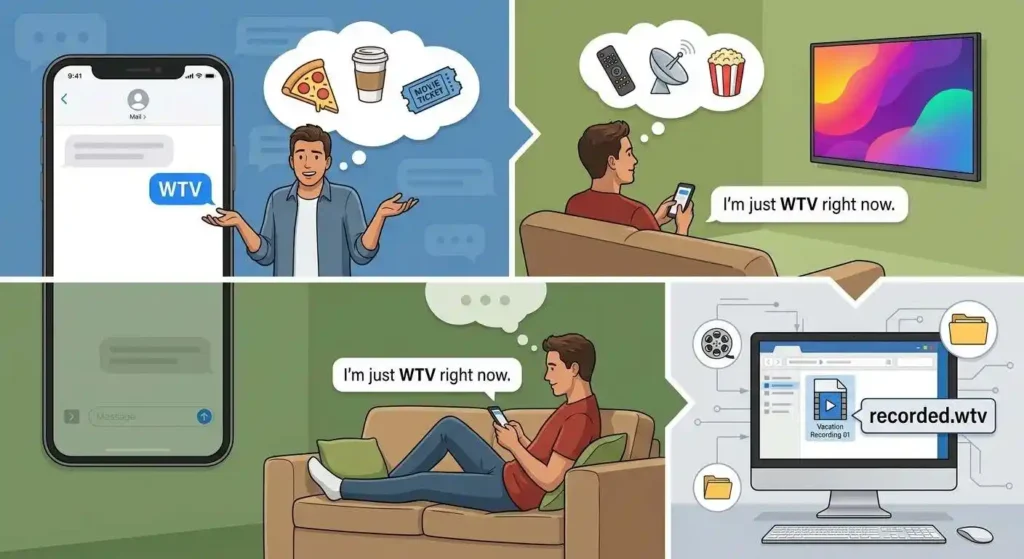
WTV as “Watching TV”
Some abbreviation references list WTV or wtv as shorthand for “Watching TV” in casual chat.
For example:
“What are you doing?”
“wtv rn.”
Here, the context could indicate “watching TV right now.”
This meaning is much more context-dependent than the standard texting meaning “whatever.”
WTV as a File Extension
In technology, .wtv refers to a Windows Recorded TV Show file format associated with Windows Media Center. It is unrelated to the texting slang “whatever.”
If you see something like “episode.wtv” on a computer, you are looking at a file extension rather than texting slang.
Common Mistakes About WTV
Assuming WTV Always Means “I Don’t Care”
Sometimes WTV means “I don’t mind” rather than genuine indifference.
“Pizza or tacos?”
“wtv.”
The sender may simply be happy with either option.
Assuming WTV Is Always Rude
A standalone WTV can sound dismissive, but it is not automatically rude. The surrounding conversation matters.
Assuming WTV Means Something Romantic
WTV does not prove that someone is flirting, interested, upset, or losing interest. The relationship and conversation provide the context.
Confusing WTV With “Watching TV”
The surrounding words usually help separate the meanings. “wtv, you choose” strongly suggests whatever, while “wtv rn” may be interpreted as watching TV right now in contexts where that shorthand is being used.
Using WTV in Formal Writing
WTV is casual messaging shorthand. Use “whatever” in professional, academic, and formal writing instead.
WTV and Related Slang
| Term | Meaning | Common Use |
|---|---|---|
| WTV | Whatever | Showing indifference or flexibility |
| IDC | I don’t care | Directly expressing lack of concern |
| NVM | Never mind | Dropping or withdrawing a topic |
| IDK | I don’t know | Showing uncertainty |
| TBH | To be honest | Introducing an honest opinion |
| FR | For real | Agreement or emphasis |
These terms can overlap in casual conversations, but they are not interchangeable. For example, WTV can mean “you choose,” while IDC more directly communicates “I don’t care.”
People Also Ask About WTV
What does WTV mean in a text message?
WTV usually means “whatever.” It can express flexibility, indifference, or a desire to move past a topic.
Is WTV the same as whatever?
Yes. In texting, WTV is a shortened form of “whatever.” The abbreviation keeps the meaning while making the message shorter.
Does WTV mean “I don’t care”?
It can. Depending on context, WTV may mean “I don’t care,” “I don’t mind,” or “you decide.” It does not always express a negative attitude.
Is WTV rude?
Not necessarily. WTV can be casual and harmless, but a short response like “wtv.” during an argument may sound dismissive or annoyed.
What does WTV mean from a guy or girl?
The basic meaning does not change based on gender. If a guy or girl texts WTV, interpret it using the conversation, wording, emojis, and relationship context rather than assuming a romantic message.
Can WTV mean “Watching TV”?
Yes. Some slang and abbreviation references use WTV for “Watching TV.” Context is important because “whatever” is the main meaning in ordinary texting.
What is the difference between WTV and IDC?
WTV means “whatever” and can suggest flexibility or indifference. IDC means “I don’t care” and is usually more direct about not caring.
Conclusion
WTV means “whatever” in text and casual online communication. It is an informal messaging abbreviation that can express indifference, flexibility, acceptance, or dismissal depending on the situation.
The tone can range from casual and playful to cold or annoyed, so the surrounding conversation matters. WTV is suitable for casual chats but is better avoided in formal school, workplace, and professional writing.
In some contexts, WTV can also mean “Watching TV,” while .wtv has a separate technology-related meaning as a Windows Recorded TV Show file format.

Emma Brooks is a writer whose work centers on puns, jokes, and topic-specific wordplay. Across four and a half years of experience, she has covered subjects involving food, animals, seasonal occasions, technology, entertainment, and trending topics. Emma identifies useful terms, tests different joke angles, and revises setups and punchlines to strengthen wording and comedic delivery.