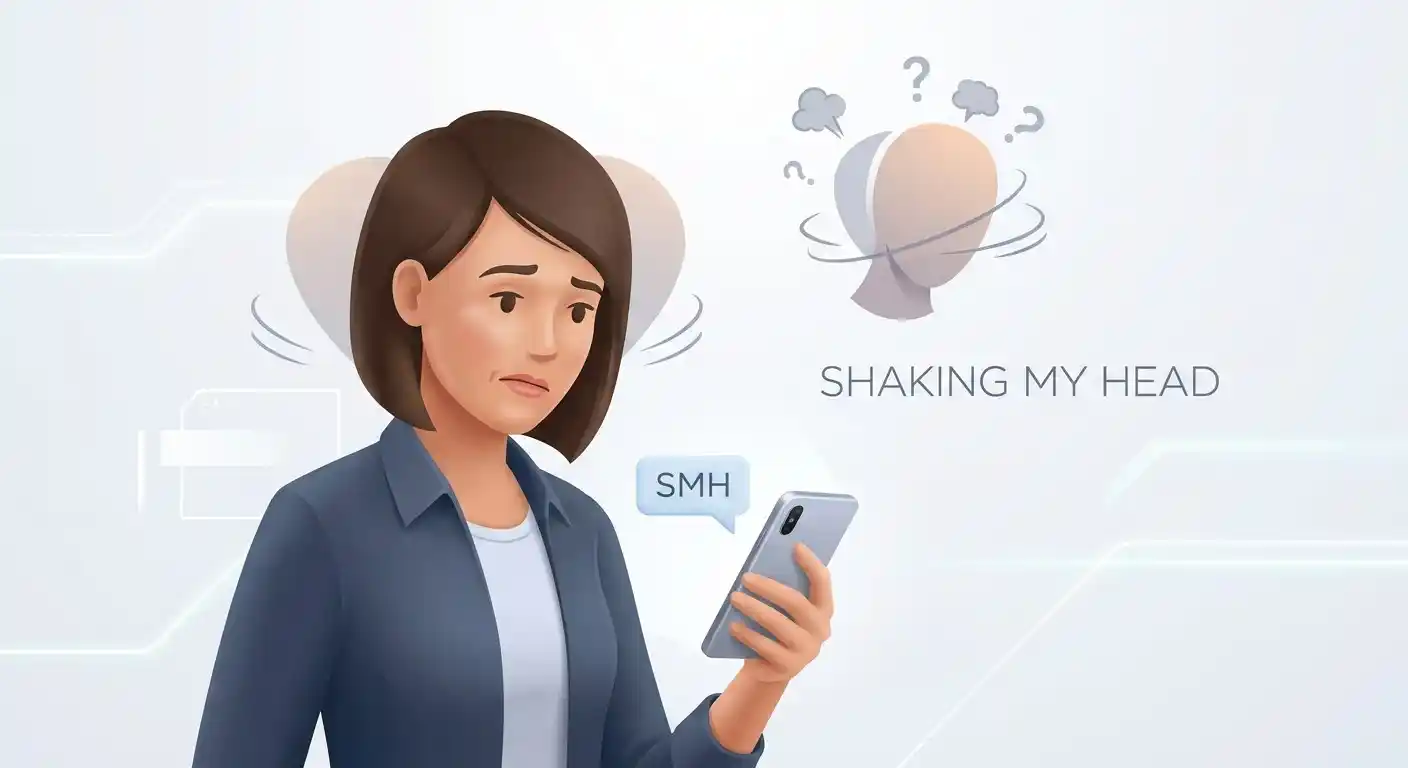
SMH means “shaking my head” in text messages and online communication. It is an informal texting abbreviation used to express disbelief, disappointment, frustration, annoyance, or mild disapproval about something someone said or did.
Key Takeaways
- SMH stands for “shaking my head.”
- It is a texting abbreviation and internet slang expression, not a traditional word.
- People use it when something seems silly, disappointing, frustrating, ridiculous, or hard to believe.
- Among friends, SMH can be playful or teasing rather than genuinely angry.
- In a serious conversation, it can sound critical, dismissive, or annoyed.
- The meaning is usually clear from the surrounding conversation, punctuation, emojis, and relationship between the people texting.
SMH Meaning in Text
In texting, SMH means “shaking my head.” It represents the reaction of shaking your head when you cannot believe something, disagree with it, or feel disappointed by what happened.
For example:
“You forgot your keys again? SMH.”
The sender is essentially communicating something like “I can’t believe you did that again” or “That’s frustrating.”
SMH is usually an informal internet slang abbreviation. It can appear as SMH or smh, with lowercase often feeling more casual.
The expression does not always mean serious anger. Depending on the situation, it can communicate:
- Disbelief
- Disappointment
- Frustration
- Mild annoyance
- Disapproval
- Amused disbelief
- Playful teasing
The context determines which feeling is strongest.
What Does SMH Stand For?
SMH stands for “shaking my head.”
Each letter represents a word:
- S = Shaking
- M = My
- H = Head
The phrase describes a physical reaction, but in texting, it works as messaging shorthand for an emotional reaction.
For example:
“He seriously forgot the appointment again. SMH.”
This does not mean the sender is necessarily physically shaking their head. It means they are expressing disbelief or frustration about what happened.
How Is SMH Used?
SMH is mainly used in casual online communication.
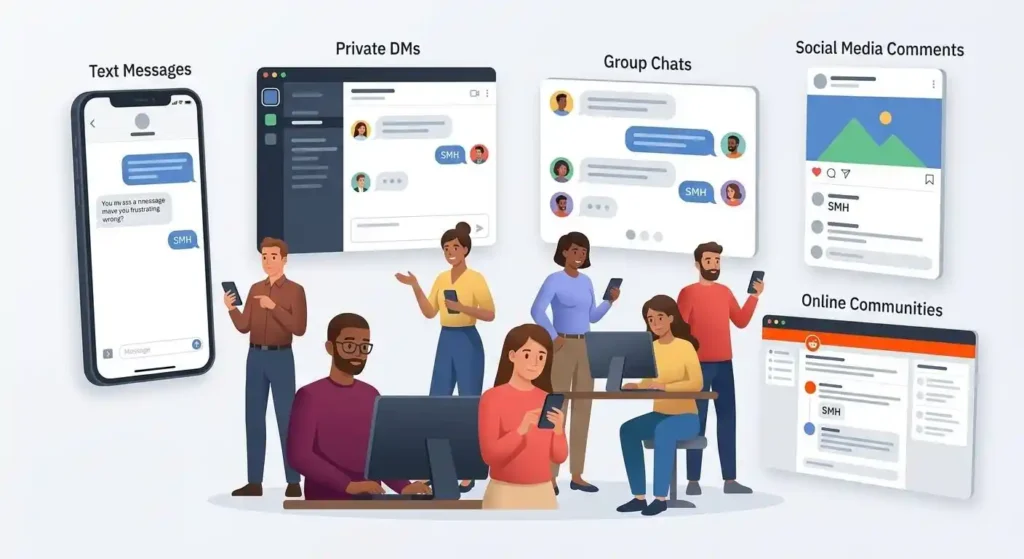
Text Messages
Friends may use it to react to mistakes or silly situations:
“I left my lunch at home again smh.”
DMs
Someone might use SMH as a quick reaction:
“You actually watched the whole thing? SMH 😂”
Group Chats
It can work as a short reaction to something another person says:
“Y’all really did that? SMH.”
Social Media Comments
SMH can appear as a reaction to posts, comments, memes, or surprising situations:
“People really believe this? SMH.”
Online Communities
It can also be used in casual online discussions when someone wants to show disagreement, disbelief, or frustration without writing a long response.
SMH is generally informal, so it is not a good substitute for clear professional wording in formal communication.
SMH in Different Contexts
The basic meaning stays the same, but the tone can change considerably.
From a Friend
If a friend writes:
“You forgot your wallet again, smh 😂”
the message is likely playful or teasing.
The emoji and friendly relationship make the reaction feel lighter.
From a Guy
If a guy sends:
“SMH you really did that?”
the abbreviation itself does not reveal whether he is joking, annoyed, or teasing.
Look at the surrounding messages and the situation rather than assuming his gender changes the meaning.
From a Girl
The same applies if a girl sends:
“smh 😂”
It could express playful disbelief, frustration, or amusement depending on what happened.
From a Crush
If someone you like sends SMH, don’t automatically interpret it as flirting or romantic interest.
For example:
“You seriously watched that movie without me? SMH 😂”
could simply be playful teasing.
In Dating
SMH can be lighthearted in a dating conversation:
“You forgot the restaurant name already? smh 😂”
But it can also express genuine disappointment:
“We talked about this yesterday. SMH.”
The surrounding conversation matters more than the abbreviation itself.
In a Relationship
Partners may use SMH to tease each other or express mild frustration:
“You left your shoes in the hallway again. SMH.”
This could be affectionate teasing or actual annoyance. The relationship and previous messages help determine the tone.
In a Group Chat
Group chats often make SMH more playful:
“You guys actually ordered 12 pizzas? SMH 😭”
Here, the expression can communicate amused disbelief rather than serious criticism.
Real Chat Examples
Here are realistic ways SMH can appear in conversations.
Disbelief
1.
A: “He forgot his own birthday.”
B: “SMH.”
2.
A: “She showed up two hours late.”
B: “smh, seriously?”
3.
A: “He said he didn’t know the test was today.”
B: “SMH 😭”
4.
A: “You really bought another pair of shoes?”
B: “SMH 😂”
Frustration
5.
A: “They changed the schedule again.”
B: “SMH.”
6.
A: “The website crashed right before I submitted it.”
B: “Ugh, smh.”
7.
A: “I forgot my charger at home.”
B: “SMH, not again.”
8.
A: “They canceled the event at the last minute.”
B: “smh.”
Disappointment
9.
A: “He promised he would help and didn’t show up.”
B: “SMH. That’s disappointing.”
10.
A: “They left without telling me.”
B: “Wow, smh.”
Playful Teasing
11.
A: “I watched the same episode three times.”
B: “SMH 😂”
12.
A: “I forgot where I parked.”
B: “SMH, how? 😭”
13.
A: “I ate the last slice.”
B: “SMH, you didn’t even ask.”
14.
A: “I wore two different socks today.”
B: “SMH 😂”
Self-Directed Use
SMH can also be directed at yourself:
15.
A: “I locked myself out again. SMH.”
16.
A: “Forgot my homework at home… smh.”
17.
A: “I just sent that message to the wrong person. SMH 😭”
Social Media Reactions
18.
Comment: “People still believe this? SMH.”
19.
Comment: “He really posted that? smh 😂”
20.
Comment: “This comment section… SMH.”
These examples show why SMH should be interpreted with the entire message, rather than assuming that every use means serious anger.
How to Reply to SMH
Your reply should depend on why the person used SMH.
Casual Replies
- “I know 😂”
- “I know, right?”
- “Fair enough.”
- “Yeah, my bad.”
- “Honestly 😂”
Friendly Replies
- “Okay, okay, I get it 😂”
- “Don’t judge me!”
- “I couldn’t help it.”
- “You know me too well.”
- “Haha, fair.”
Funny Replies
- “Don’t shake your head too hard 😂”
- “I stand by my decision.”
- “No regrets 😭”
- “You knew this was coming.”
- “What can I say? 😂”
Neutral Replies
If you cannot tell whether the person is joking:
- “Wait, what do you mean?”
- “Are you serious?”
- “Why SMH?”
- “Did I do something?”
- “What’s wrong?”
Flirty/Relationship Replies
If the broader conversation is already clearly playful or romantic, you could respond:
- “You secretly love my chaos 😂”
- “Aww, don’t be like that.”
- “You know you think it’s cute.”
- “Okay, okay, I’ll behave.”
- “You’re still talking to me though 😂”
SMH alone does not establish romantic interest, so the rest of the conversation is important.
What Tone Does SMH Have?
SMH is context-dependent, but several tones are common.
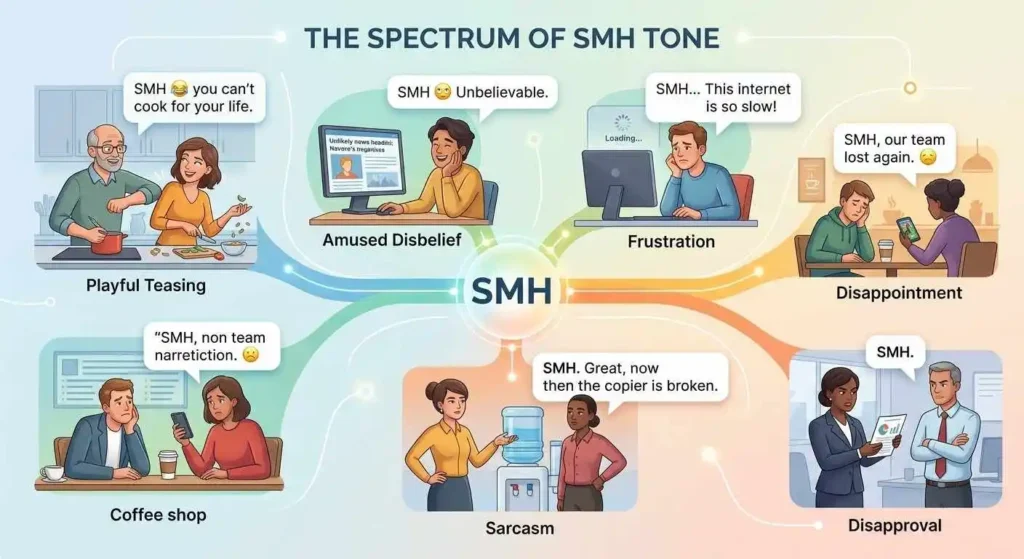
Casual
A simple:
“smh”
can be an informal reaction between people who regularly use texting slang.
Frustrated
“You forgot again. SMH.”
Here, the sender sounds genuinely annoyed or disappointed.
Playful
“You ate the whole cake? SMH 😂”
The emoji and situation can make the message teasing rather than harsh.
Sarcastic
SMH can accompany sarcasm when someone is deliberately exaggerating their reaction.
Disapproving
“You knew that wasn’t okay. SMH.”
In this setting, it can sound more critical.
Direct
A standalone “SMH” can feel stronger because there is no explanation softening the reaction.
A message such as:
“SMH 😂”
usually feels lighter than:
“SMH.”
Punctuation, emojis, and surrounding words can affect how the message is interpreted.
Is SMH Rude or Offensive?
SMH is not inherently offensive or profane, but it can sound dismissive or judgmental depending on the situation.
Casual Conversations
It is generally appropriate for informal conversations when the other person understands texting slang.
Friends
Friends may use it jokingly:
“You forgot your own password? SMH 😂”
Social Media
It can be used casually in comments and replies, although the tone may be interpreted differently by strangers.
School
It may be fine in casual messages between friends, but it is not appropriate for formal assignments.
Work
Use caution in professional communication. Even though SMH is not a swear word, it can sound dismissive or unprofessional when directed at a coworker or supervisor.
Formal Writing
Avoid SMH in essays, reports, applications, and other formal writing unless you are specifically discussing the abbreviation.
Other Meanings of SMH
For ordinary texting and social media, “shaking my head” is the established meaning of SMH. Collins lists SMH as an abbreviation for “shaking my head” specifically in text messaging and social media.
You may occasionally encounter alternative expansions online, but they are not necessary to understand ordinary texting use. Do not assume an unusual expansion unless the surrounding conversation clearly supports it.
Common Mistakes About SMH
Assuming SMH Always Means Anger
SMH can communicate frustration, but it can also be playful.
“You watched the entire season without me? SMH 😂”
That is very different from:
“You ignored what I told you. SMH.”
Thinking SMH Means “Shame”
SMH does not normally stand for “shame.” In texting, the standard meaning is “shaking my head.”
Assuming It Always Means Serious Disapproval
The relationship between the people, emojis, and wording can make SMH much softer.
Assuming SMH Proves Romantic Intent
If someone you like sends SMH, the abbreviation itself does not prove they are flirting or interested romantically.
Confusing SMH With Similar Acronyms
SMH is sometimes confused with other short internet expressions such as SMDH, LOL, or WTF. These do not mean exactly the same thing.
SMH and Related Slang
| Term | Meaning | Common Use |
|---|---|---|
| SMH | Shaking my head | Disbelief, frustration, disapproval |
| SMDH | Shaking my damn head | Stronger frustration or disbelief |
| LOL | Laughing out loud | Amusement |
| OMG | Oh my God | Surprise or shock |
| FR | For real | Agreement or emphasis |
| NGL | Not gonna lie | Introducing an honest reaction |
| WTF | What the f*** | Strong surprise, confusion, or frustration |
Among these, SMDH is the closest variation because it keeps the “shaking my head” idea while adding stronger emphasis.
People Also Ask About SMH
What does SMH mean in texting?
SMH means “shaking my head.” It is used as a quick reaction to something disappointing, frustrating, silly, surprising, or difficult to believe.
Does SMH mean angry?
Not necessarily. SMH can show genuine annoyance, but friends may also use it playfully to tease each other or express amused disbelief.
What does SMH mean from a guy?
The abbreviation has the same basic meaning regardless of the sender’s gender: “shaking my head.” Whether it sounds playful, annoyed, or critical depends on the conversation and relationship.
What does SMH mean from a girl?
It generally means “shaking my head” when used by a girl as well. The surrounding message, emojis, punctuation, and situation help determine the intended tone.
Is SMH rude?
SMH is not inherently rude or offensive, but it can sound dismissive or judgmental when used during a serious disagreement. It is best suited to casual communication.
What is the difference between SMH and SMDH?
SMH means “shaking my head,” while SMDH adds “damn” for stronger emphasis. SMDH generally communicates a more intense reaction.
Can SMH be used jokingly?
Yes. Among friends, SMH can be playful:
“You really ate the whole pizza? SMH 😂”
The context makes the reaction feel humorous rather than genuinely angry.
How do you know what someone means by SMH?
Read the messages immediately before and after it. Also consider punctuation, emojis, the topic, and your relationship with the sender rather than interpreting the three letters alone.
Conclusion
SMH means “shaking my head” in text and online communication. It is an informal abbreviation used to express disbelief, disappointment, frustration, annoyance, or disapproval.
Its tone can range from playful and teasing to genuinely critical, depending on context. It is common in casual messages, group chats, social media, comments, and other informal online conversations.
SMH is generally fine for casual communication but can sound dismissive in serious conversations and unprofessional in formal settings. When you receive it, focus on the whole conversation rather than the abbreviation alone to understand what the sender intended.

Writing puns and jokes for three and a half years has given Grace Collins experience working with language across varied subjects. As a writer, she covers food, animals, seasonal themes, technology, entertainment, and trending topics. Grace gathers subject-specific terms, explores word associations, and polishes joke structures to improve phrasing, punchlines, and comedic timing.